
Western Meadowlark in Song
.
As I walk along the trails at the back of the campground in the mornings or evenings, I can hear Western Meadowlarks calling out in the grasslands. If I’m lucky, one will take a high perch on one of the trees at the campground’s property edge and belt out a beautiful song!
.

Western Meadowlark
.
.
Black Hills Rock Climber
.
While reviewing this photo I took along the Needles Scenic Highway in the Black Hills National Forest, I noticed a ‘spot’ at the top of one of the tallest rock formations.
It was a rock climber! Here, I’ll show you.
.
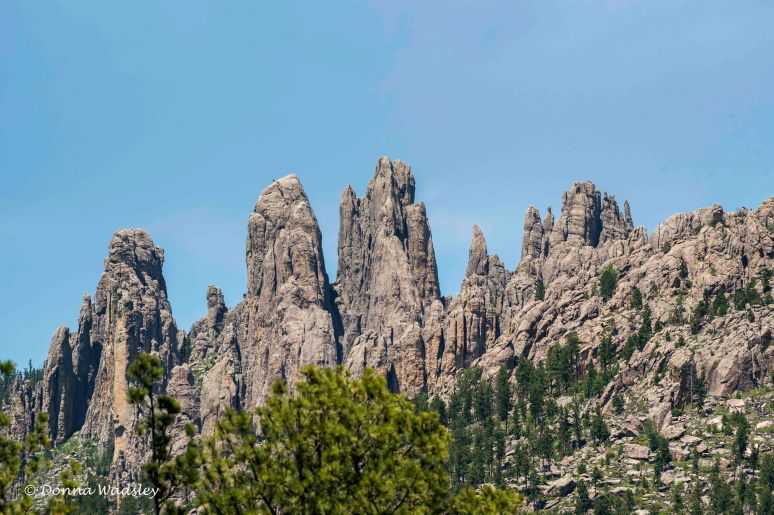
Can you see the rock climber?
.

Now can you see the rock climber?
.
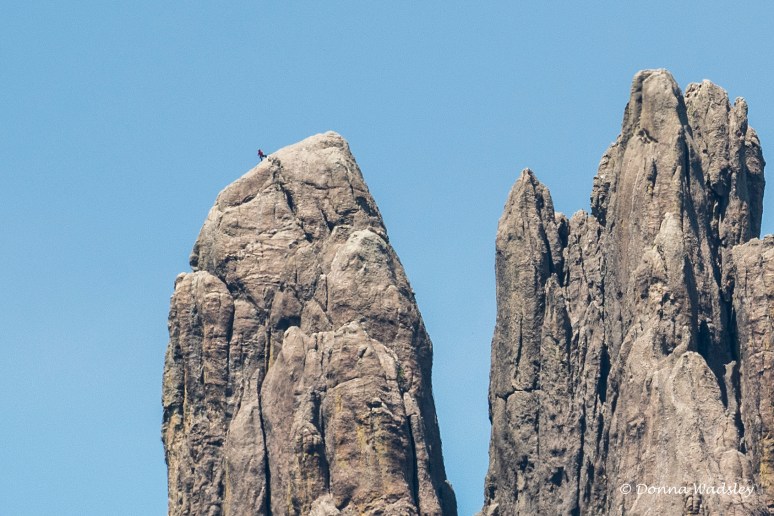
Ah-ha!
.
Go back to my first photo, and I bet you see that spot I did! 🙂
.
.
Black Hills National Forest
.
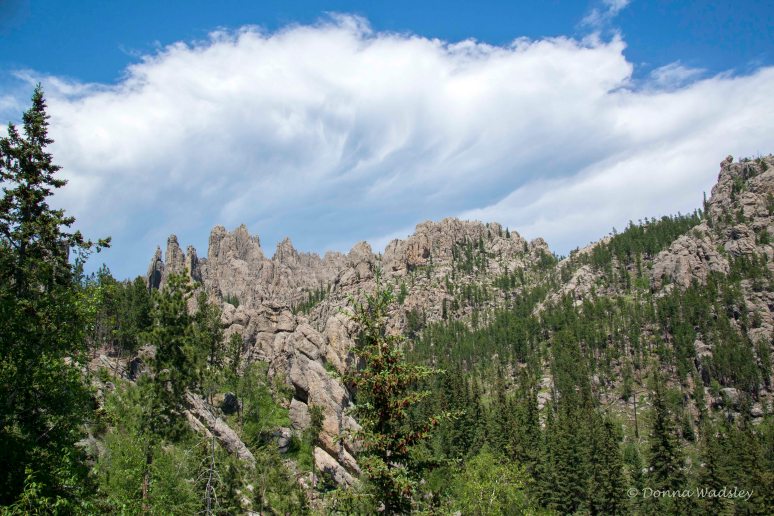
Our venturing through and around the Black Hills National Forest in South Dakota has been a wonderful adventure. It is quite gorgeous every where we drive, no matter the direction!
Here are some of my favorites from the last couple weeks taken within the Black Hills.
.
.
The name “Black Hills” comes from the Lakota words Paha Sapa, which mean “hills that are black”. Seen from a distance, these ponderosa pine-covered hills appear black.
.

.
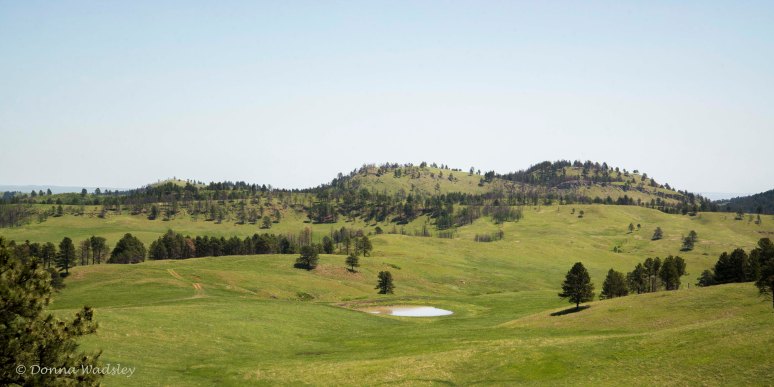
It is from the surrounding prairies the Black Hills rise.
.
.
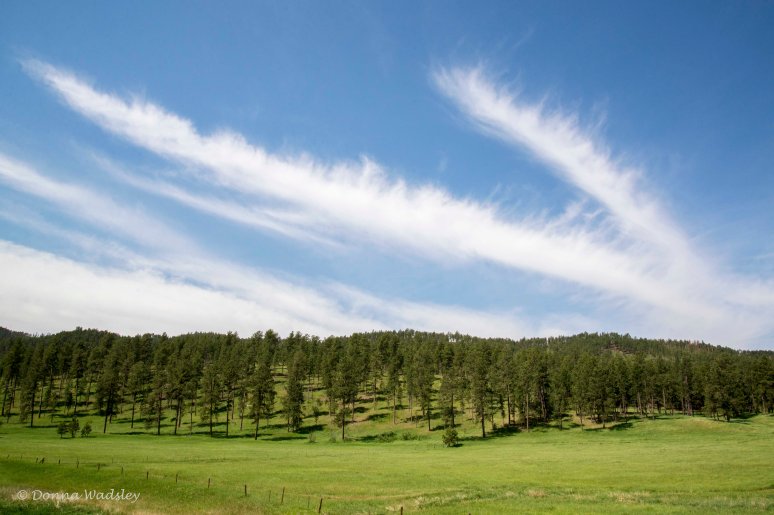
.
The Black Hills National Forest straddles between western South Dakota and northeastern Wyoming and consists of 1.2 million acres of forested hills and mountains.
.
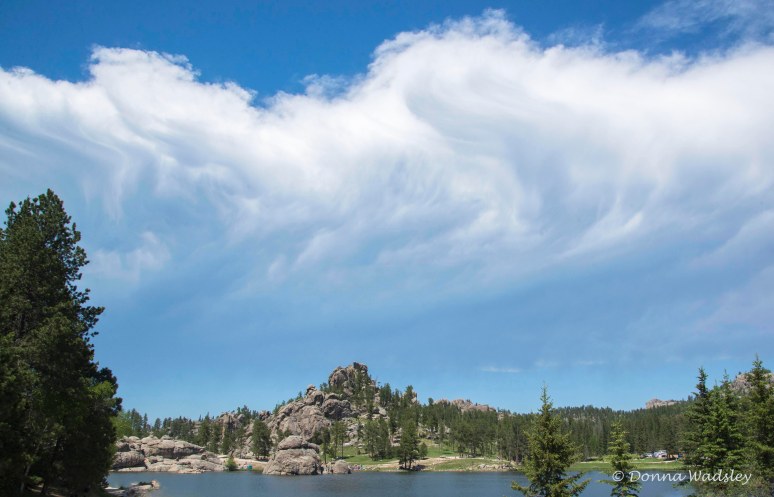
A peek at Sylvan Lake with dramatic sky
(I had to crop out the ugly road guardrail at bottom of shot)
.
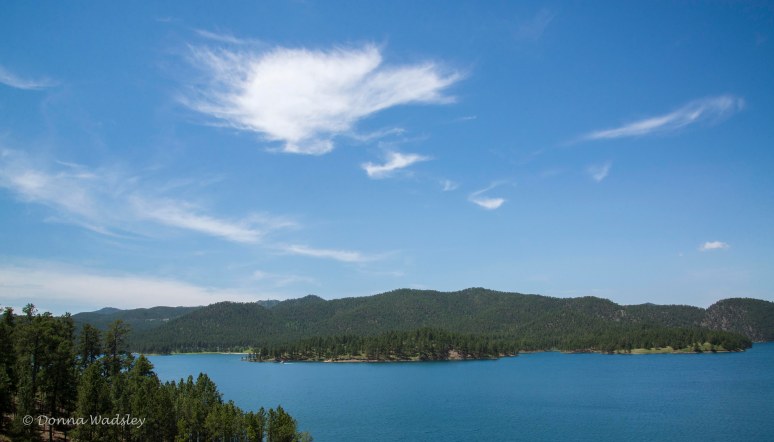
Pactola Reservoir
.
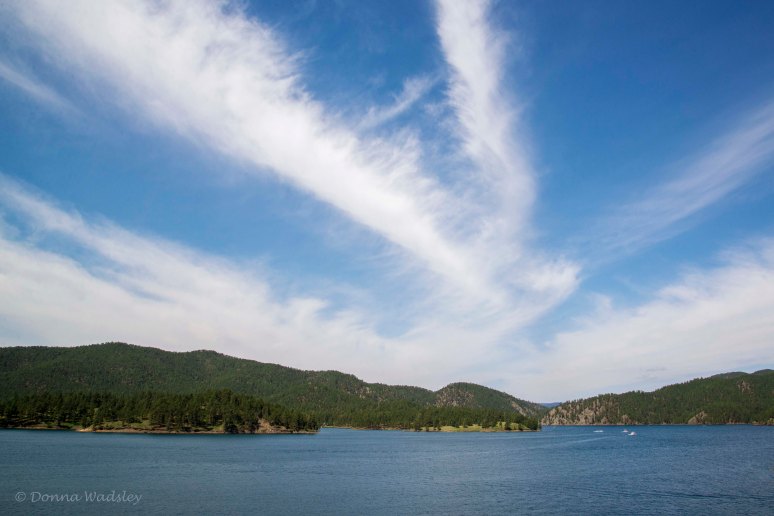
Pactola Reservoir another day
.
As you can see, I loved taking our scenic drives on partly cloudy days.
.

.
I am guessing I’ll be sharing more landscape photos of the Black Hills National Forest….I’ve got one more folder that I’ve not looked at yet….and tomorrow we’re going cruising again. 🙂
.
.
American Robins
.
Whew, we’ve been on the go the last few days! I had these American Robin photos processed just before, so I’ll present those. 🙂
There’s a nice walking/biking path around the campground, and there are Robins everywhere. I liked this shot of an adult American Robin lit with the evening sun.
.

American Robin (adult)
.
I found this fledgling on the sidewalk part of the path.
It did not want to move and just stood there looking at me.
I took a few more steps. Still not moving…..and now giving me the dare stare. 🤨
.
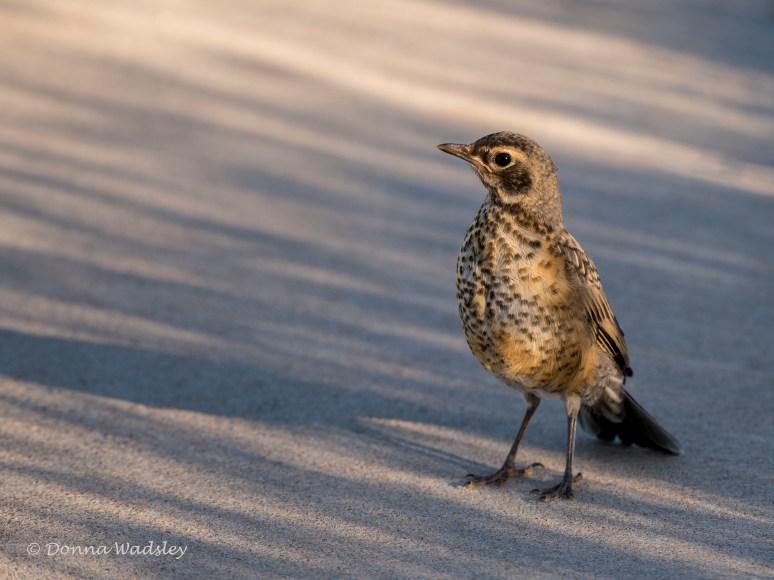
American Robin (teenager 😉 )
.

American Robin close-up
.
You should have seen me standing there talking to coax it to move on so I could pass through. 😅 Finally, it flew off!
.
.
Series: Take A Moment and Enjoy A Sunset
.
Time for a sunset! I photographed this one from the back of our campground in South Dakota.
First, the eastern clouds lit up behind me, creating a gorgeous, dramatic sky.
.

.
As the eastern sky slowly darkened, the western sky started to blaze.
And then the sun set.
.

.
I took this last photo walking back to our campsite. It turned out pretty cool, so I’ll add it as a bonus.
.
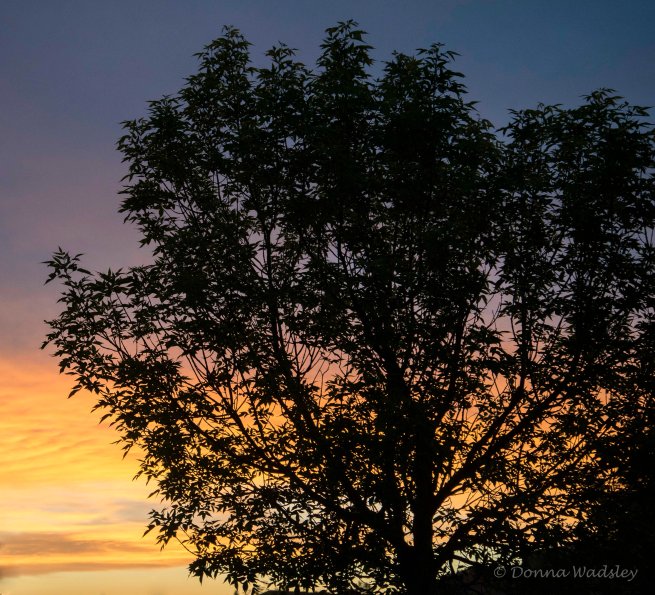
.
“Clouds come floating into my life,
no longer to carry rain or usher storm,
but to add color to my sunset sky.”
―
.
.
Balancing Act
.
My last post shared the new-to-me Brewer’s Blackbird, and we have another blackbird as well at the campground, the Red-winged Blackbird.
.

Red-winged Blackbird (male)
.
I enjoy photographing these birds on dried reeds for the nice contrast and seeing their great balancing acts.
.
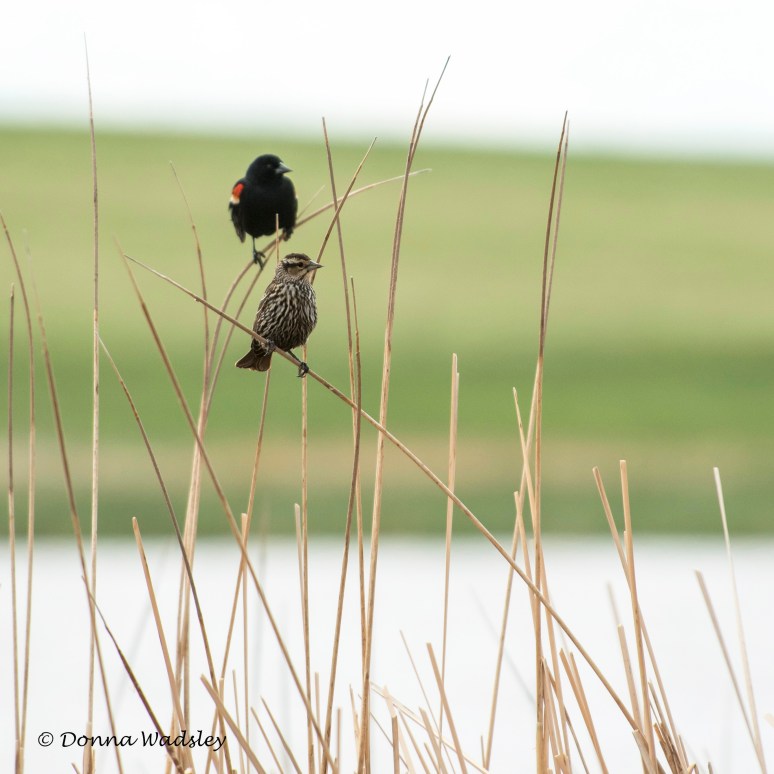
Red-winged Blackbirds (female and her mate)
.
Most of us know these territorial birds found abundantly across much of North America. They are certainly quick to let us know they are around with their loud calls!
.
.
Brewer’s Blackbird
.
Sooooo…..I was lounging (being lazy) in our campsite and noticed blackbirds coming and going from the pine tree in the site next to us that was presently empty. When the male perched atop the tree and started singing, I knew it was a different species of blackbird. It got me up and out of that chair too! 😉
Welcome to my lifer list #232 Brewer’s Blackbird! A common blackbird that resides and/or migrates over three-quarters of the U.S., it is rare to find along most of the east coast including where I live.
.
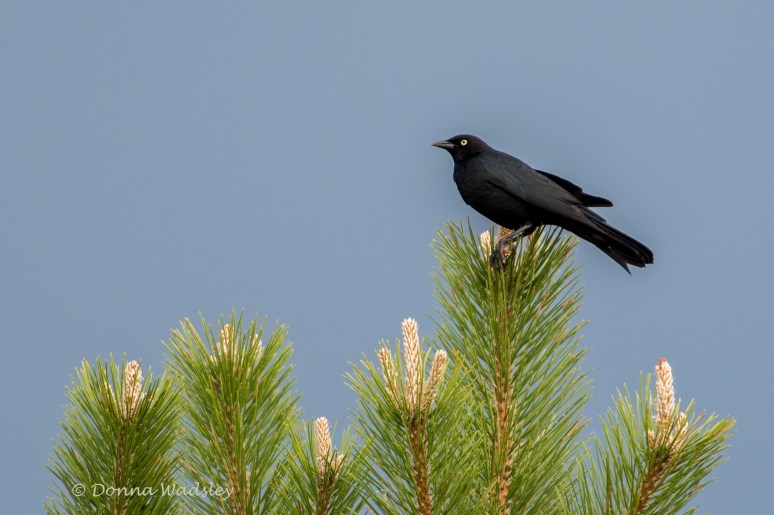
Brewer’s Blackbird (male)
.

Brewer’s Blackbird (female) picking up nesting materials
.
Right after taking the above photos, the male swooped down and suddenly began mating with the female.
I shot 18 photos, but who wants to see that many of birds doing it. 😅 I’ll share three in this slideshow.
.
.
And like any other wildlife mating session, it was over just as quickly as it started.
.
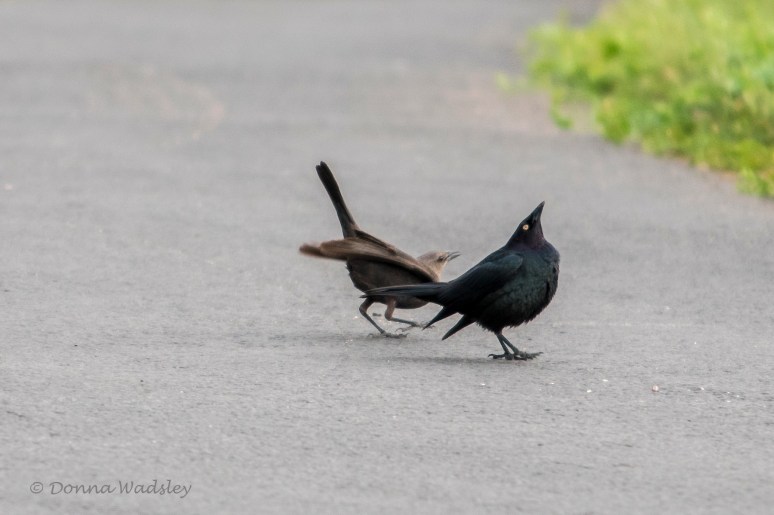
“Mr. Proud-of-Myself”
.
Then zip zip, both took flight and were gone!
.
.
Badlands National Park – Bighorn Sheep
.
This is the last in my series sharing the Badlands National Park from our recent visit, with this gallery of photos of bighorn sheep, specifically female (ewes) and lambs. (Get ready for super-cuteness a little further down!)
We did see a herd of males (rams) at a great distance; but by the time we reached the area on the scenic drive loop, they were gone.
.

Bighorn sheep (four ewes, two lambs)
.
There were about 2 million bighorn sheep before their decline due to European expansion into the American West, causing bighorn populations to plummet to just 20,000 by 1940.
Conservationists stepped in to defend and protect the species.
In 1964, the Badlands received 22 bighorn sheep translocated from Pike’s Peak in Colorado. The park later received a second population in 2004 from Wheeler Peak in New Mexico. The Badlands National Park now serves as home to about 250 bighorn out of the 80,000 which exist in the United States today.
.
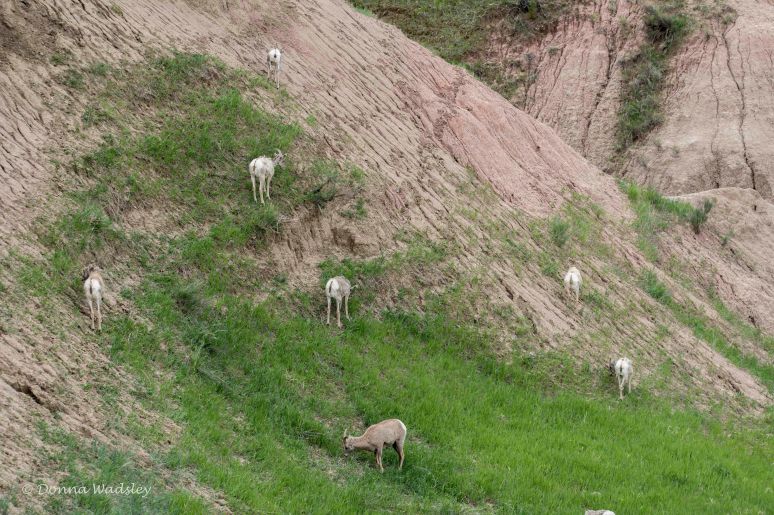
Bighorn sheep feeding
.
Bighorn sheep are grazers, eating grasses and shrubs.
After descending to grasslands to quickly eat large amounts of vegetation, bighorn sheep will then retreat to cliffs away from predators.
Once safe on the cliffs, bighorn sheep regurgitate their food and chew it as cud before digesting it fully.
.
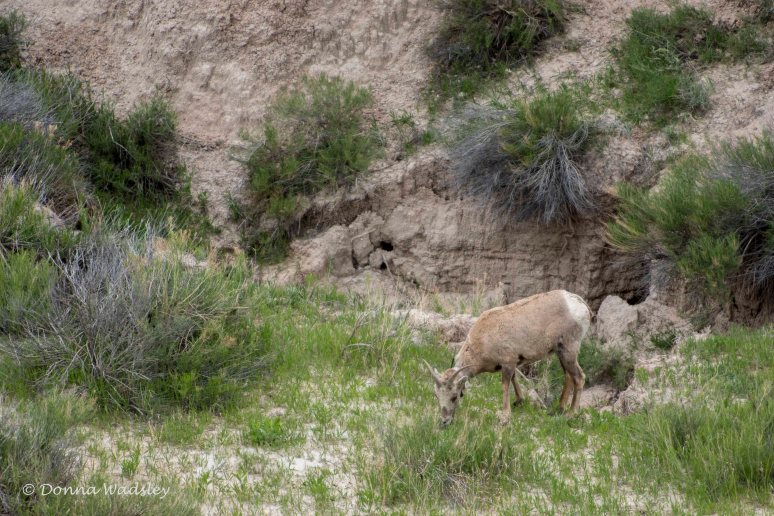
Bighorn ewe feeding
.
Badlands NP have fitted many bighorn sheep with numbers and GPS collars so that park rangers can monitor their positions.
.
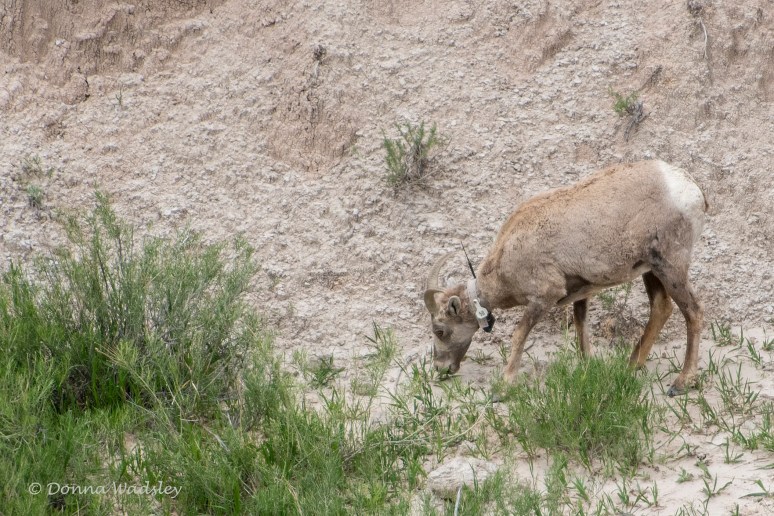
Bighorn ewe #50 fitted with a GPS collar
.
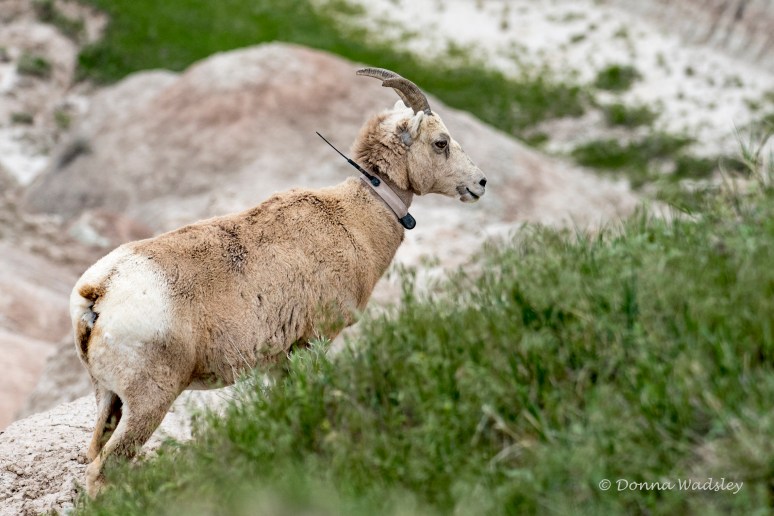
Bighorn ewe fitted with GPS collar (# tag on other side)
.
Bighorn ewes give birth during the spring, and hide their lambs on narrow, rocky ledges at higher elevations in order to protect them from almost all predators.
.

Bighorn ewes and lambs
.
After breeding, the ewes and lambs live together in large herds. Lambs nurse until they’re about six months old.
.
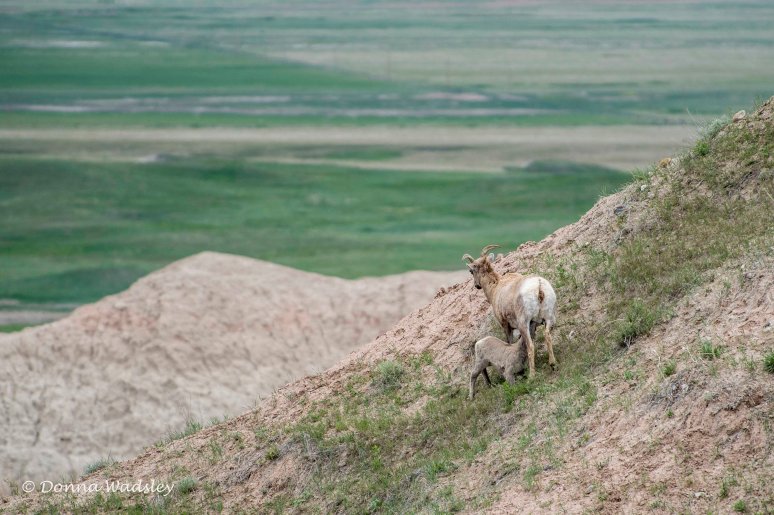
Young lamb nursing
.
If the lamb is female, it will stay with its mother’s herd throughout its life.
However, if the lamb is male, it will leave its mother’s herd at about 2-4 years old and seek out to live with a bachelor group led by a dominant ram.
.
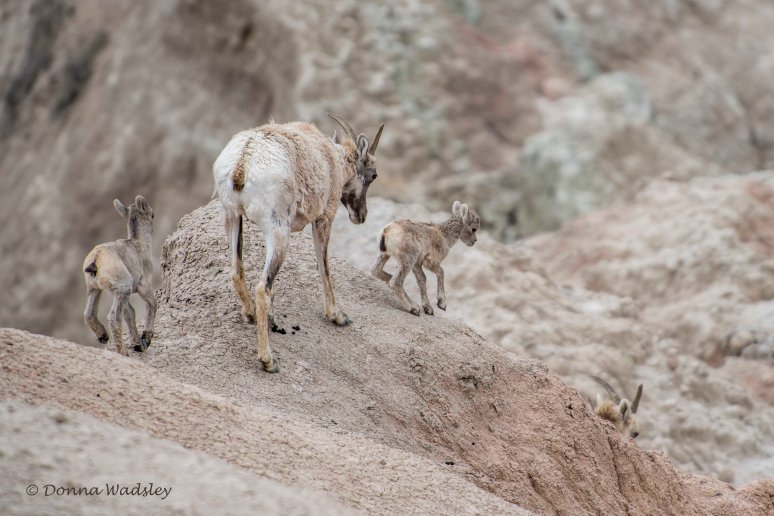
Momma with her little lambs
.
When we came upon the location where most of these photos were taken, there was a pair of lambs exploring the cliffs. I think my heart skipped a beat quite a few times!
.

Two lambs exploring their home of cliffs
.
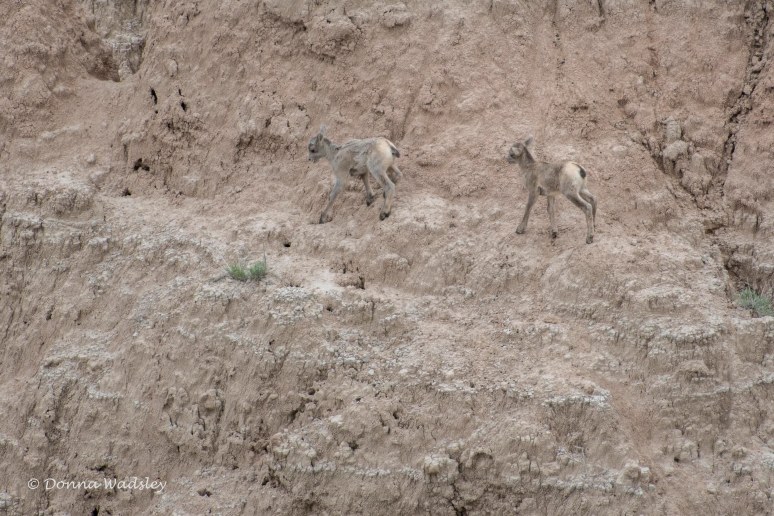
“Follow me!”
.
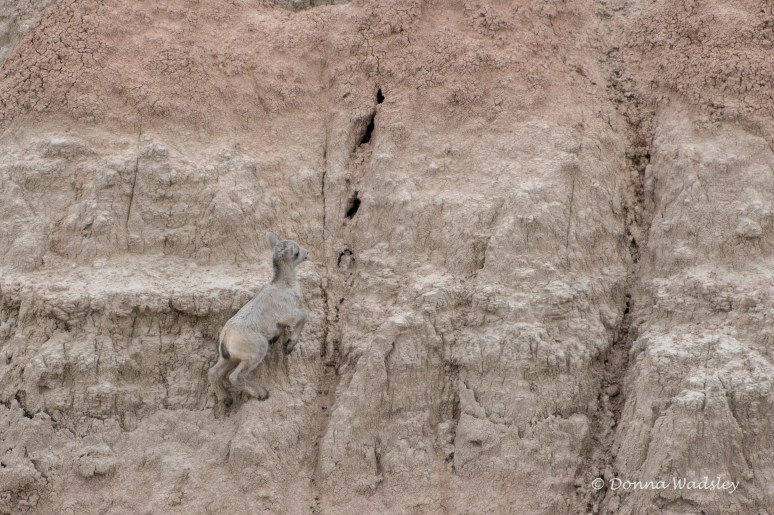
Lamb climbing up side of cliff with ease
.
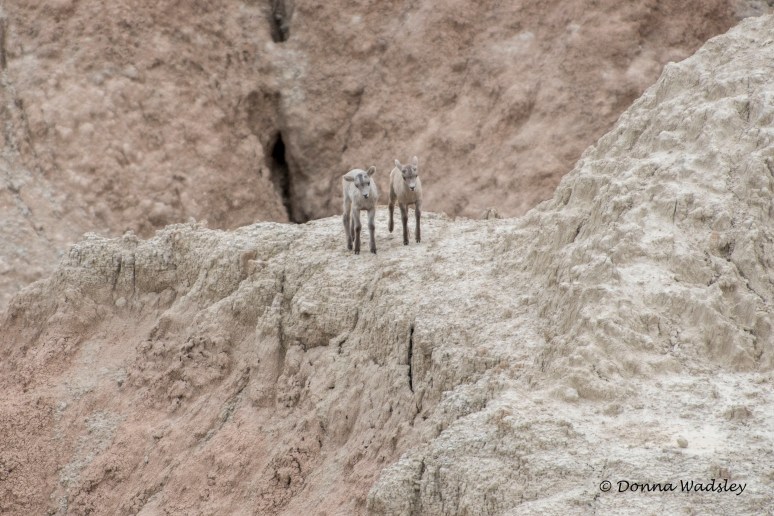
“Hey, let’s go down there!”
.
The little lambs really did look like they were having fun. I could have watched them and this herd for hours.
A few more of my favorites….
.

Bighorn ewe keeping watch
.

Young bighorn down below with others
.
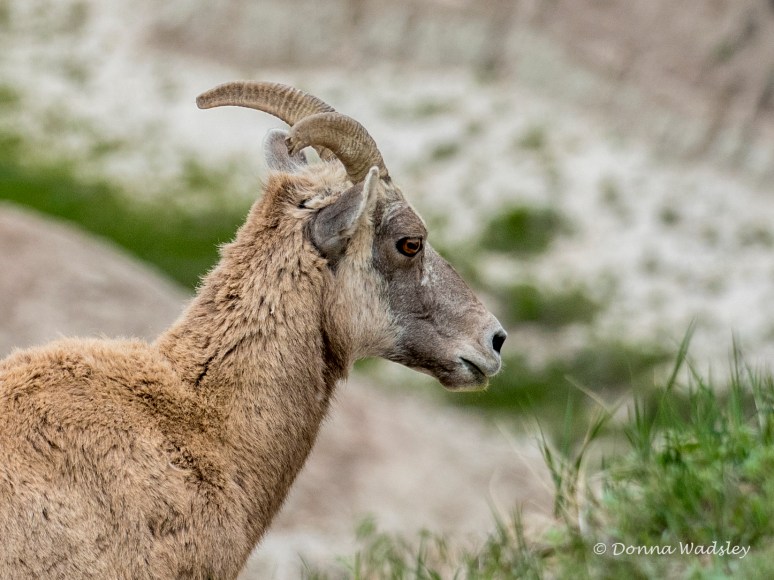
Bighorn ewe close-up
.
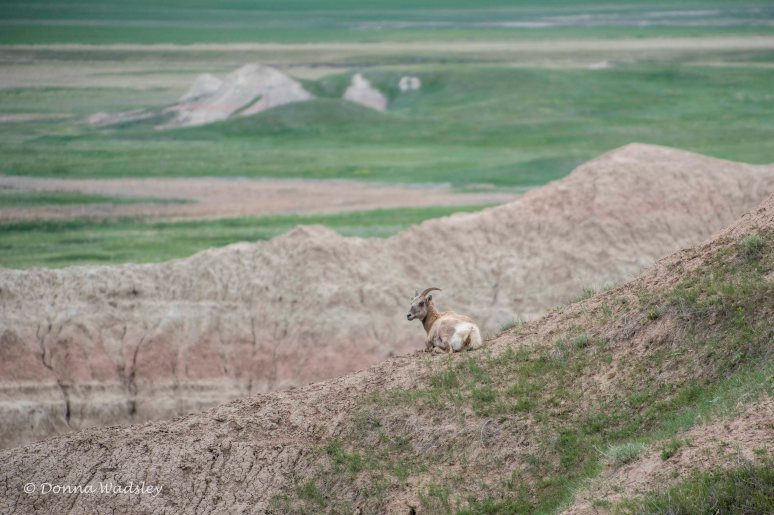
Bighorn ewe high up above the herd, keeping watch
.

Little lamb sweetness
.
If you missed any of the series, here are direct links:
Badlands National Park – Landscapes
Badlands National Park – Birds
Badlands National Park – American Bison Part 1
Badlands National Park – American Bison Part 2
Badlands National Park – Prairie Dogs
Badlands National Park – Pronghorn
I highly recommend the Badlands NP in the spring time with all the young wildlife activity and plant growth taking place. And, if you love to bump along dusty unpaved roads, I can only imagine the additional wildlife to be seen.
We relocated over a week ago to the west side of South Dakota, now camping near the Black Hills National Forest. There’s lots to see and do in this area, and we’re here until the end of June. Plenty of time to explore…..and chill!
.
.
Badlands National Park – Pronghorn
.
Not as easily to find as the prairie dogs and bison in Badlands National Park, so it was a thrill to get a quick sighting of pronghorn on Sage Creek Rim Road.
While we were stopped to watch bison in the distance on my husband’s side of the car, I turned to look out my window to find a male and two female pronghorn coming up a hill cautiously alongside my side of the car. Right place right time!
.

Male and two female pronghorn
.
Pronghorn are found only in North America. They are frequently called antelopes, but they are not nor related to the antelope. The pronghorn is the only living member left of the family antilocapridae and is most closely related to the giraffe.
Pronghorn have horns, not antlers, hence their name. The male’s horns are 12-20 inches long and curve in towards each other. The female’s horns are usually straight, short spikes between 3-4 inches long.
.

Female pronghorn beginning to run
.
Pronghorn are the fastest land animal in North America, and the second-fastest land animal in the world, following the cheetah.
Pronghorn can run at speeds close to 60 miles an hour. Although pronghorn are not as fast as cheetahs, they can maintain a fast speed for a longer period of time than cheetahs.
.
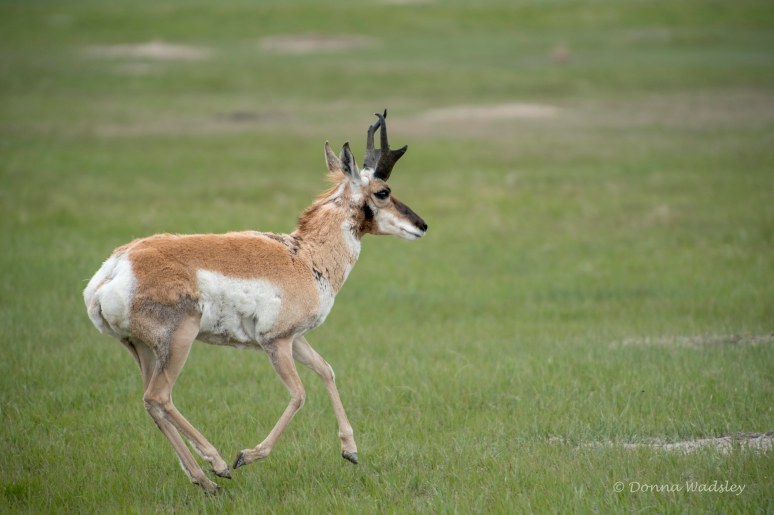
Male pronghorn beginning to run
.
After a short run, the three pronghorn stopped and looked around. Feeling no threat from the five cars now sitting along the road watching them, the pronghorn continued their trek casually away from all of us and towards a herd of bison.
.
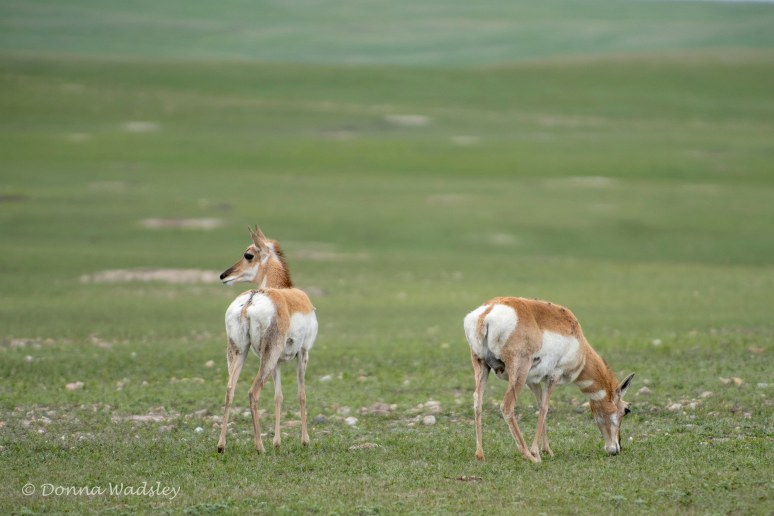
Female pronghorn
.
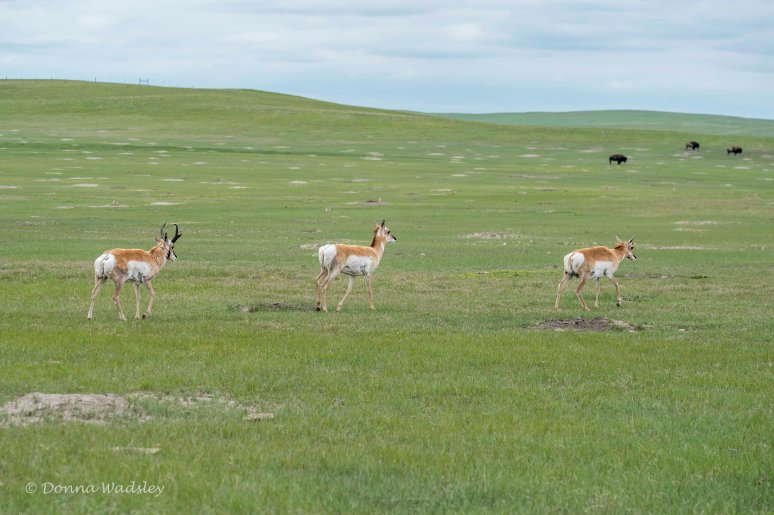
Pronghorn moving on, bison in the distance
.
They were beautiful, and I truly felt lucky to see them!
More wildlife to come from Badlands National Park…..the rock-climbing Bighorn sheep!
.
.
Badlands National Park – Prairie Dogs
.
On the Sage Creek Rim Road, a fun area to see is Robert’s Prairie Dog Town, where a colony of prairie dogs live in a complex underground “town” of entrances, tunnels, sleeping chambers, storage areas, and back door escapes.
The largest ever recorded prairie dog town located in Texas encompassed a 100 mile by 250 mile area and contained an estimated 400 million prairie dogs. That’s 25,000 square miles – an area greater than the state of West Virginia. 😲
.

Just a small view of Robert’s Prairie Dog Town
.
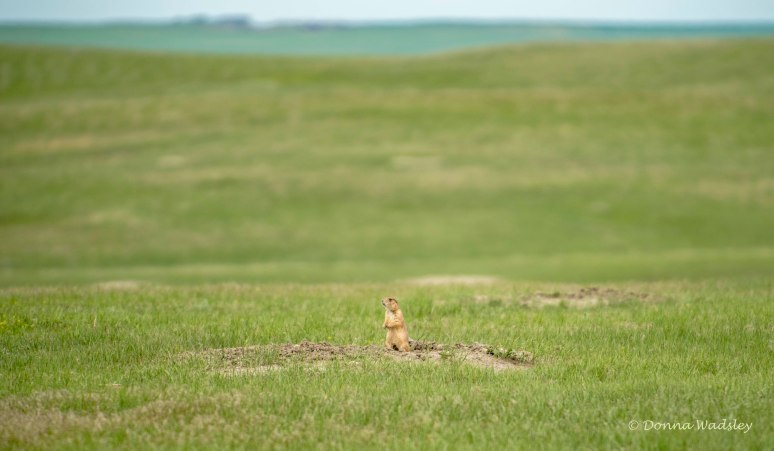
Prairie dogs are members of the squirrel family and are only found in North America.
.

Prairie Dogs
.
The prairie dog species found in the Badlands is the black-tailed prairie dog, the most common prairie dog of the five species.
.

Prairie Dog Pups
.
Prairie dogs were once a major part of the American landscape, originally ranging from Canada to Mexico. Before 1800, it was estimated over 5 billion prairie dogs roamed the American plains. Today, it’s estimated there’s a healthy return of 10-20 million prairie dogs roaming. What happened?
In the 1800s, homesteading settlers viewed prairie dogs as disease carriers and grazing area destroyers for their cattle. We now know these assumptions to be untrue. Regarded as vermin, settlers killed prairie dogs in large quantities with poison and by recreational shooting. How sad.
.



 Bay Photos by Donna