
Red-tailed Hawk
.
The most common hawk in North America is the Red-tailed Hawk. Even with their stouter body and broader wings, the Red-tailed Hawk is slightly smaller than the Osprey but larger than the Red-shouldered Hawk.
The Red-tailed Hawk’s wingspan is 45-53″ (114-133cm), compared to the Osprey’s 59-71″ (150-180cm) and Red-shouldered Hawk’s 37-43″ (94-111cm) wingspan.
I captured this beautiful Red-tailed Hawk soaring in circles above me.
.

Red-tailed Hawk
.

Red-tailed Hawk
.

Red-tailed Hawk
.

Red-tailed Hawk
.
As it continued it’s circling, the hawk was quickly carried away in the slight wind. What a beauty!
.
.
Eastern Bluebird
.
An Eastern Bluebird visiting our dock, waiting for me to arrive.
At least, that’s the way I saw it. 😉
.

Eastern Bluebird (male) hanging with a pair of House Sparrows
.
.
Osprey vs Eagle
.
With both the Eagles and Osprey nesting across the creek from each other, they are both soaring in the same sky space.
This doesn’t always sit so well, if it’s at the same time.
Being the underdog, it is the Osprey that gets defensive and chases the Eagle, who just flies away faster, trying to avoid those extended Osprey talons.
.
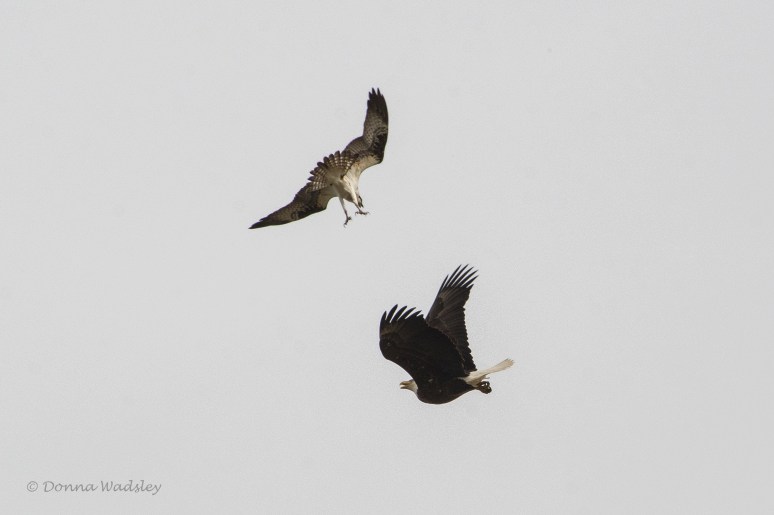
Osprey vs Bald Eagle
.
No one gets hurt, and I’ve told them to keep it that way. We can all live together and get along!
.
.
Welcoming Sightings
.
Exciting news to share, we’ve purchased a little over two acres raw land and will be moving back to Maryland’s Eastern Shore and the Chesapeake Bay waters, near the small fishing town of Rock Hall.
.

Our boat pier 🙂
.
As soon as we got back from Florida to do our feasibility study before settlement, we walked the overgrown property, and flushed out a herd of piebald deer (one is almost entirely white!) laying down in our deep thicket. Wow!
Everything around was beautiful and quiet. It was perfect for what we were looking for.
And, during that first day’s visit, the following three of my top favorite birds were there to greet us. That was definitely the icing on the cake! 😉
The flash of red instantly caught my eye down by the pier as a male Cardinal landed to say hi.
.
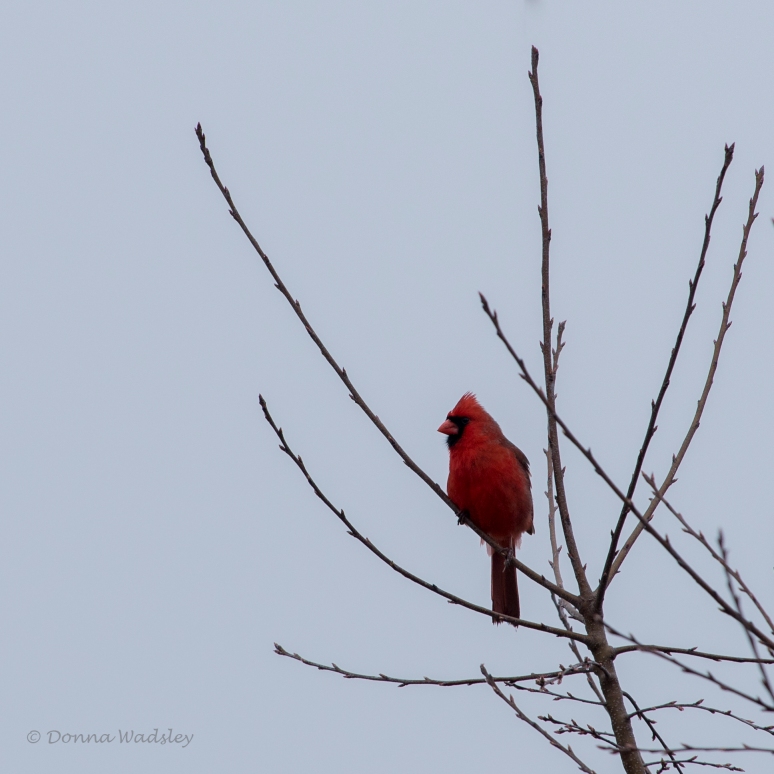
Northern Cardinal (male)
.
A pair of Bald Eagles soared overhead. I’ve already narrowed down the approximate location of their nest across the creek.
.
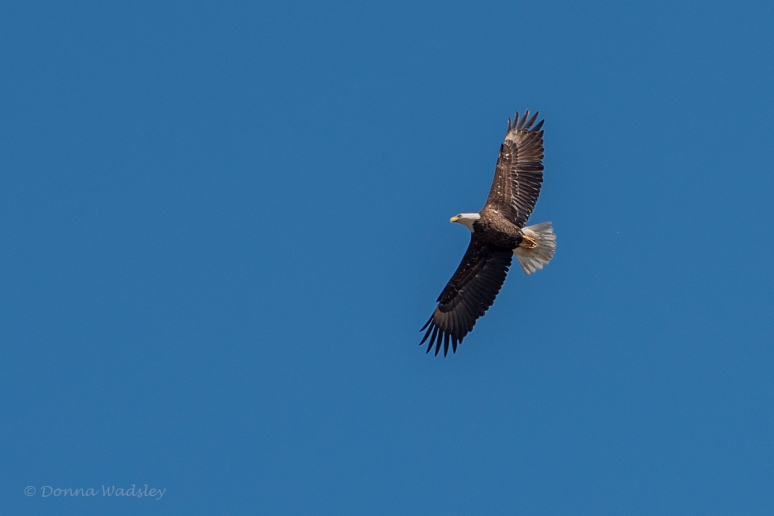
American Bald Eagle
.
And, of course, the bird that started it. A pair of Osprey were busy re-establishing their nest at a distance across creek.
The Missus was fishing and came over to greet me on the pier. 🙂
.

Osprey (female)
.
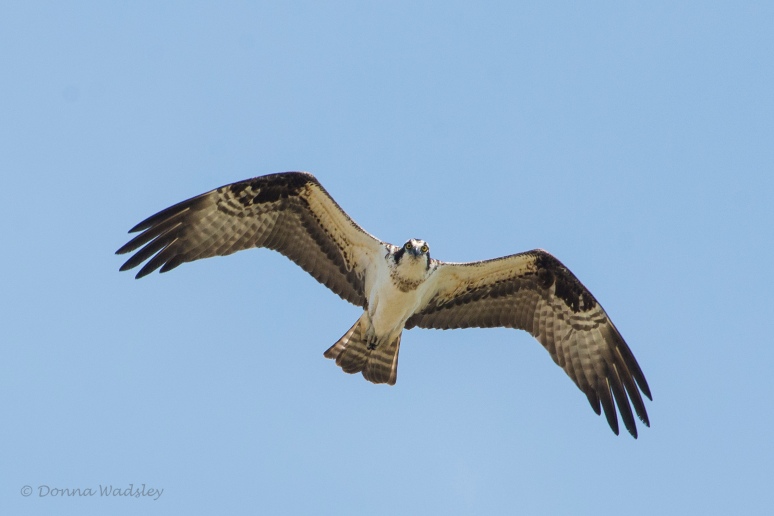
Osprey (female)
.
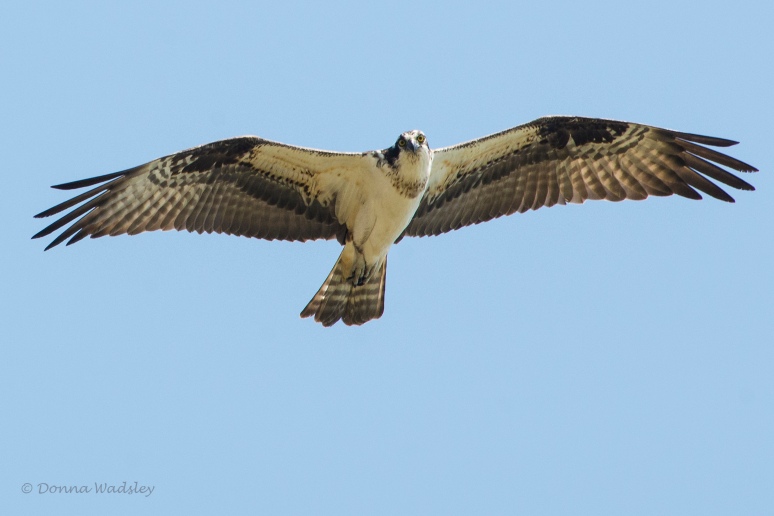
Osprey (female)
I think she likes me! 😏
.
Now’s the fun and challenging part of designing our dream house, hopefully breaking ground Spring 2022. Until then, we’ll continue to do some RV traveling this summer to see our beautiful country and wildlife that I’ll be sharing!
.
.
Warblers
.
Sharing three warblers captured back in January and February in Florida. By now, they are all migrating north for breeding!
.

Black-and-white Warbler
.
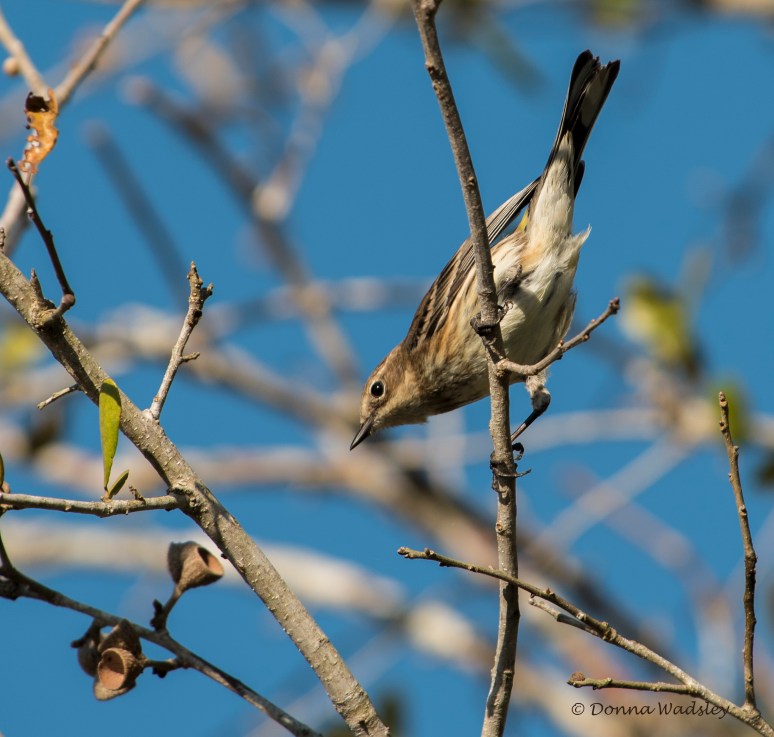
Palm Warbler
.
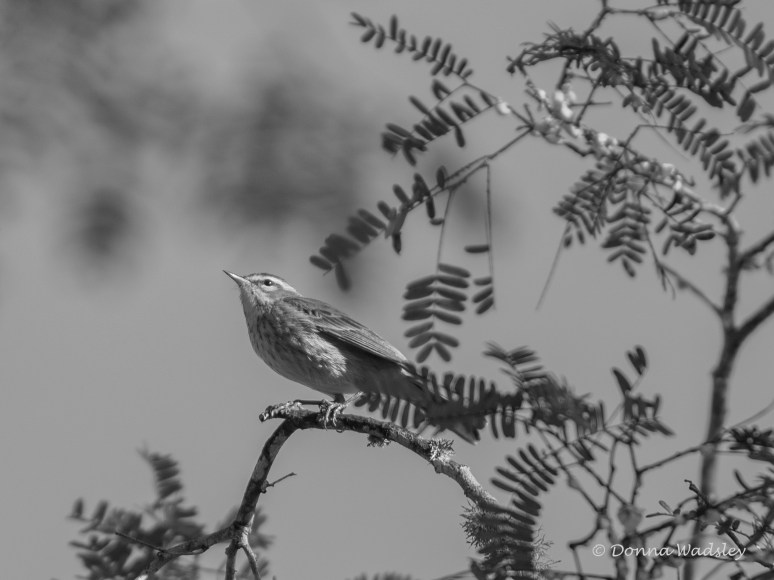
Palm Warbler
.

Yellow-rumped Warbler
.
.
Flower Power
.
A gallery of colors! I don’t know flower names near as well as birds 😏 but I still enjoyed photographing Florida’s flowers this past winter.
.


.
.
.
Thank you, Mother Earth
.
I’ve been literally unfunctionable since Thursday with an angry tooth, followed by Monday oral surgery. I’m finally feeling like I’m part of this Earth again today, thankfully. I’ve missed everyone.
.
Today is Earth Day. I love Mother Earth and am thankful for the wonderful gifts she provides us. A post was a must. 🙂
.
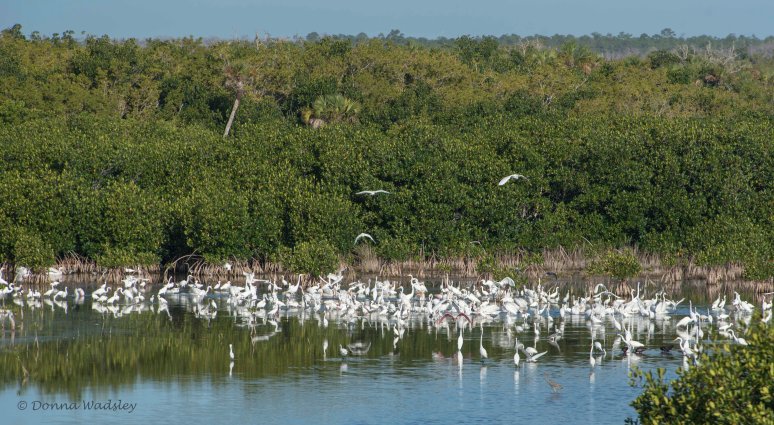
Minimum 10 species of birds cohabitating
.
Great Egret
Snowy Egret
Reddish Egret
Great Blue Heron
Little Blue Heron
Tricolored Heron
White Ibis
Glossy Ibis
White Pelican
Roseate Spoonbill
.
“If we see only the worst, it destroys our capacity to do something. We don’t have
to engage in grand, heroic actions to participate in the process of change. Small acts,
when multiplied by millions of people, can transform the world.”
— Howard Zinn
.
.
Mr & Mrs Cardinal
.
I just loved that this male Northern Cardinal allowed me to take a series of photos of it singing its heart out at sunrise when I arrived at the refuge.
.
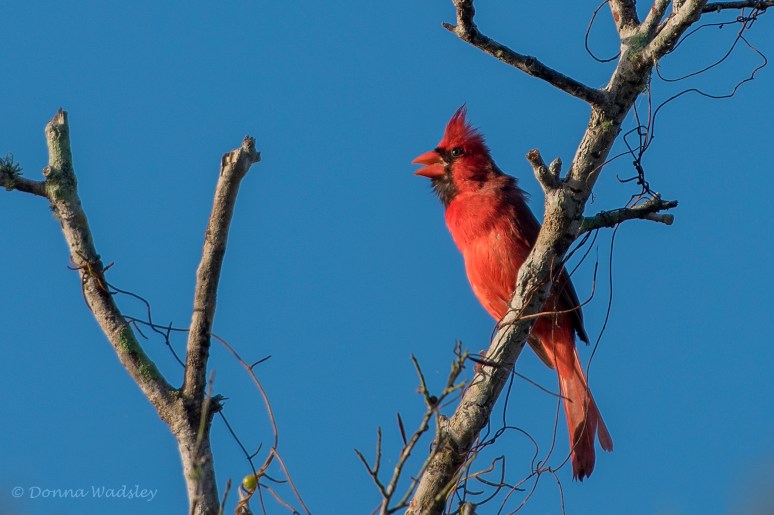
Northern Cardinal (male)
.
The Mrs stayed hidden while he sang, but she gave me some chances a couple hours later as I passed back by their living area at the end of my hike.
.

Northern Cardinal (female)
.
(Taken March 1, 2021, at the 10,000 Islands NWR, Florida)
.
.
Anhinga Gallery
.
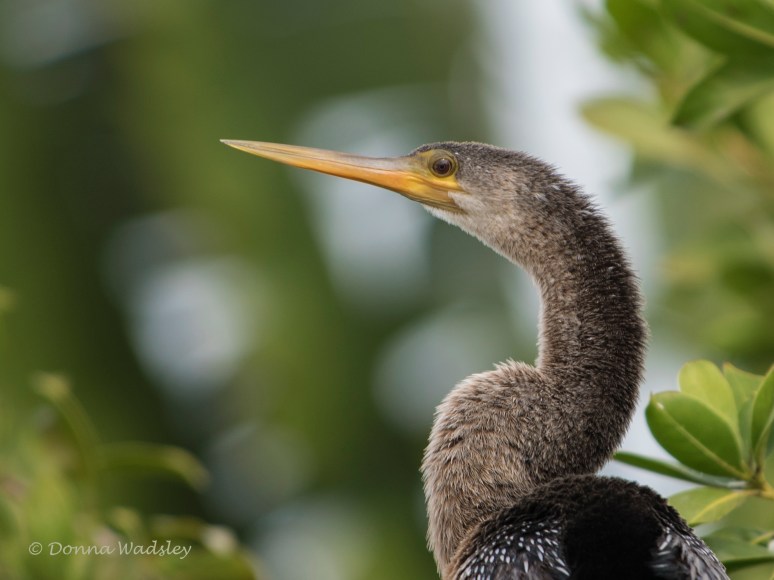
Found in the southeast United States from Texas to the Carolinas, the Anhinga is a large, slender waterbird with a long neck, long tail, and dagger-like beak.
.

.

.
Anhinga’s distinctive shape has earned it two nicknames, “water turkey” for its turkey-like tail, and “snake bird” for its long snake-like neck as it slithers through the water.
.

.

.
Unlike most waterbirds, Anhingas do not have waterproof feathers. While that may seem like a disadvantage for their watery lifestyle, their wet feathers and dense bones help them slowly submerge their bodies under the water so they can slyly stalk fish.
.

.
.
Therefore, when taking a break, Anhingas do need to spread their wings to dry them inbetween fishing.
.

.

.
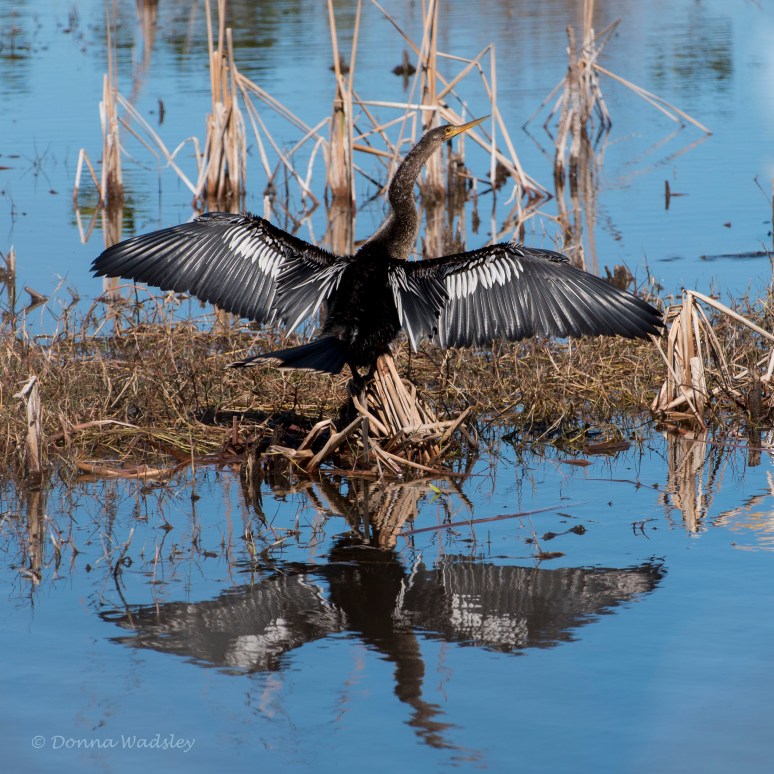
.
The Anhinga is in a small family of birds known as “darters”. There are three other species of darters on the globe; one in Africa, one in Asia, and another in Australia.
.
.

.
.
Boat-tailed Grackles
.
Strictly a coastal species, Boat-tailed Grackles are found along the U.S. East and Gulf Coasts, as well as across the entire state of Florida generally near marshes and lakes.
With the lighting just right, the black male will shine with iridescent colors of purples, blues, and greens.
.

Boat-tailed Grackle (male)
.
The female is dark brown and russet in color.
.

Boat-tailed Grackle (female)
.
Boat-tailed Grackles are aptly named for their very long tails that make up almost half their body length and resembles the keel of a boat.
.

Boat-tailed Grackle (male)
.
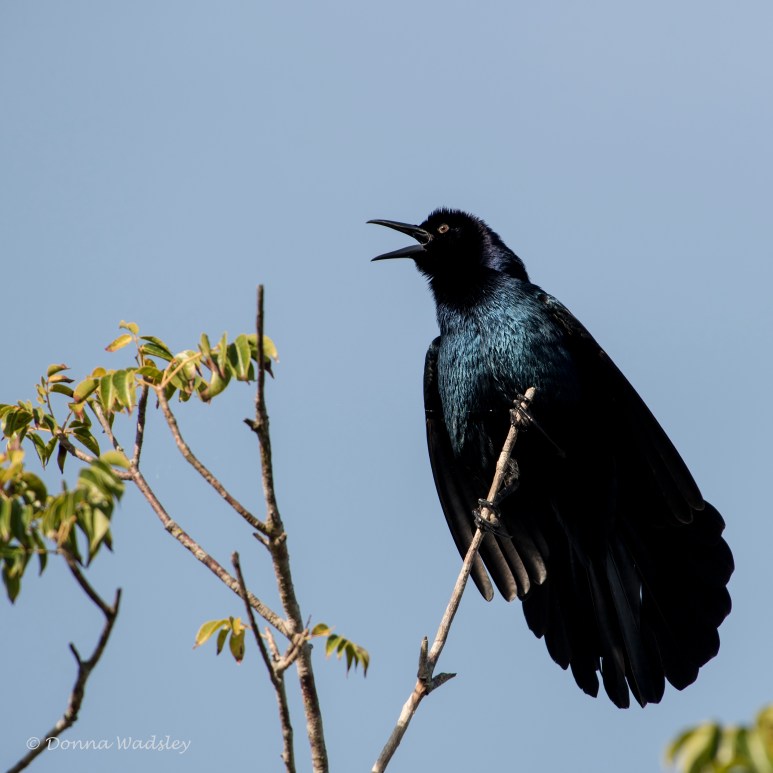
“Singing A Song”
.
There are two eye color variations with Boat-tailed Grackles Those males along the Gulf Coast and in Florida have brown eyes, as mine shows above. Along the East Coast, you’ll find the males with bright yellow eyes.
.
.

 Bay Photos by Donna