
Bella & Beau 2019: Signs Show A Possible Egg
Osprey nest location: Cambridge, Maryland, Chesapeake Bay Region, USA
April 20, 2019
In the past 1½ weeks, Bella & Beau had to deal with some rain and a lot of windy days, many days exceeding 20+ mph, even a couple days of gale force winds.
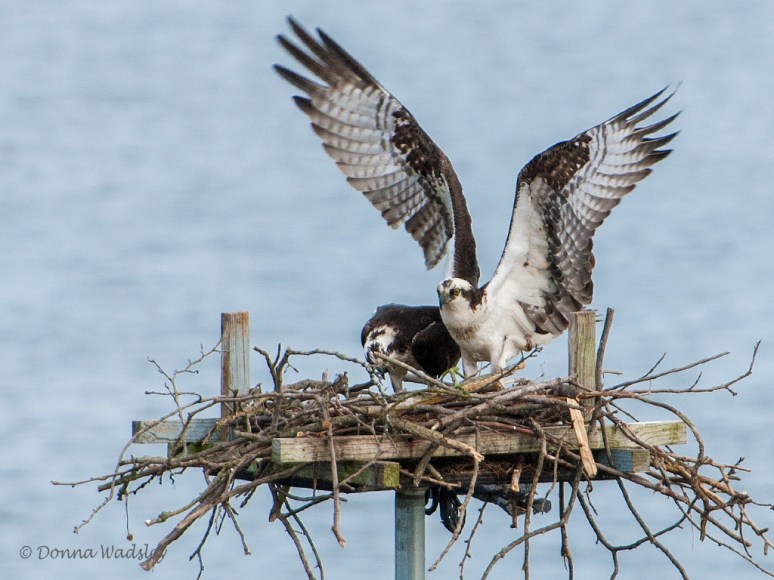
Beau showing off his beautiful wingspan
The wind played havoc with Beau’s continued hard work to build a strong nest. But he has never given up, no matter the weather.

Beau heading up to the nest.

Beau with more nesting material.

Bella landing with a nice stick!
Beau delivering sticks to the nest
Even Bella has been helping, specifically materials for the nesting cup they have created.

Bella bringing nesting cup materials.

Beau watches Bella.

Bella bringing in more nesting cup materials.

Bella bringing in more nesting cup materials.

Beau watches.
Bella bringing more nesting cup materials

Bella found something interesting.

Bella bringing her prize to the nest.

Bella heading to the nest.

Bella heading to the nest.

Bella heading to the nest.
Bella found something different that she worked into the nesting cup
With all those sticks arriving, they have to be placed just right, according to Beau.

Beau working hard while Bella watches

Beau renovating more
Sometimes Bella disagrees, and a tug-of-war occurs.

Teamwork!

“Let’s put it over here.”

“No, I want it over there!”
One rule about an Osprey nest, it is to be kept clean of poop. The chicks are taught early to back up, lift their tail, and aim up & over the nest rim to the outside world. Bella gives an example.

Bella preparing.

Bella relieving herself.

All done!
“Excusez-moi!”
Mating has been non-stop. Beau’s instinct is strong to procreate! When they finish, most times Beau takes off the nest, fetches a stick, and returns back to place it for Bella.
It is important that the male show his commitment to the female so she knows he can provide a nest as well as feed her and a new family.
So Beau has also been quite busy fishing and bringing back meals to Bella. Beau will usually eat the head first before taking it to Bella so he can get some nourishment as well. Bella can be very aggressive when Beau arrives, usually snatching it away from him, then taking off with the fish to a telephone pole across the creek from the nest.

Beau delivering headless fish for Bella.

Beau stays still while Bella moves to get the fish.

Bella grabs the fish from Beau’s talons.

Bella gets a hold of the fish,

and takes off with it in her mouth.

Bella heading to her telephone perch to each her meal.

First, a quick change of the fish from the mouth to the powerful, sharp talons. Bella doesn’t want to drop it!

Beau arriving with a fish for Bella.

Bella moves quickly to grab it.

“I’ll take that from you.”

Bella started taking the fish.

Bella positions the fish in her talons.

Bella takes off with her fish to the telephone pole.

Bella eats almost all her fish here.

Beau snuggles down in the nesting cup while keeping an eye on Bella.

Beau arriving with breakfast.

Bella doesn’t bother to look.

Beau continues to land.

Bella is still ignoring Beau.

“I’m here, Bella.”

“Is that the biggest you could catch??”
There’s still the occasional harassment from other area Osprey. No longer any real challenges, just the airspace territory they all think they own around them. The Osprey seem to all have their own nests now and are busy with their lives. Thank goodness, they all really challenged Bella & Beau to take their nest platform from them. We said it before, waterfront real estate is prime!
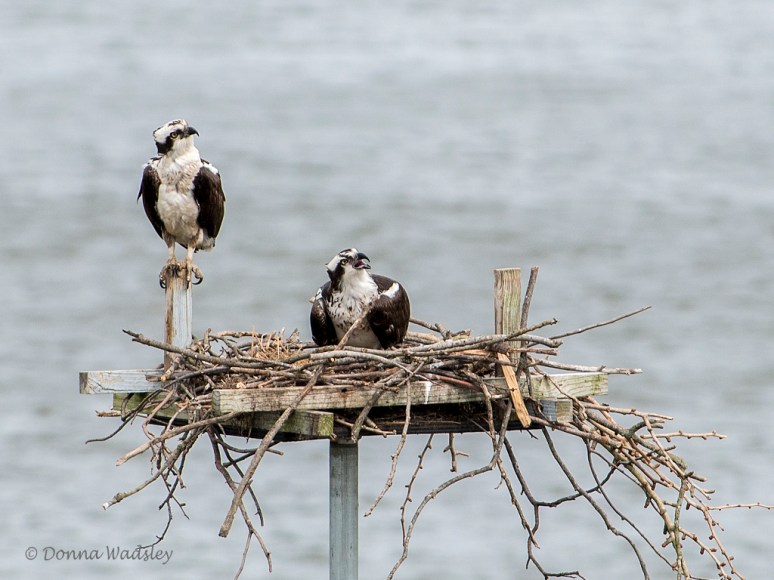
Bella giving a warning to an intruding Osprey overhead
There is also the occasional Bald Eagle that ‘passes through’ overhead, much to the frustation of Bella & Beau. I was watching and taking some photos of them, when they both started screaming, took off the nest and flew towards me. Why are they flying at me so angry?

Bella & Beau taking off and flying towards me
I snapped some shots but was also looking away from my camera towards them, making sure I wasn’t possibly getting attacked. I saw then they weren’t looking at me but something up over my head.

Bella chasing an Eagle

Bella chasing an Eagle
Bella in a frenzy flight

Beau begins pursuit of Eagle

Beau in pursuit of Eagle
Beau also in a frenzy flight
What was the frenzy about? Suddenly, a Bald Eagle passed out in front of me, with Beau in pursuit.

Beau chasing Eagle

Beau chasing Eagle

Beau chasing Eagle
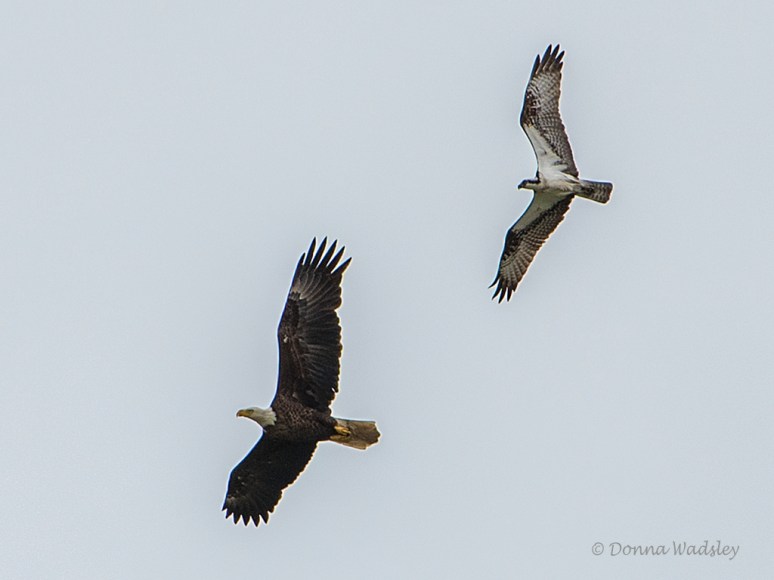
Beau closing in on Eagle – Note the size comparison between these two raptors
The Eagle kept on going, trying to out-fly Beau. Proud Beau finally gave up the chase as the Eagle headed off.
Last year, Bella laid her first of three eggs on April 17th. I’ve been on watch, looking for signs for this year’s first. During the last few days, more mating occurred, and the nest was constantly being attended to. In addition, I noticed both Bella & Beau did a lot of napping. A busy last few days!


It is exhausting being an Osprey!
Beau even began laying in the nest cup as if he was incubating, while Bella stayed perched alongside the nest rim or if she left with a fish. This worried me at first, I wondered had Bella laid an egg but didn’t care to incubate it, yet Beau was trying?
When Beau left the nest, Bella would not change her perch. I researched this odd behavior and found that the male will possibly start mimicking incubating as another sign to the female he can be the Dad he needs to be when she needs a break. I had never seen this before!
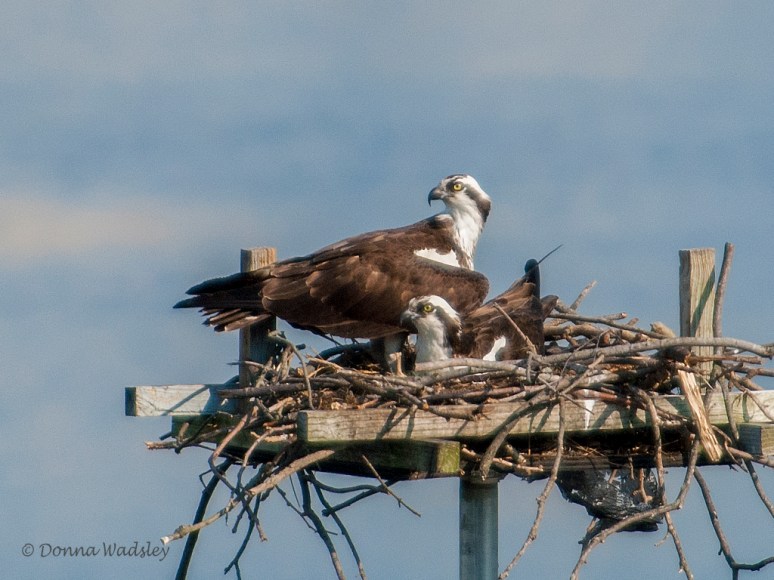
Bella (standing) while Beau is laying in the nesting cup, practicing incubating


Beau in the nesting cup, practicing incubating
Well, today, I believe was finally the day! Early this afternoon, Bella changed her normal perch stance, and got into the nesting cup. I checked on her often with my binoculars; and she remained there, shifting, panting, napping, moving soft nesting materials around her. Beau would arrive and perch, look at Bella often, and then leave.
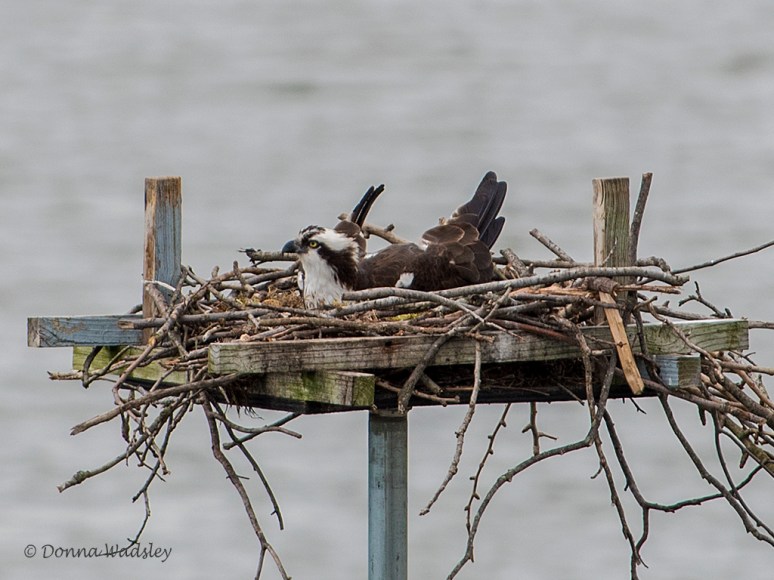
Bella possibly in the process of laying an egg
I only saw Bella get up once, taking a quick flight due to a pedestrian walking below the nest platform with a dog. She quickly returned and I watched her shimmy and shift, as if she was incubating.


Bella returning quickly after a pedestrian worried her, immediately getting back into an incubation positioning
My last shot this evening at a cloudy sunset.
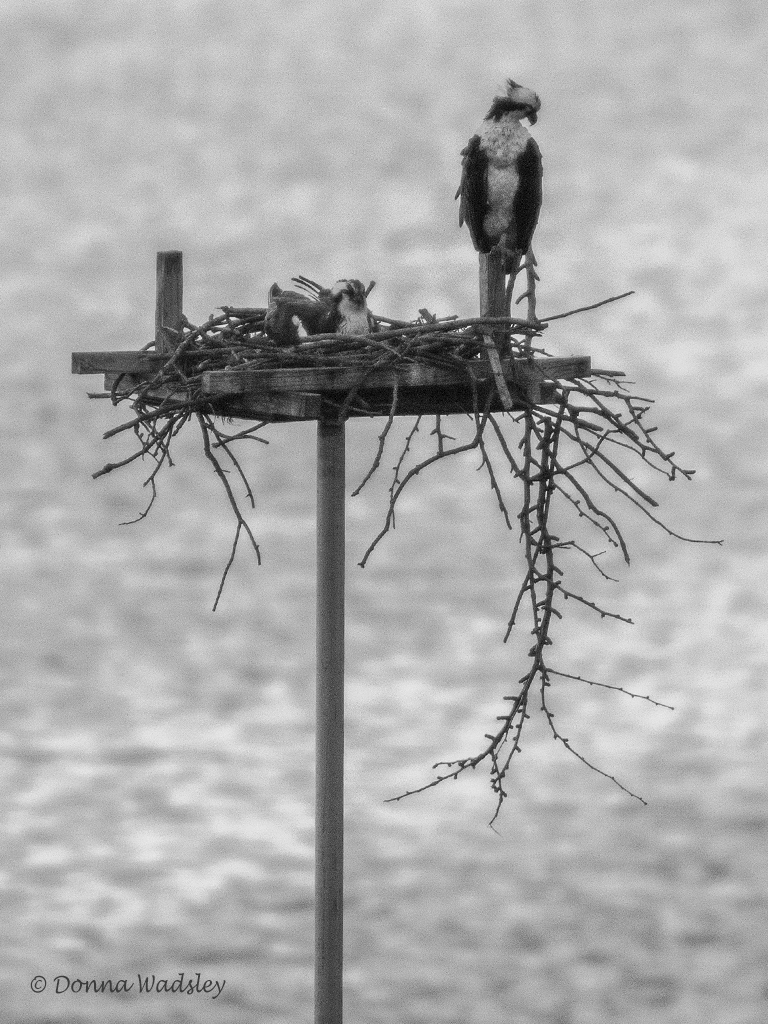
Bella possibly incubating her first egg while Beau spots something in the water, taken during this evening’s cloudy sunset
If Bella did in fact lay an egg, up to 2-3 more eggs can follow, each laying 1-3 days after the previous. Time will tell this coming week!
With that exciting news, I’ll end with a bunch of beauty shots of the hopefully soon-to-be parents, Bella & Beau.

Beau in flight

Beau in flight

Beau in flight

Beau in flight

Bella in flight

Bella in flight

Bella coming in for a landing
Bella in flight
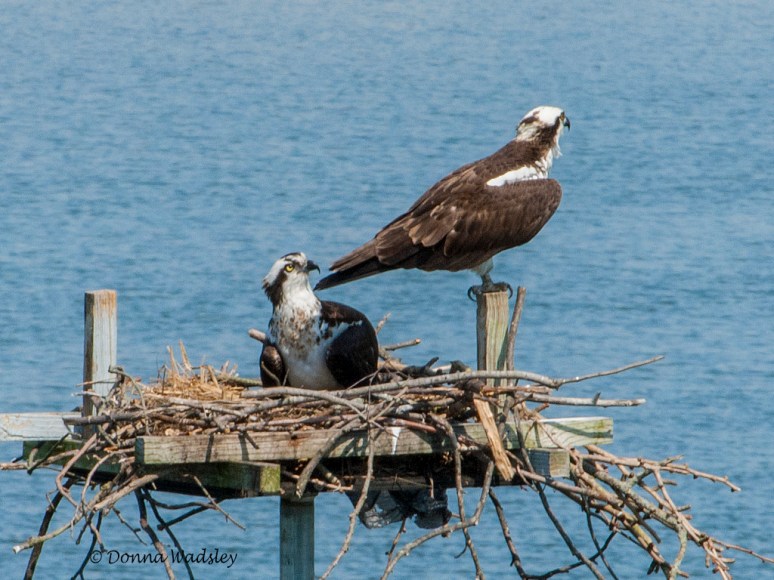
Bella giving Beau ‘a look’ when he doesn’t react to her cries
 Another wingspan shot of Beau

The soon-to-be Parents!
Note: The majority of my photos for the Bella & Beau series are shot from my balcony about 200+ feet where I’ve got just enough advantage height equal to the top of the platform. My equipment: a Nikon D200 and D750, with a Nikon AF-S VR-Nikkor 70-200mm F2.8 lens combined with a Nikon Teleconverter (1.7x magnification), zooming all the way in. At photo processing, it is then necessary to crop at least 50% to share close-ups with you. The Bella & Beau series is not so much about high-quality photos (although I seriously strive to get the best, detailed shots for the storyline!) as it is about the antics and adventures of an Osprey pair’s daily life. It is also my hope you will learn a little bit about the amazing Osprey and enjoy following along!
Eagles At Rest
Since I am on a recent posting ‘kick’ with Bald Eagles, I’ll finish it off with some recent perched shots of several at rest.
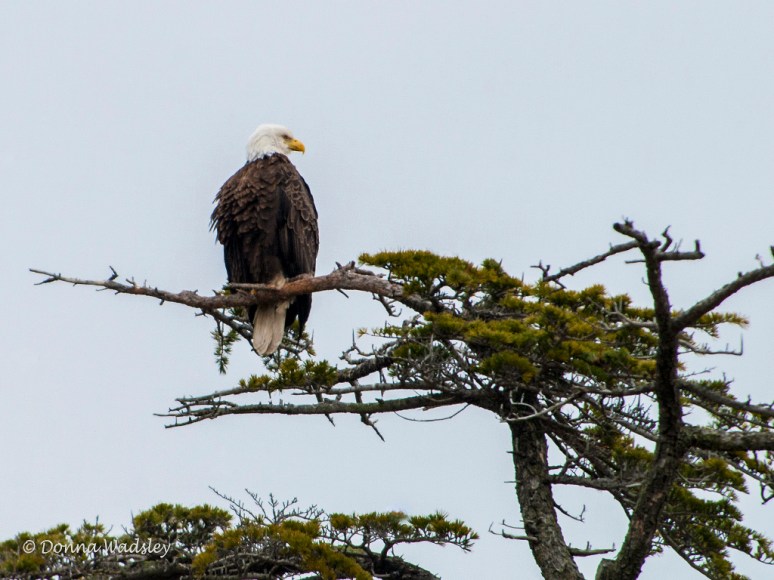
Bald Eagle – Upper Hooper Island, Maryland
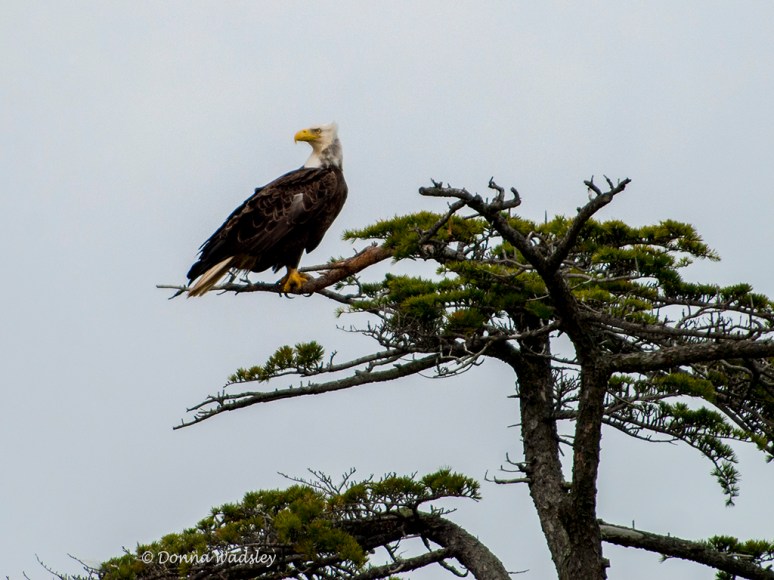
Another day, same tree – Bald Eagle – Upper Hooper Island, Maryland

Bald Eagles on Osprey webcam/platform – Blackwater NWR
(unfortunately, to date Osprey have not occupied this platform)
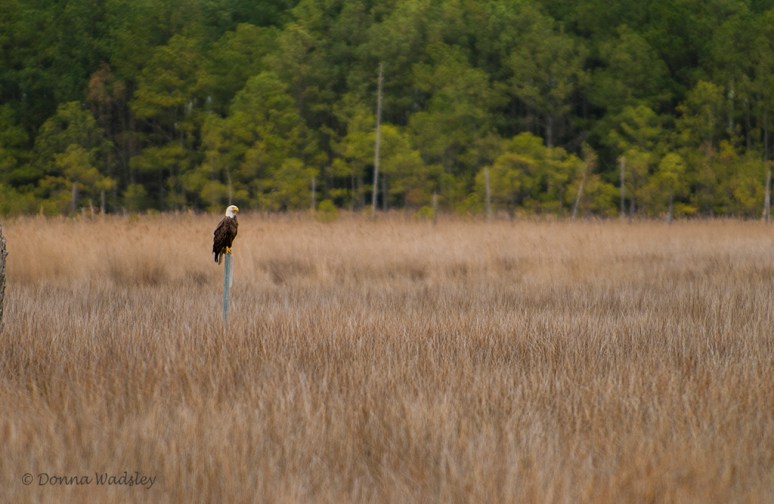
Bald Eagle – Blackwater NWR

Same Eagle, head turned slightly, aware of juvenile Bald Eagle approaching for a fly-by
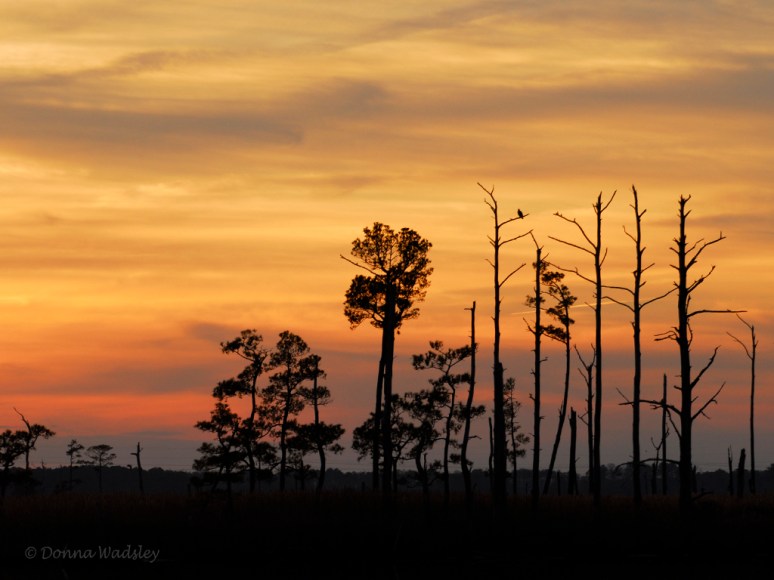
Bald Eagle at sunset – Blackwater NWR
An Eagle is beautiful and majestic, no matter the scene!
Three Eagles In Flight
Three Bald Eagles in flight on three different types of days.
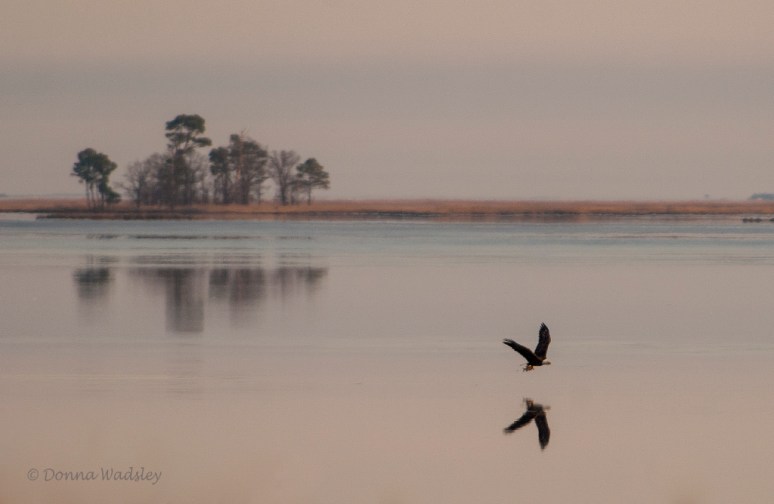
Bald Eagle in flight with catch on a foggy day
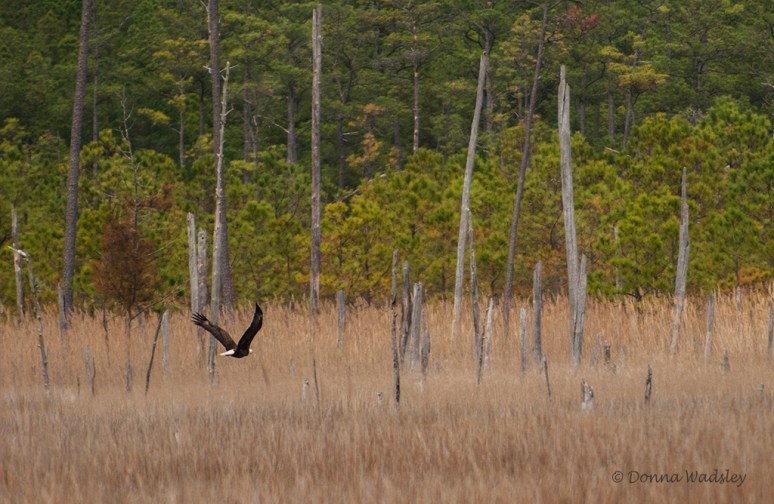
Bald Eagle in flight on a cloudy day
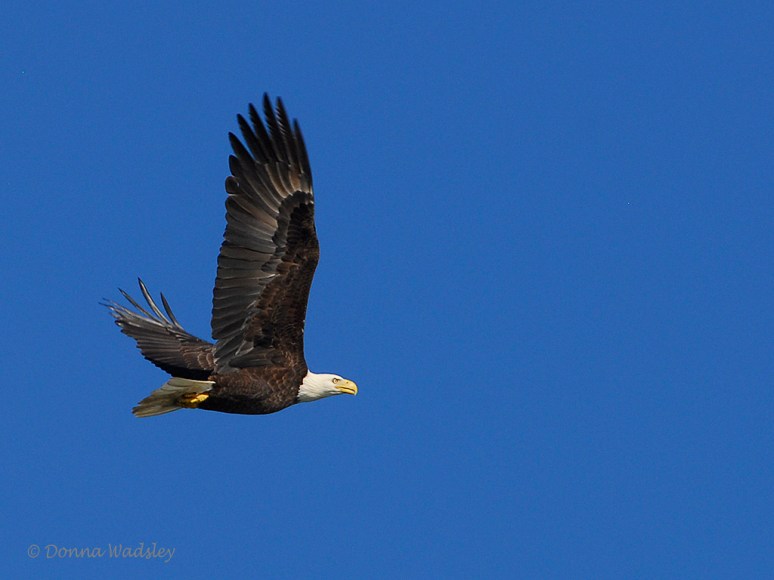
Bald Eagle in flight on a sunny day
No matter the weather or how often, always an exciting moment to see an Eagle!
All recently photographed at Blackwater National Wildlife Refuge.
Eagles Nesting in Trees and on Beaches
Living near the Chesapeake Bay, I am fortunate to be able to see Bald Eagles most days year-round
when out and about. I also love to look for and know where many active nests are located.
Scanning the tree tops of their favorite Loblolly pines is perfect now in locating them before
surrounding leafy trees sprout. Here are a few recent nest photos.

Bald Eagle pair and their nest

Bald Eagle pair and their nest

Bald Eagle on nest
Bald Eagle Nest seen from Observation Boardwalk – Blackwater NWR
Today, the Chesapeake Bay region hosts the largest concentration of Bald Eagles in the lower 48 states, where there are over 1200 pairs of Bald Eagles currently breeding.

Bald Eagle Nest

Bald Eagle Nest

Bald Eagle on nest

Bald Eagle on nest
Another Bald Eagle Nest – Blackwater NWR
Bald Eagle nests average 4-5 feet in diameter and 2-4 feet deep. An Eagle pair will keep and control their nest year-round. Each fall, they begin preparing it, adding another 1-2 feet of nesting materials. By late January to early March, the female will lay her eggs which will hatch in about 30 days. So our area Eagle nests have chicks in them. 🙂
Interesting fact: The largest recorded Bald Eagle nest was in St. Petersburg, Florida, at 9.5 feet diameter, 20 feet deep, and weighed approximately 3 tons. That was one hefty nest!
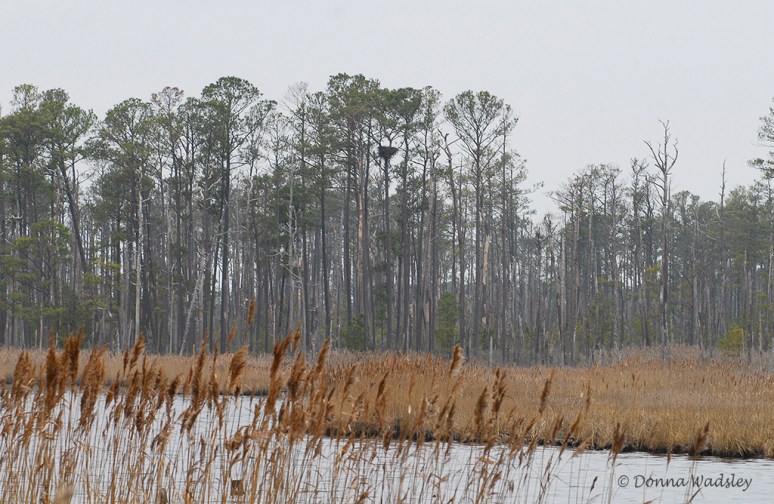
Another Bald Eagle Nest – Blackwater NWR
I know of several other nests that can be seen from the roads surrounding Blackwater NWR, and
there are many more unseen. Even while driving backroads, I’ve sighted many nests.
It is pretty cool to see Bald Eagles flourishing, knowing they were at one time on our federal
endangered species list.

Bald Eagle Nest – Queen Anne, MD

Bald Eagle Nest – Queen Anne, MD
Bald Eagle Nest – Queen Anne, MD
Those were all Bald Eagle treetop nests. I had also mentioned in my post title of Eagle beach nests.
I recently read and thought interesting to share The Center for Conservation Biology’s article
on Eagles beach-nesting on the barrier islands of Virginia’s Eastern Shore, a little over a
hundred miles south of me.
Eagles nesting on open beaches?
Read on for the full article and amazing photos.
~~~~~~~~~~~~~~~~~~~~~~~~~~~~~~~~~~~~~~~~~~~~~~~~~~~~~~~~~~
Beach-nesting Eagles
By Bryan Watts | bdwatt@wm.edu | (757) 221-2247
April 2, 2019
Sometimes no matter how long you have worked with a species and no matter how wild you let your imagination run, you just cannot anticipate what they will do next. The Center for Conservation Biology has mapped and inspected more than 5,000 eagle nests over the past few decades but we never expected to see them taking up residence on the open beach. A newly constructed eagle nest was discovered by the Cape Charles Christmas Bird Count crew on the north end of Smith Island on 30 December 2018. The nest was isolated out on the open beach. This nest would later have two eggs and on 30 March the adult was observed brooding small young. Amazingly, on 1 March 2019 Alex Wilke would find a second beach nest with a young eaglet on Ship Shoal Island.
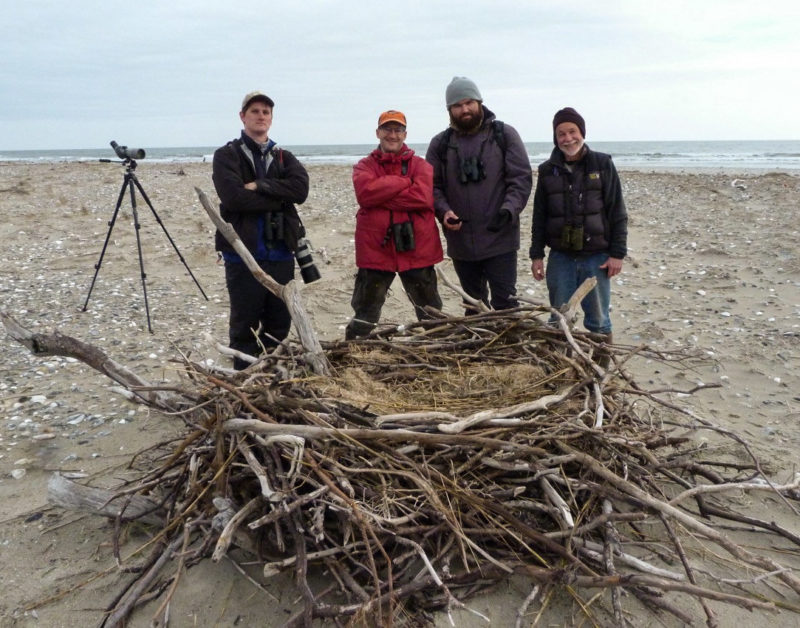
Christmas Bird Count crew pose with a new eagle nest on the north end of Smith Island on 30 December 2018. Photo by Michael Male.
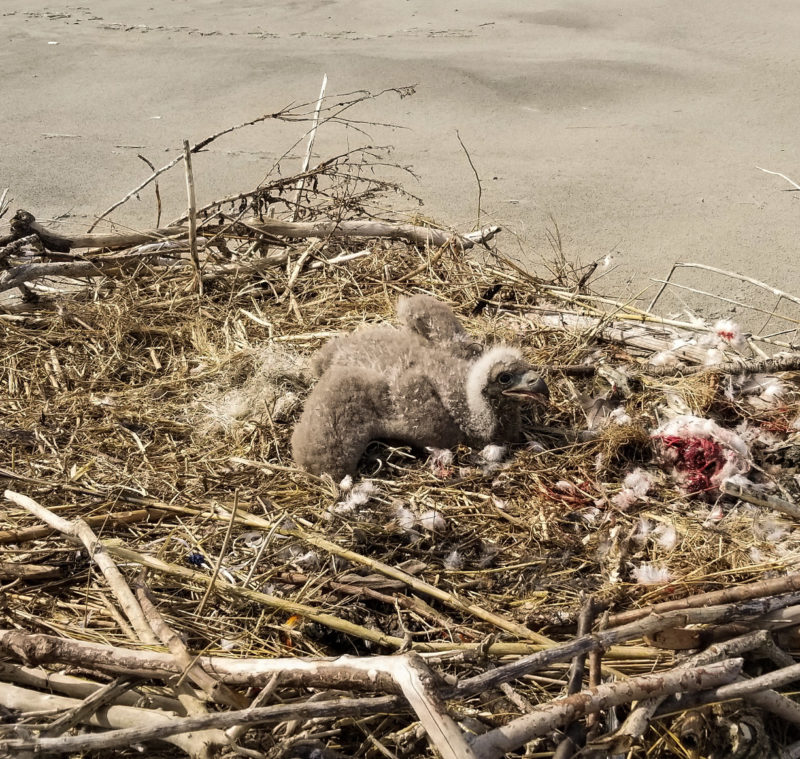
Eaglet in a new beach nest found on south Ship Shoal Island by Alex Wilke on 1 March 2019. A horned grebe was the prey of the day in the nest. Photo by Alex Wilke.
The beach nests discovered in early 2019 represent the 4th and 5th ground nests constructed on the Virginia Barrier Islands in recent years. On 26 April 2013, while flying shorebird surveys along the barrier islands, Bryan Watts and Barry Truitt discovered an eagle nest built on the ground on the north end of Little Cobb Island. On 5 June 2013, while conducting surveys for beach-nesting birds, Ruth Boettcher discovered an eagle nest built on the ground on Cedar Island. On 1 June 2018 Bryan Watts and Bart Paxton, while flying colonial waterbird surveys, located an eagle nest built on a log on the back side of Wreck Island. These previous ground nests were in the dunes or on the back side of the islands. What makes the two new nests different is that they were located between the primary dune and the active surf zone, a position subject to overwash during high tides or storms and a place normally reserved for nesting plovers, terns, and oystercatchers.
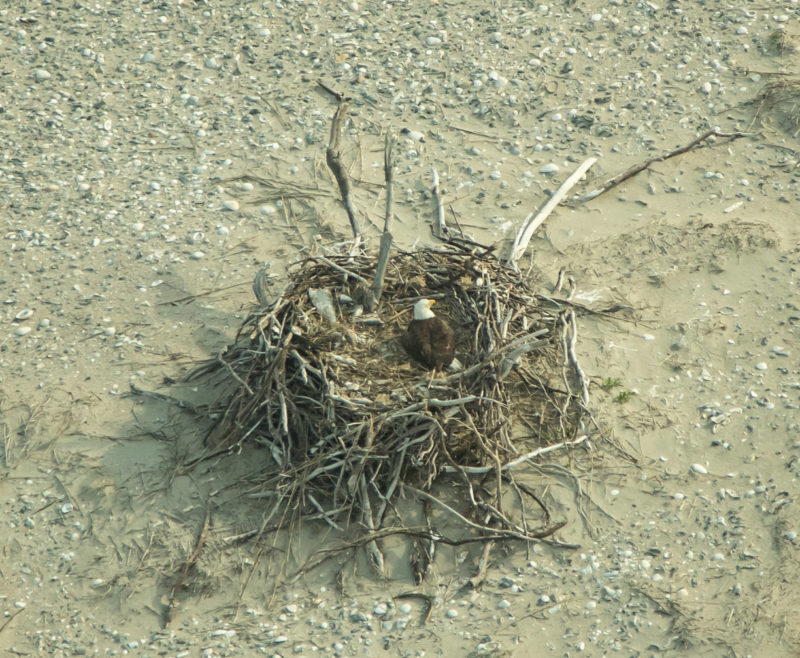
Nest out on the beach on north Smith Island with adult brooding small eaglets on 30 March 2019. Photo by Bryan Watts.
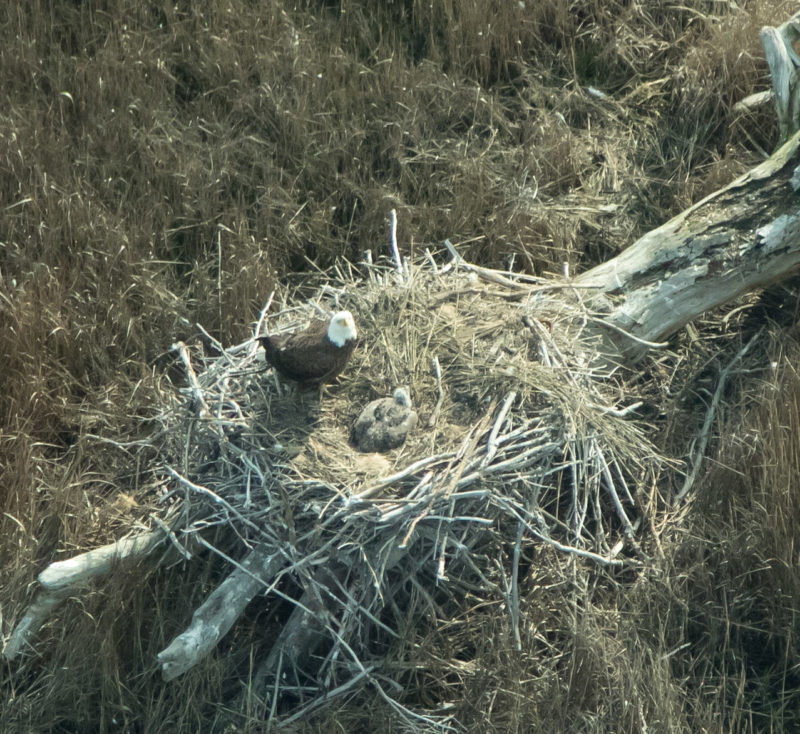
Adult attending young on nest built on a log along the edge of the marsh on the back side of Wreck Island – 30 March 2018. Photo by Bryan Watts.
As with the other sea eagles, bald eagles are tree nesters. Outside of the treeless Arctic, ground nests are very rare. Only a few have been found since the late 1800s, and most of these have been on predator-free offshore islands with examples coming from British Columbia, coastal Texas, and isolated mangrove keys in Florida Bay. The ground nests represent a larger movement of nesting eagles from the mainland of the Delmarva Peninsula out to the barrier islands. On a survey of the islands conducted on 30 March 2019, Bryan Watts and Mitchell Byrd located 14 active nests on the islands including 1 nest on Fisherman Island, 2 nests on Smith Island, 1 nest on Ship Shoal Island, 1 nest on Wreck Island, 1 nest on Little Cobb Island, 2 nests on Hog Island, 1 nest on Revel Island, 2 nests on Parramore Island, 2 nests on Wallops Island, and 1 nest on Chincoteague Island. All of these nests had either young or incubating adults. Despite the abundant prey around the islands, there is little recorded history of eagles nesting on the islands. Prior to 1960 we know of a single record of a pair on Parramore Island. Beginning in the mid-2000s pairs started to nest on a couple of the northern islands, and by 2010 a pair colonized Parramore Island. By 2011 there were 4 nests on the islands and by 2016 there were 11 nests.
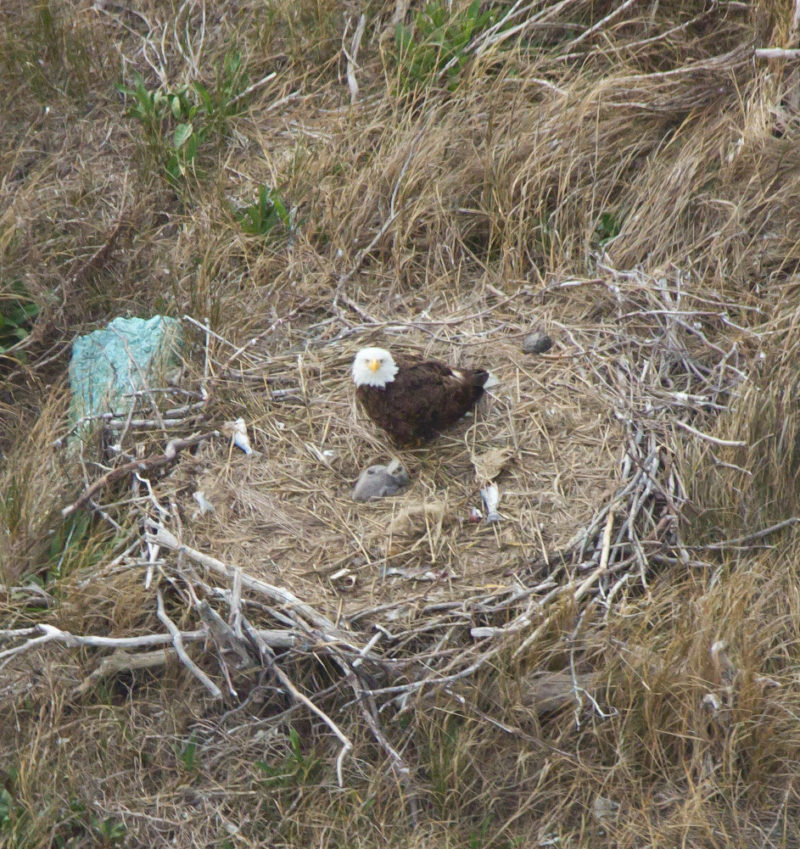
Adult attending young eaglet on a nest in the dune of Little Cobb Island. Photo by Bryan Watts.
Please remember to always keep a safe distance from active eagle nests – for your safety and to avoid disturbing the nesting pairs and their young. Please also remember that most of Virginia’s barrier islands are owned and managed by The Nature Conservancy, the U.S. Fish and Wildlife Service, and the Commonwealth of Virginia. Use policies and seasonal closures are in place to protect nesting birds – contact the appropriate organization for more information.
Lesser Scaup
The last of the beautiful winter ducks have departed the Chesapeake Bay region, leaving a few stragglers here and there for whatever reasons.
The most of any one winter duck visiting in our local area were Lesser Scaup. I got so many wonderful captures of them, it was hard cutting down my final ones to these.

Lesser Scaup males vying for a female’s attention

Female Lesser Scaup and her entourage

Lesser Scaup (female)
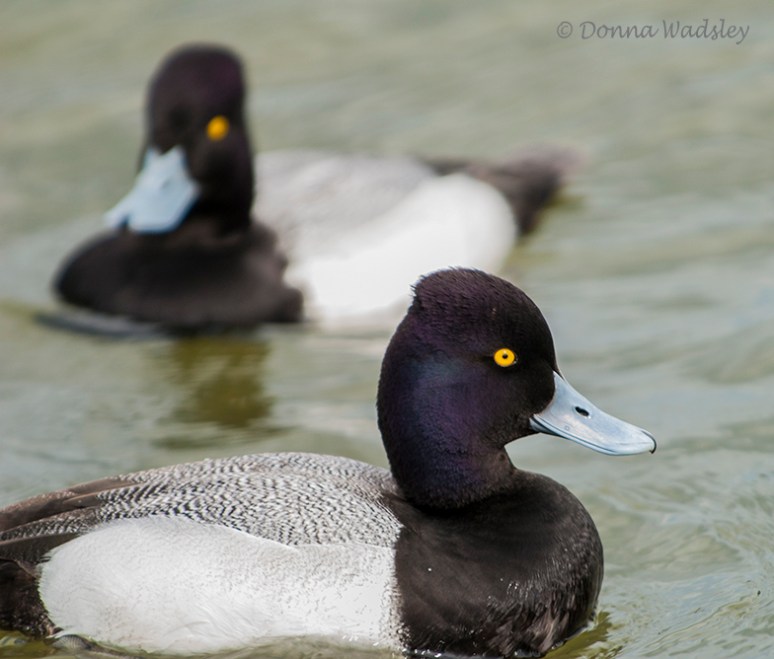
Lesser Scaup (male)
The United States harbors Lesser Scaup year-round in parts of Washington and Oregon, but the rest of the country’s winter visiting Lesser Scaup migrate back to breed in Montana, Wyoming, and Canada.


Lesser Scaup in flight
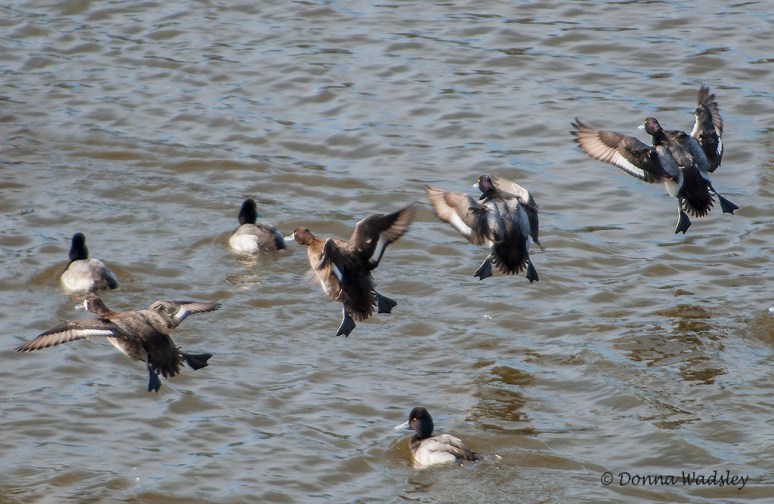
Lesser Scaup landing

Lesser Scaup landing

Lesser Scaup landing

Lesser Scaup taking off at sunset

Lesser Scaup taking off after sunset

Lesser Scaup taking off after sunset
Lesser Scaup taking off at sunset

Female Lesser Scaup coming in for a landing

Female Lesser Scaup landing

Female Lesser Scaup landing

Female Lesser Scaup landing
Female Lesser Scaup landing with reflections

Female Lesser Scaup coming in for a landing

Female Lesser Scaup landing

Female Lesser Scaup landing
Female Lesser Scaup landing with reflections


Male Lesser Scaup landing

Lesser Scaup (male) coming in for a landing
 Lesser Scaup (male) preparing to land
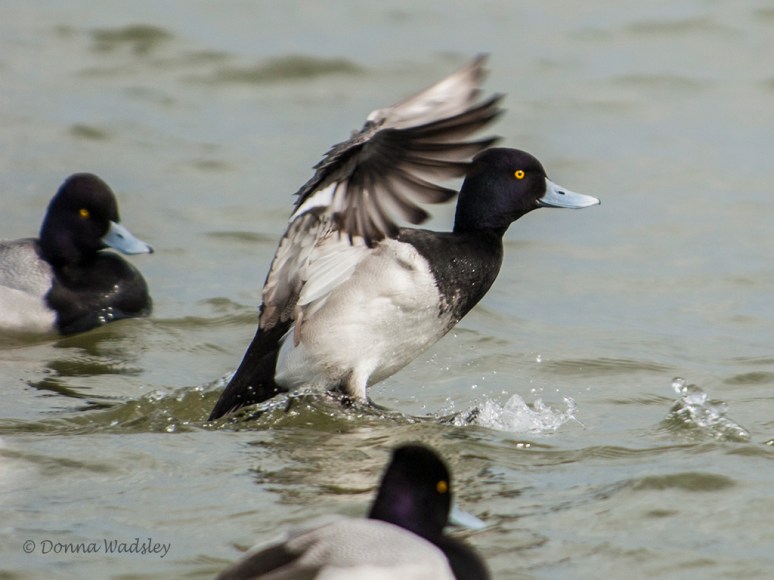
Lesser Scaup (male) landing
Lesser Scaup are the most abundant diving duck in North America, with a breeding population estimated at 3.8 million.

Male Lesser Scaup popping up from a dive

Male Lesser Scaup popping up from a dive

Male Lesser Scaup up and ready for another dive
Male Lesser Scaup “popping back up” from a dive for food
Way too many photos, sorry!

“Yes, Donna, too many photos!”

Lesser Scaup (male)
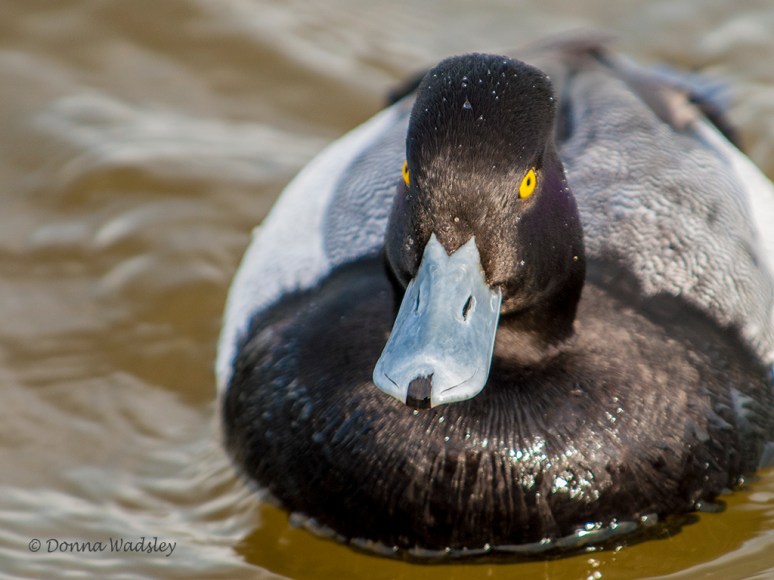
Lesser Scaup (male)
How nice to know they will be back late Fall the end of this year!
Series: Take a Moment and Enjoy a Sunset
The faint, wispy skies didn’t seem to appear they would produce a dramatic sunset tonight.
Still I watched.
Never underestimate the power and display of Mother Nature.
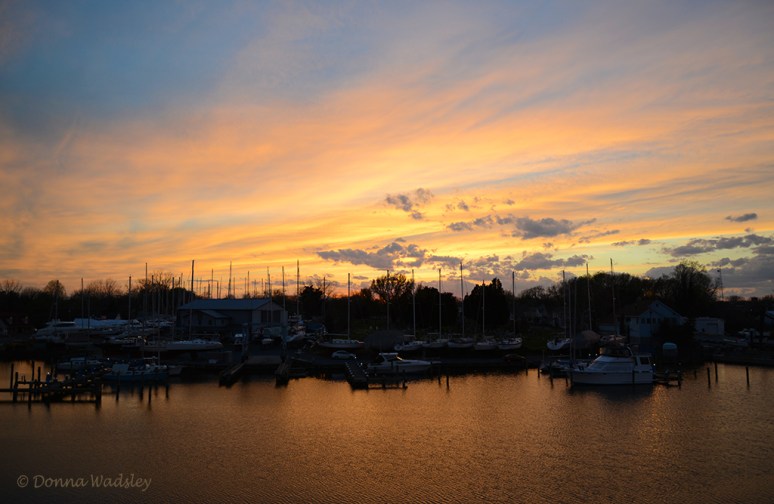
Sunset over Cambridge Creek – April 9, 2019
“My joy is the golden sunset giving thanks for another day.” ― Jonathan Lockwood
Bella & Beau 2019: Nest Guard-Duty and Attacking Intruders
Osprey nest location: Cambridge, Maryland, Chesapeake Bay Region, USA
April 9, 2019
As remarkably adaptable birds of prey, Ospreys can be found on every continent except Antarctica; but they have a special attraction for the Chesapeake Bay, where it is estimated to host over 10,000 pairs. Nowhere else on the planet is there a larger breeding population.
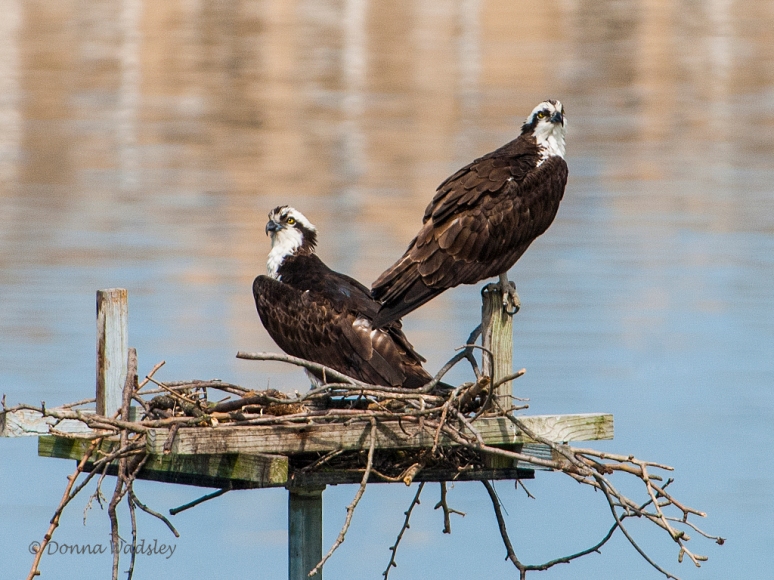
Bella & Beau
At my last posting, I was coming down with what became the flu. I feel for anyone that had it this season, I’m still trying to recover my strength.
And while I tried to improve, I could hear the constant commotion of Osprey outside my windows. Bella & Beau were at battle with several other pairs of Osprey early in the week, trying to keep control of their home.
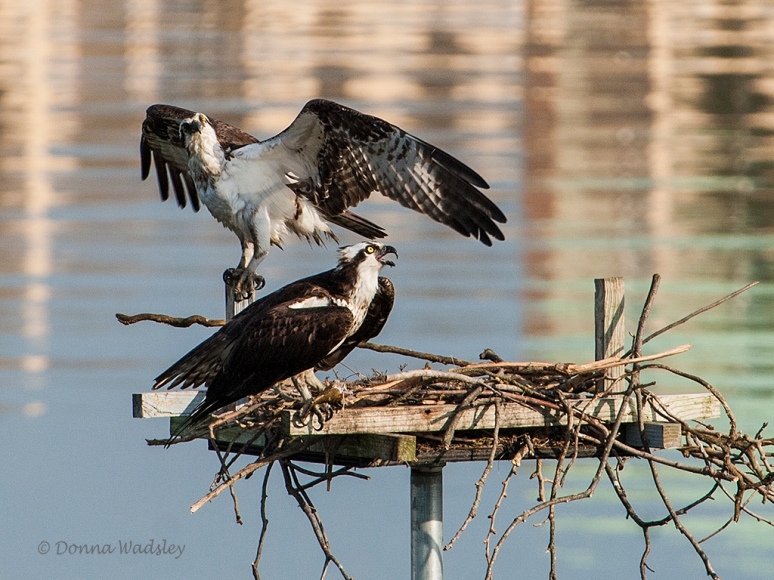
Bella & Beau in defense stance, warning overhead Osprey
The attacks were fierce and intense. I watched in horror two different times an intruding female Osprey knock Bella off the nest platform and into the water. One of the times, she recouped immediately and chased the intruder down, knocking it to the water as retaliation. Bella got a smile out of me then.
I really wasn’t feeling well for photo ops, but did try a couple times. Photos bad but give the gist of the action!

Bella defending her nest from intruding Osprey attacks

Bella defending her nest from intruding Osprey attacks

Bella trying to defend her nest

Bella knocked off her nest

Closeup Bella knocked off her nest
Bella knocked off her nest

Beau chasing intruding Osprey

Beau chasing intruding Osprey
Beau chasing an intruding Osprey
The growing nest itself suffered in the attacks. Sticks got knocked off from quick take-offs and hard landings.
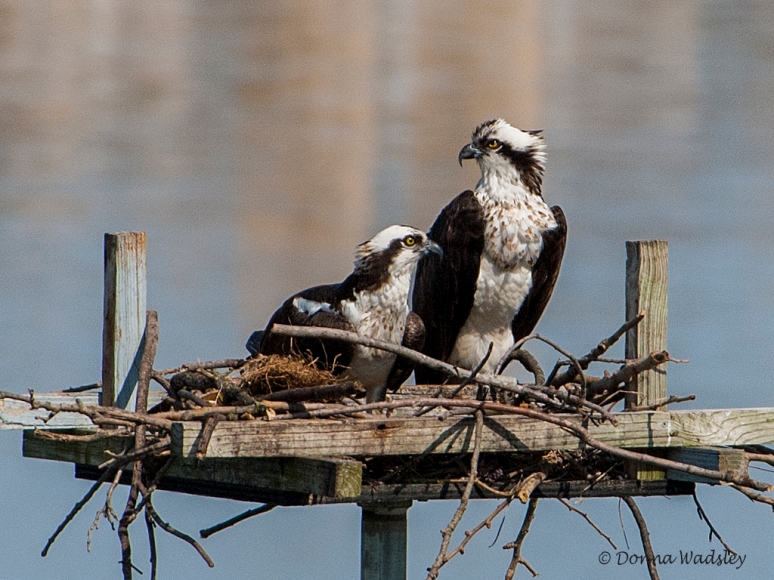
Bella (right) & Beau (left) with much of the nest lost
Thankfully, the area Osprey intruders have settled down with the harassment. I’ve done a quick survey of the area and know of five other Osprey nests that are being built within a mile’s vicinity. It seems Bella & Beau’s platform was prime, but the others have settled for what they have (cell tower, two building tops, a crane, and another platform).
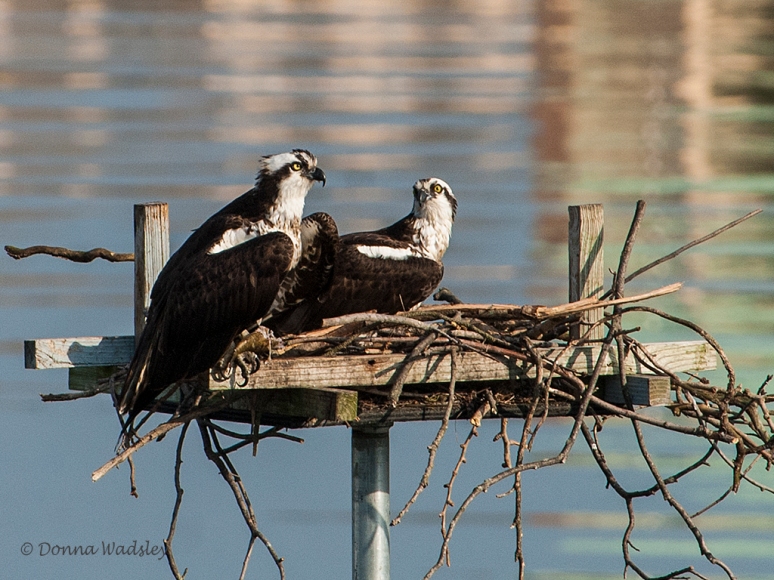
Bella & Beau with a new growing nest
Bella has become more of the homebody again, protecting her home.

Bella in defense stance

Bella in defense stance
Beau, in the meantime, worked hard in bringing more sticks and nesting materials, trying to keep the nest built.

Beau preparing to grab a stick in the water

Beau returning with nesting materials

“I’ve got more, Bella!”

“Let me grab this one too!”

Beau enroute with a stick

Beau enroute to the nest
Beau busy delivering nesting materials

Beau taking off to get more nesting materials…..

while Bella watches on.

Go Beau!
Beau off to get more nesting materials

Beau delivering while Bella looks on

Beau delivering while Bella looks on

Beau delivering while Bella looks on
Bella watching Beau making the deliveries

Beau moving a stick while Bella could care less.

Beau moving a stick while Bella rests.
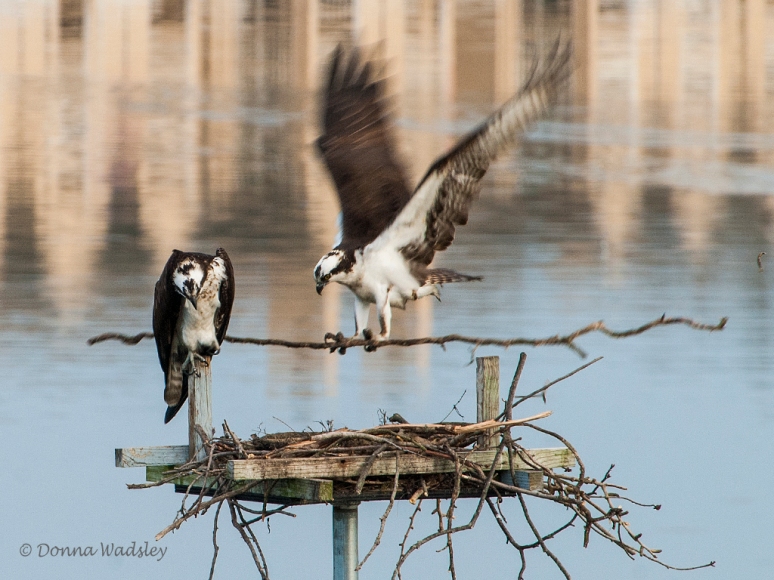
Beau delivering a rather large stick.
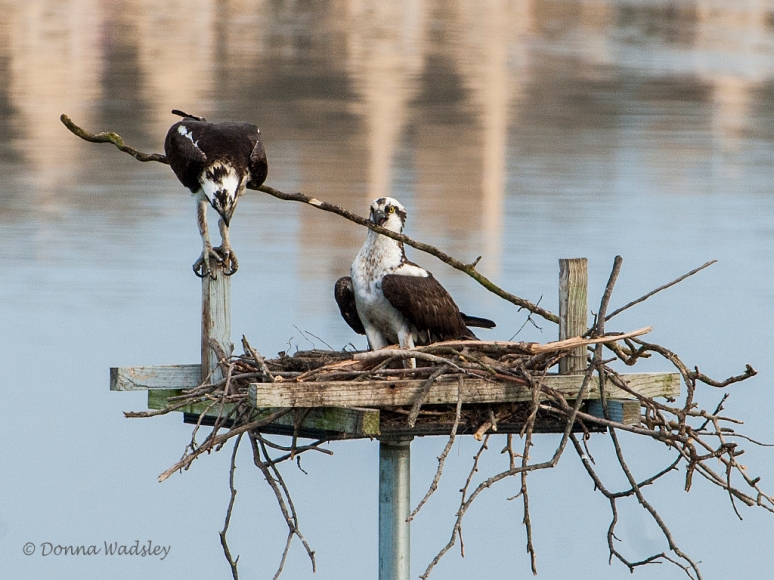
“Where do you want it, Bella?” Beau asks as he whacks her with it.
My goodness, with all that action of attacks and nest rebuilding, Bella & Beau were still able to squeeze in mating time. Yes, their instinct is very strong, and time is of the essence for the season. Last year, Bella laid her first egg around April 17th.


Bella & Beau mating
The deed is quick with Beau usually taking flight to retrieve another stick or a bit later with a headless snack for Bella to devour.

Beau delivering a gift of fish to Bella.

Bella eating her gift from Beau.
Beau delivers a fish to Bella
What a week! I was able to finish it out with several beautiful flight shots of both Bella and Beau.
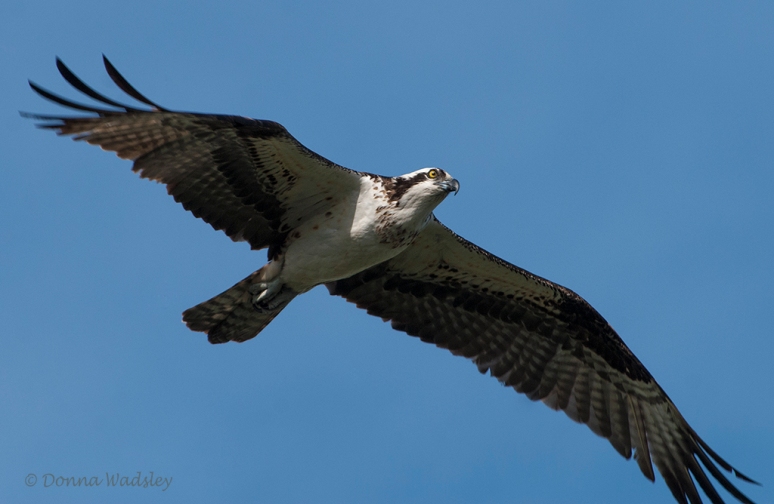
Bella in flight
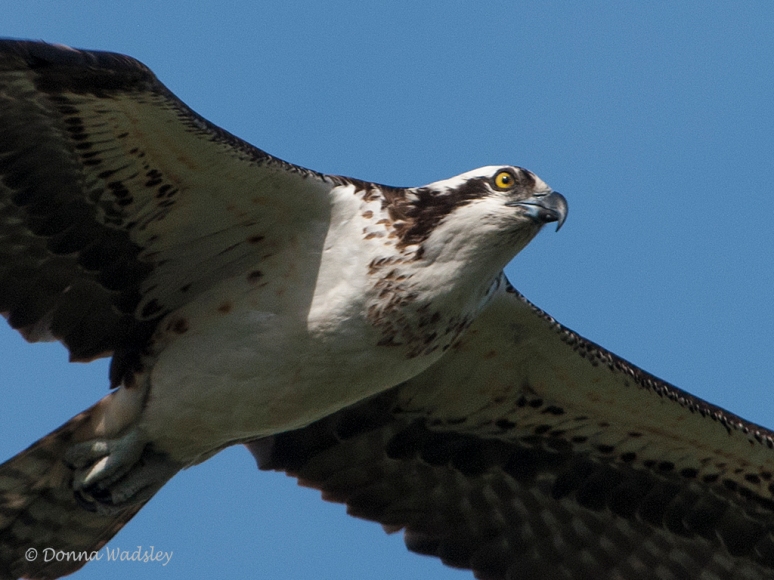
Bella “close-up”
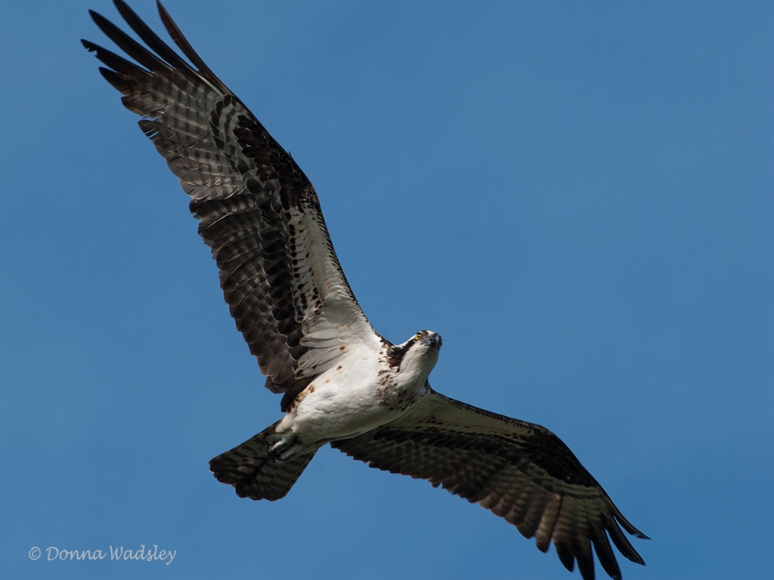
Beautiful Bella
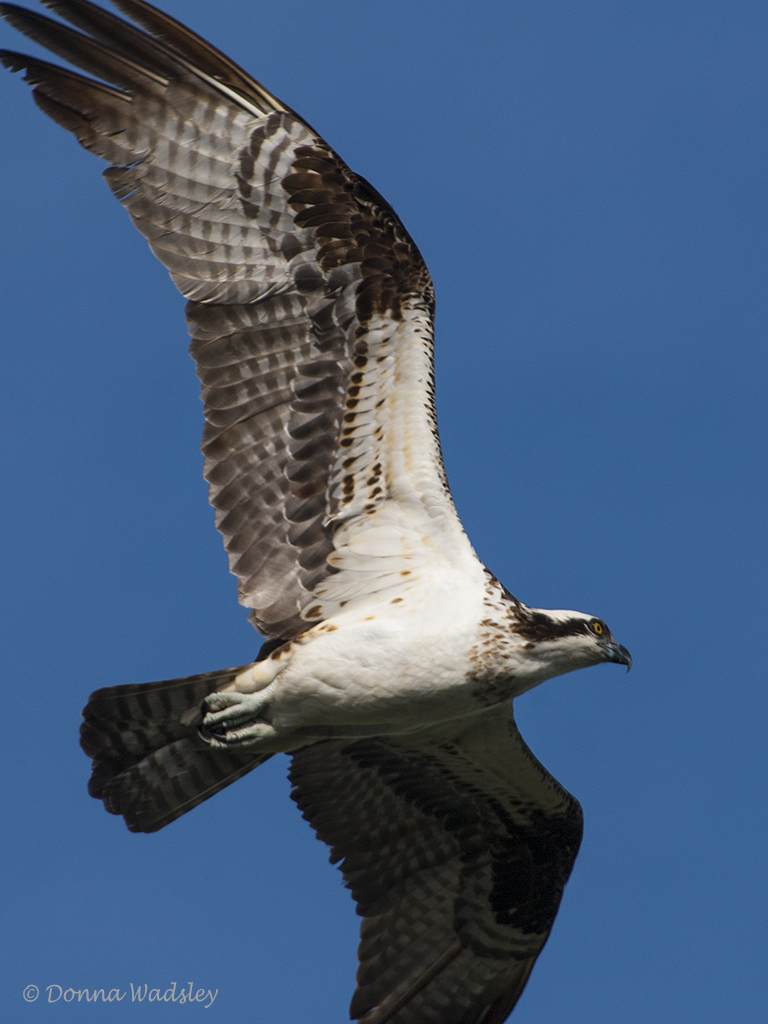
Bella in flight
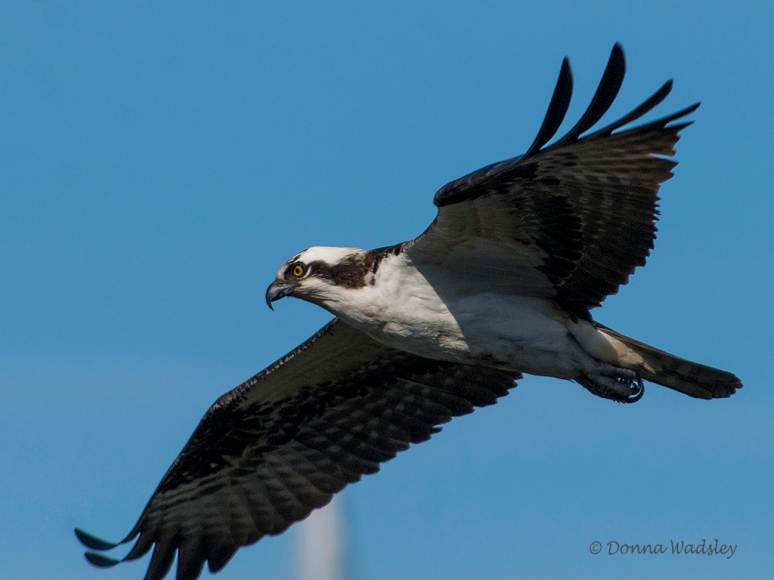
Beau in flight
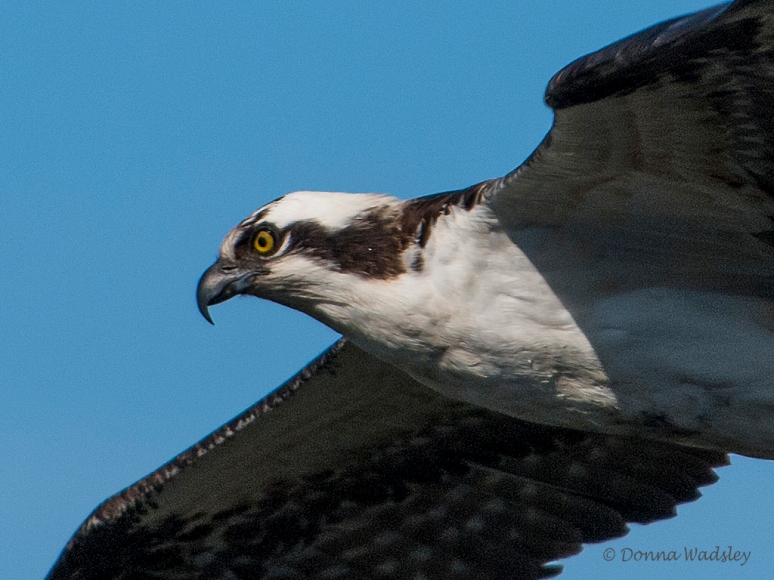
Beau “close-up”
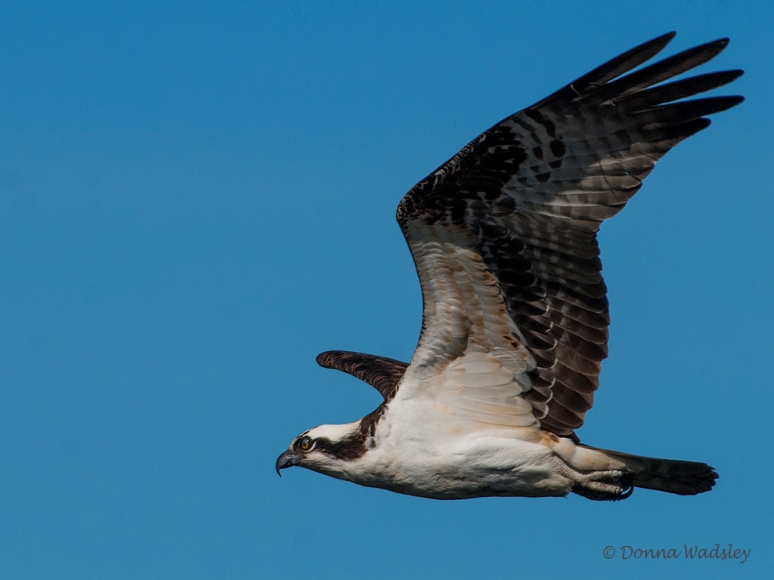
Beau in flight
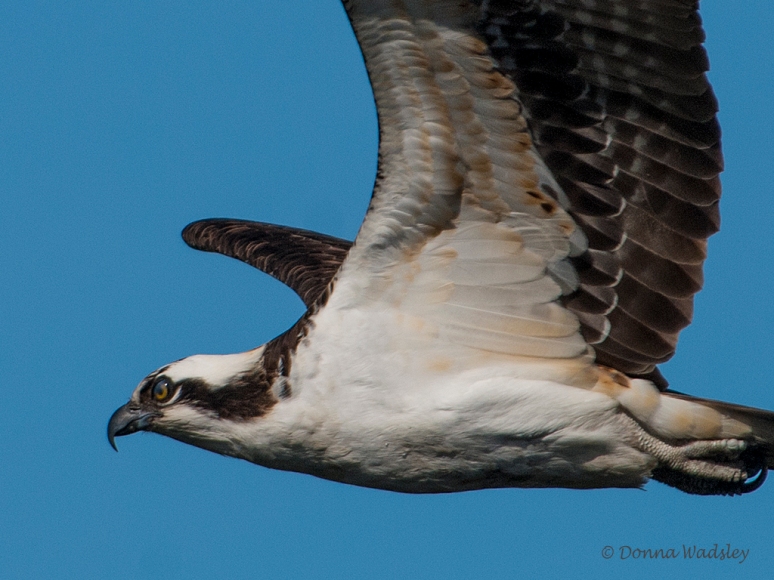
Beau “close-up” with his third semi-transparent eyelid (called a nictitating membrane) acting as a goggle
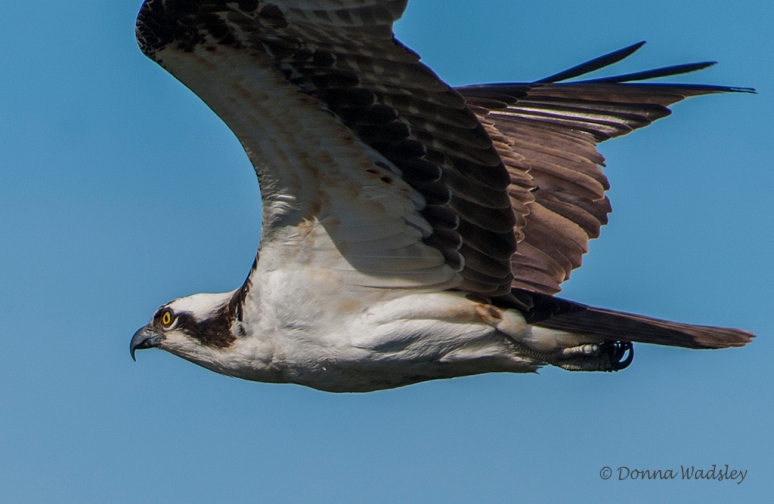
“Beau cruisin’ on by”
And some of my last shots to end this update…..
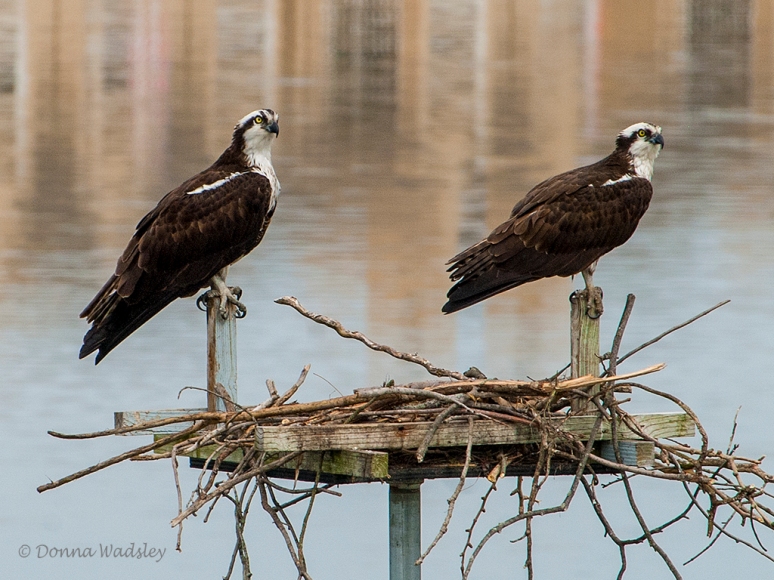
“The Happy Couple”
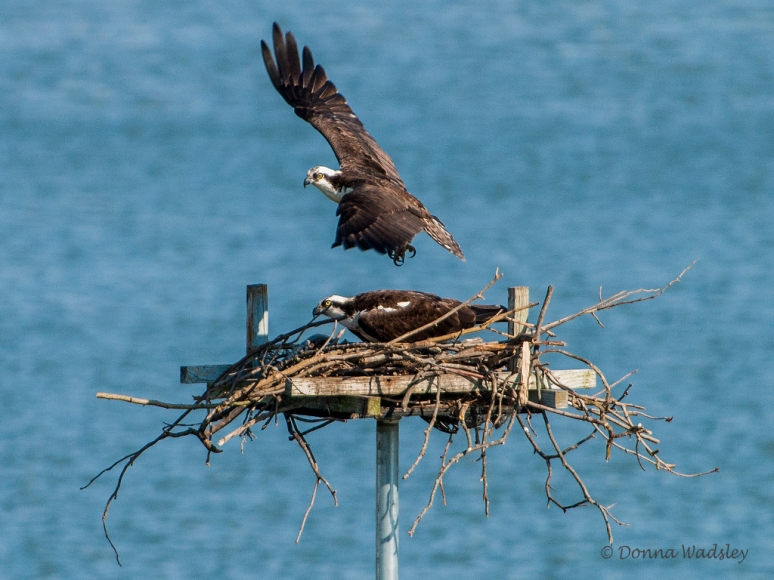
Beau taking flight
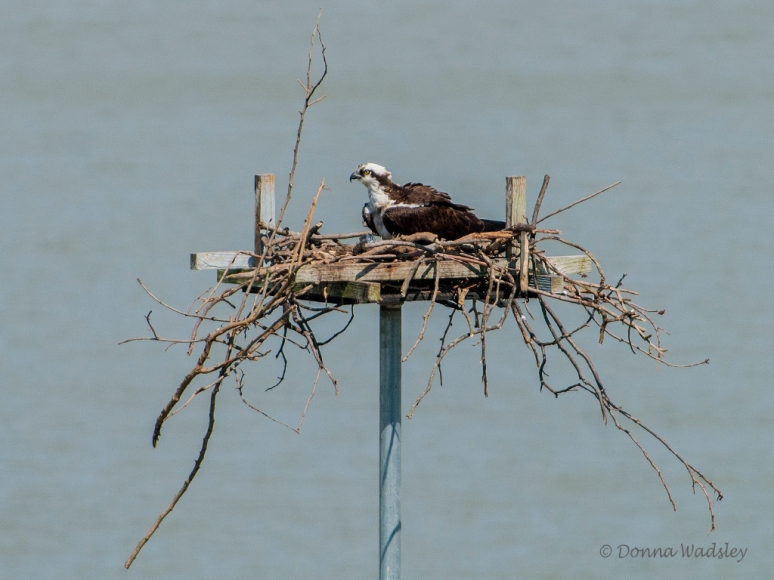
Bella on nest guard-duty – the last photo of the nest to date
I am glad the week ended on a good note that all seems back to normal with the usual antics of an Osprey’s daily life.
Note: The majority of my photos for the Bella & Beau series are shot from my balcony about 200+ feet where I’ve got just enough advantage height to reach into the top of the platform. My equipment: a Nikon D200 and D750, with a Nikon AF-S VR-Nikkor 70-200mm F2.8 lens combined with a Nikon Teleconverter (1.7x magnification), zooming all the way in. At photo processing, it is then necessary to crop at least 50% to share close-ups with you. The Bella & Beau series is not so much about high-quality photos (although I seriously strive to get the best, detailed shots for the storyline), as it is about the antics and adventures of an Osprey pair’s daily life. It is also my hope you will learn a little bit about the amazing Osprey and enjoy following along!
Bella & Beau 2019: Nest Building and Safeguarding
Osprey nest location: Cambridge, Maryland, Chesapeake Bay Region, USA
March 31, 2019
The past week continued with Bella & Beau rekindling their bond. The instinct to breed is strong and mating is often.

Lovebirds Bella (left) and Beau (right)
We left off on the last post with just a few small sticks laying in Bella & Beau’s nest platform. Home building has picked up pace considerably. Beau seems to be proving his nest building skills are better this year.
At first, Beau was the only one retrieving nesting materials. Bella remained perched on the platform, either watching or ignoring him, even making demands for more. But Beau didn’t take it to heart and kept at it. Maybe his lady was still recovering from the long flight and any obstacles she had just endured before arriving a week ago.

Beau delivering nesting materials


“And that’s how it’s done!”
Beau landing with a big stick while Bella watches


Bella demanding more sticks and Beau takes off


Beau going for more nesting materials.

Beau picking up a stick in the parking lot across the street
Beau even began rearranging the sticks. Bella just watched.

Making a nest

Beau rearranging the nest
After delivering so much, Beau would push his body down onto the nesting materials in the center, mashing them. He was creating the base for the egg cup.


Beau mashing and breaking nesting materials apart to form a soft egg cup
By mid-week, Bella was ready and started retrieving nesting materials, as well as taking over the job of arranging the home. It was now a joint effort!


“And this one goes over here!”


This past week has brought many more returning Osprey to the Chesapeake Bay region. In 2017, there were approximately 10,000 pairs of Osprey here. That means good nesting locations are prime.
Bella & Beau’s platform has been attracting Osprey, keeping them both on alert for intruders, squatters, or even another Osprey looking for a mate.
The harassments and chases are daily. Even a few platform attacks have occurred, but no one appeared injured.


Intruding Osprey attacking Bella at the nest
Another intruder was a pair of Fish Crows who perched on the empty platform. Bella came out of nowhere and landed, while the crows flew. They circled around and started harassing Bella. Harmless and more an annoyance, Bella ignored them. But finally, she made some threatening calls and both crows took off. Who knew Bella could speak crow?


Fish Crows harrassing Bella
Finally, some flight shots of Bella & Beau.


Beau


Beau


Bella in flight with a fish on a cloudy day
Wow, what a week and how about that nest! Go Beau!!
Note: The majority of my photos for this series are shot from my balcony about 200+ feet where I’ve got just enough advantage height to reach into the top of the platform. My equipment is a Nikon D200 and D750, with a Nikon AF-S VR-Nikkor 70-200mm F2.8 lens combined with a Nikon Teleconverter (1.7x magnification), zooming all the way in. At photo processing, it is then necessary to crop at least 50% to share close-ups with you. The Bella & Beau series is not so much about high-quality photos (although I seriously strive to get the best, detailed shots for the storyline), as it is about the antics and adventures of an Osprey pair’s daily life. It is also my hope you will learn a little bit about the amazing Osprey and enjoy following along!
American Robins
One of our first American Robins arrived back for their Spring to Fall residency on February 24. He sang his praises at 3:30 a.m. that morning outside our bedroom window. The tree perch enjoyed the most last year is there; so far, it appears to be the same favorite perch again this year.

American Robin
Since that date, the mate has returned as well. We now have two nature alarm clocks. I don’t mind waking up to their song around sunrise, but not at 2:15 a.m. and off and on until then!
They did this last year too. I’ve read that light pollution can confuse Robins and some other birds; our marina and creek are lit up at night so this makes sense. I’m guessing they take great afternoon naps.
It’s been difficult trying to get a photo of one of them because of all the branches on the tree. I lucked out finally a couple weeks ago.
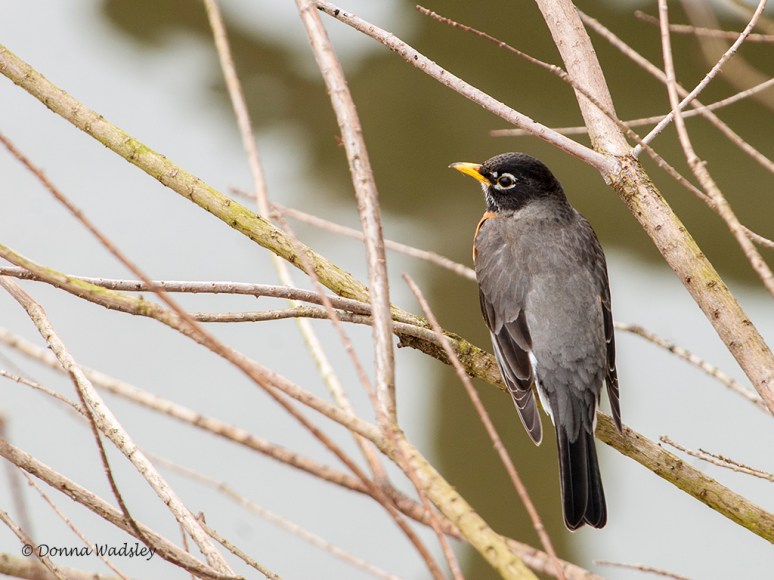
American Robin

“Singing A Song”
(at a more appropriate time of day!)
Yesterday I watched one of them foraging below me in the mulch. Missed the shots on the little worms he was finding, but did like this direct-down shot.

American Robin
This morning they started at 2:25 a.m. I love my birds, but……come on! I need my beauty sleep, Mr. Robin! 😉
Series: Take a Moment and Enjoy a Sunset
At Blackwater NWR, the sun began to drop behind the clouds, on its way down to the horizon.
The silver-lining effect gave a beautiful, moody reflection.
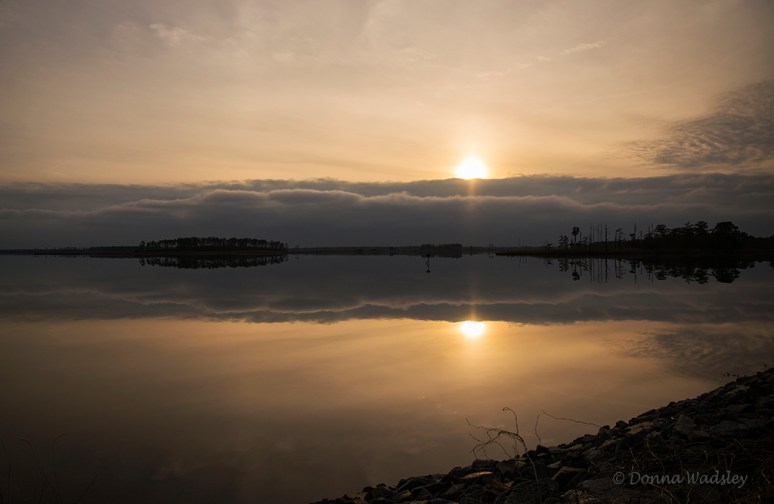
Sunset at Blackwater NWR
I cropped the above photo and loved it as well, so decided to share it below.
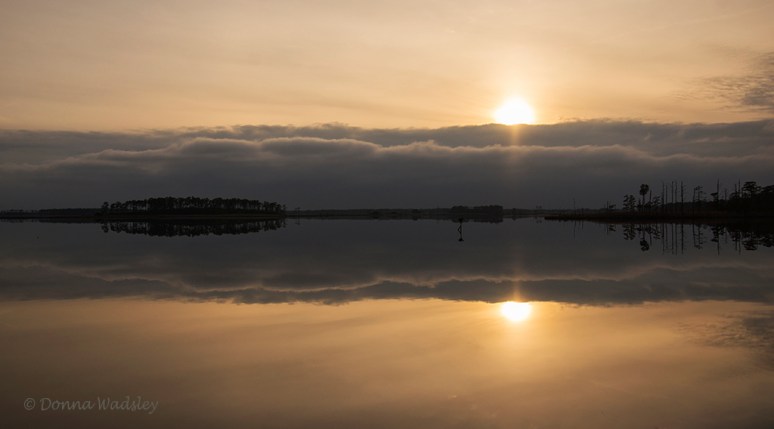
Sunset at Blackwater NWR
Which one do you like better? I can’t decide!
“My sun sets to rise again.” — Robert Browning

 Bay Photos by Donna