American & Eurasian Wigeons
In past winters, I’ve been lucky to see and photograph American Wigeons, but always at a distance. In the past month, I’ve found them hanging out in a location closer to the shore. Several visits finally paid off for me to really show the beauty of this dabbling duck in wonderful lighting.

American Wigeon (male)
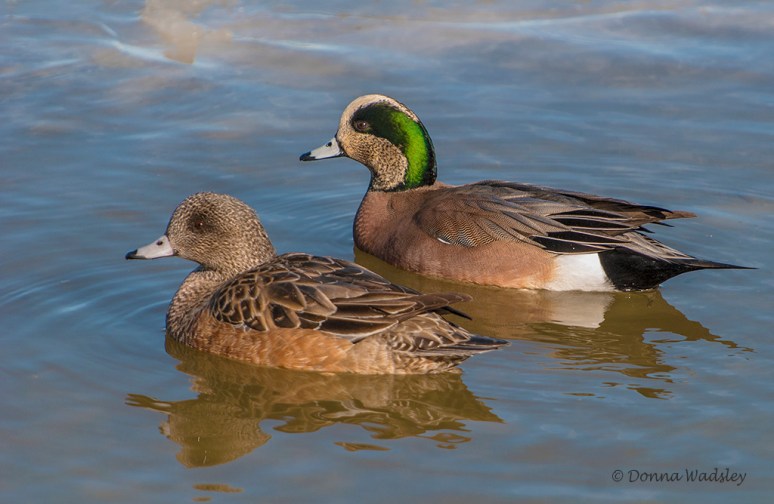
American Wigeons (male & female)
The American Wigeons’ calls are a cute, unique nasal whistle. It is pretty neat to hear them whistling constantly when they’re together in a flock.

American Wigeons


American Wigeon (male)

American Wigeon (male)
Even when they are departing, American Wigeons are gorgeous!

American Wigeon (male) in flight over ice

American Wigeon (male) in flight over ice
By March, American Wigeons will return back to their breeding grounds in Canada.
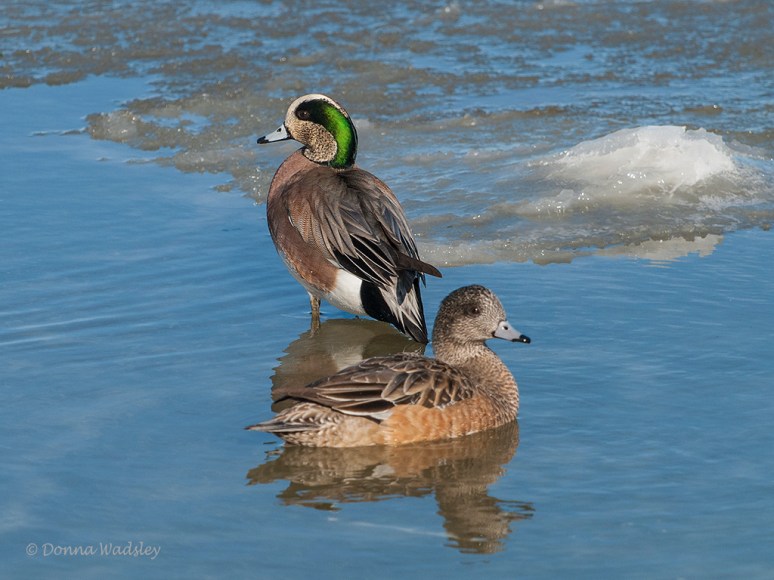
American Wigeons
These American Wigeon images have me recalling my first winter photographing American Wigeons in February 2012. Riding past the waterfront Holiday Inn at Kent Narrows, Maryland, I saw a group of people in the parking lot, along the waterfront with binoculars and cameras/tripods.
Of course, I pulled in! I grabbed my camera & 70-200mm lens and went to see what the hoopla was about. Several were excited to point out an Eurasian Wigeon among American Wigeons and other wintering birds.
I later learned that although common and widespread in the Old World, the Eurasian Wigeon is a sporadic visitor to North America. The ones we are fortunate to see each year along the Atlantic and Pacific coastlines likely come from eastern Siberia and Iceland.
Here’s my best shot through the reeds and cropped considerably of that Eurasian Wigeon, I shared back in 2012.
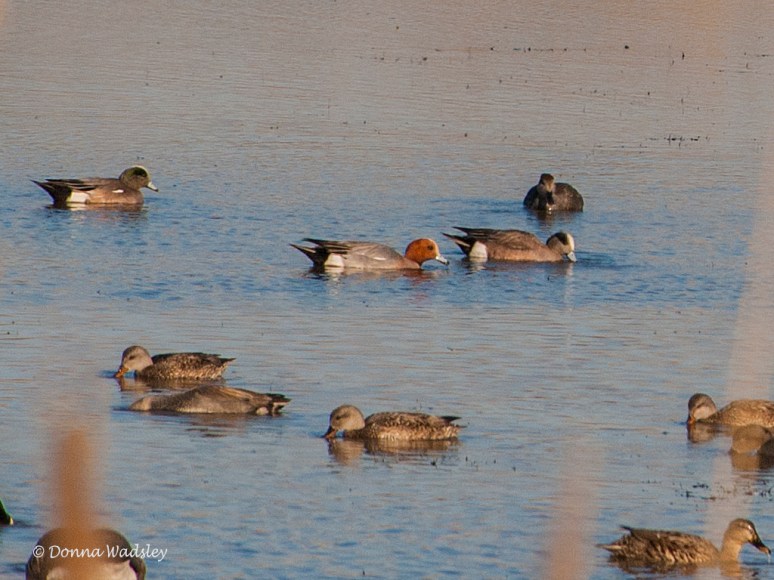
Eurasian Wigeon (male, dead center) with American Wigeons and Mallards
All the wigeons were gone the next day; and I visited quite often after that, hoping for their return, especially the Eurasian Wigeon, but to no avail.
Having only been amateur ‘birding’ for a year and a half, I found that moment quite exhilarating to see a bird that was rare to my area.
And, now, here I am, seven years later, more in love and fascinated with our amazing feathered friends, along with enjoying the opportunities to photograph and share their beauty with you. 😊
By the way, I’ve never seen an Eurasian Wigeon since.
Canada Geese – Flight, Miffed, & Reflecting
While I’m on a ‘goose’ kick, here’s three more photos to share of Canada Geese taken last week.
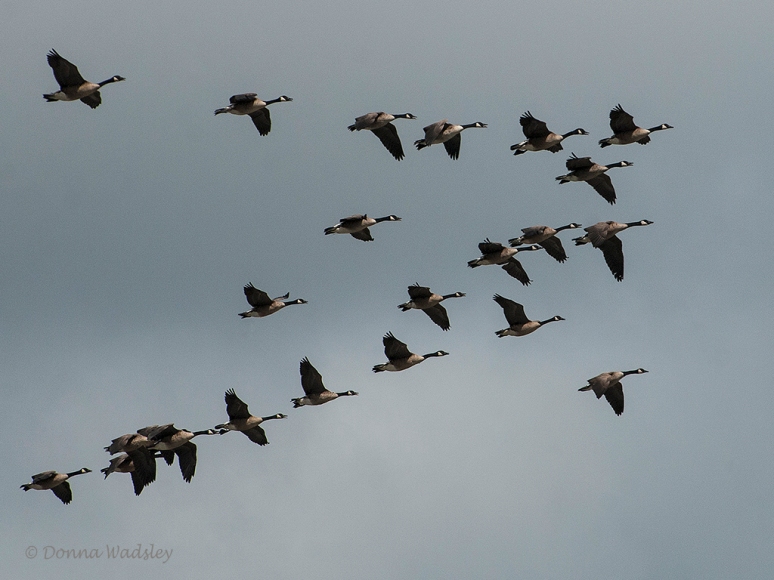
Canada Geese In Flight

“A Bit Miffed”
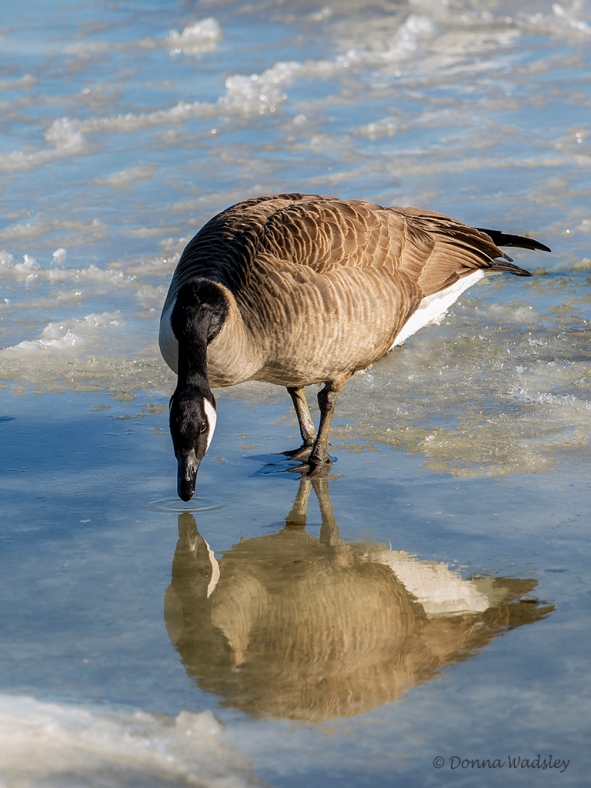
“Melting Ice Reflection”
I said it in my last post, Canada Geese photography is fun stuff!
Canada Geese
I’ve gathered a small collection to share of Canada Geese photos taken since last fall on Cambridge Creek where a small flock continues to visit off and on.


Canada Geese

Canada Goose “Abstract”

Canada Goose Taking Flight

Canada Goose Reflection #1
Inspired by several of your blogs showcasing in B&W, here’s my attempt of the above photo in B&W below.

Canada Goose Reflection #2
And finally, a flock of Canada Geese making wakes, which I actually found I liked better as B&W.

Canada Geese “Making Wakes I”
Did you notice the back left goose waving?

Canada Geese “Making Wakes II”
Canada Geese photography can be fun stuff!
Let’s Get Buggy
I am more keen on sighting birds than other smaller wildlife, like insects. But on occasion, an insect presents itself.
I came across this beautiful, bright neon green caterpillar last fall; I couldn’t believe it’s size, almost three inches long. I later learned it was a Luna Moth caterpillar.
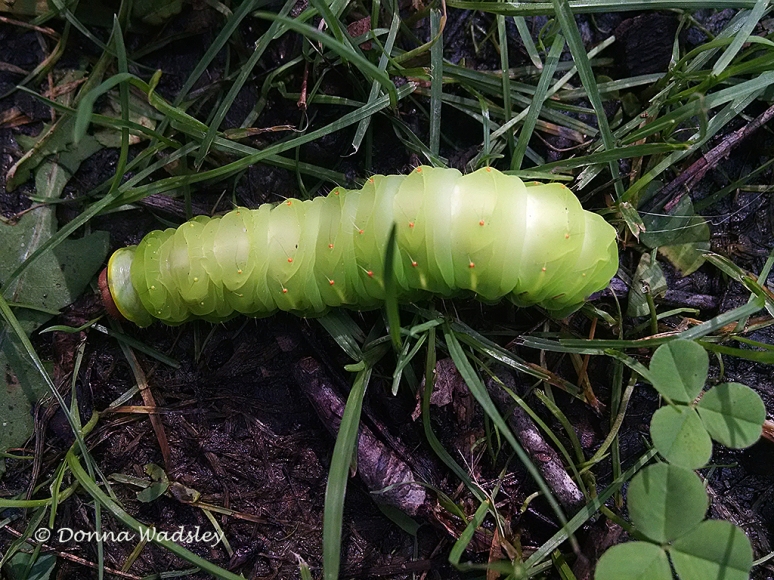
Luna Moth Caterpillar
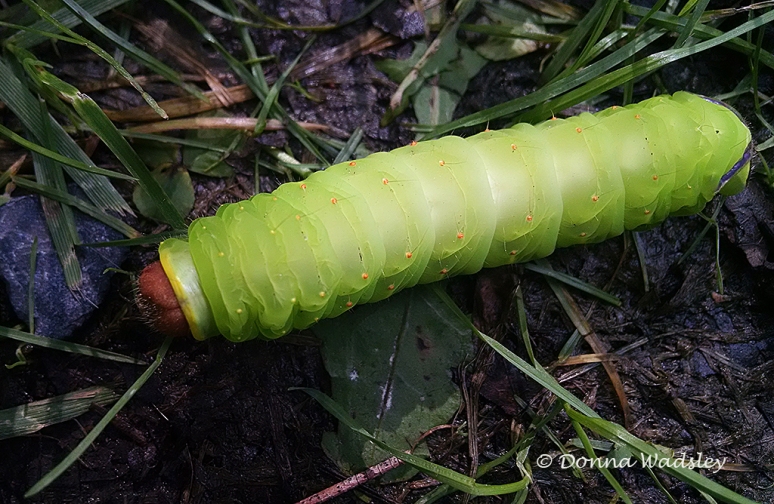
Luna Moth Caterpillar
As a caterpillar, it eats constantly for about a month and then builds a cocoon, where it lives inside for about three weeks. It then emerges as a huge, beautiful Luna Moth.
The Luna Moth is one of the largest moths in North America, with an average wingspan 3 to 4 1/2 inches. Below is the caterpillar’s transformation into a moth.
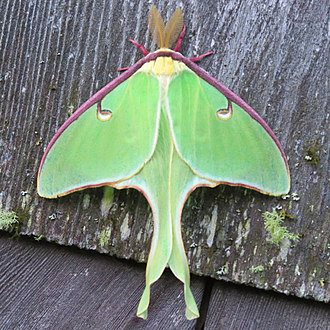
Luna Moth (male)
Courtesy of Wikipedia
Interesting fact: As a moth, the Luna Moth does not have a mouth or digestive system, therefore, it doesn’t ever eat. That’s because a Luna Moth only lives for about a week after leaving the cocoon.
Series: Take a Moment and Enjoy a Sunset
It’s time to take a moment and enjoy a sunset!
This three-photo series is from the end of the sunset on December 29, 2018.
The clouds were wispy wonderful.

Sunset over Cambridge Creek – December 29, 2018
As an added bonus at the end, the sunset produced a bright sundog.

Sundog
The icing on the cake? The sundog’s reflection on the water, accented by sailboat masts abstracts.

Sundog reflection
“Sunset is still my favorite color, and Rainbow is my second.”
— Mattie Stepanek
Great Blue Heron Portrait
With a couple of my recent posts featuring Great Blue Herons, I wanted to share another one from last summer, during one of our boat trips up Tuckahoe Creek. I had set it aside and then over-missed it, tsk tsk.
As we drifted by, I took several beautiful angles of this Great Blue Heron perched on a private dock pier. He never moved, so it was all about his shaded background line-up that would determine my favorite.
Here’s the one….
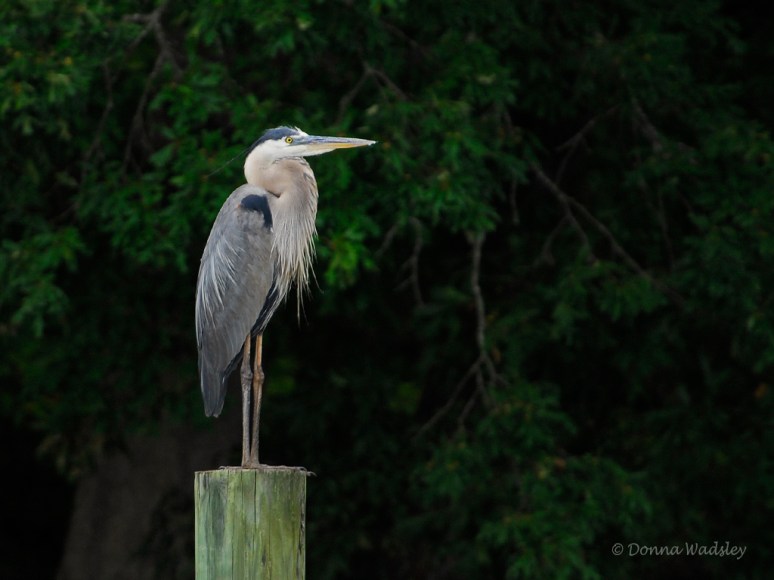
Great Blue Heron “Portrait”
We continued on and had stopped for some other wildlife activity when a Great Blue Heron came from behind and flew right past us.

Great Blue Heron
I really don’t know if it was the same Great Blue Heron, it had been an hour since the pier shots; but I did enjoy this one’s fly-by with the subtle shoreline background.
I never tire photographing Great Blue Herons.
Mallard Hanky-Panky?
I really get a giggle out of this photo’s possible story.
Appears the fella in the middle is oblivious to what looks like a little hanky-panky between the other two behind his back.

“Hey there, gorgeous.” “Well, hello there, handsome.”
(Mallards)
Of course, Mallards are like this! Ha!
I love when wildlife makes us laugh and smile, and hope this one gave you a chuckle.
Great Blue Heron Fly-By
Great Blue Herons are year-round residents of the Chesapeake Bay region, as long as there is a source of water and food. Once the water freezes, they’ll move around until they find another area that offers their needs.
With the changing of the seasons, it had been a couple months since I’d seen a Great Blue Heron on Cambridge Creek.
That changed recently. Two times on two different days last week, I watched one fly towards and past me from the watermen’s public marina/ramp where it had been hanging out.
A Great Blue Heron doing a fly-by….
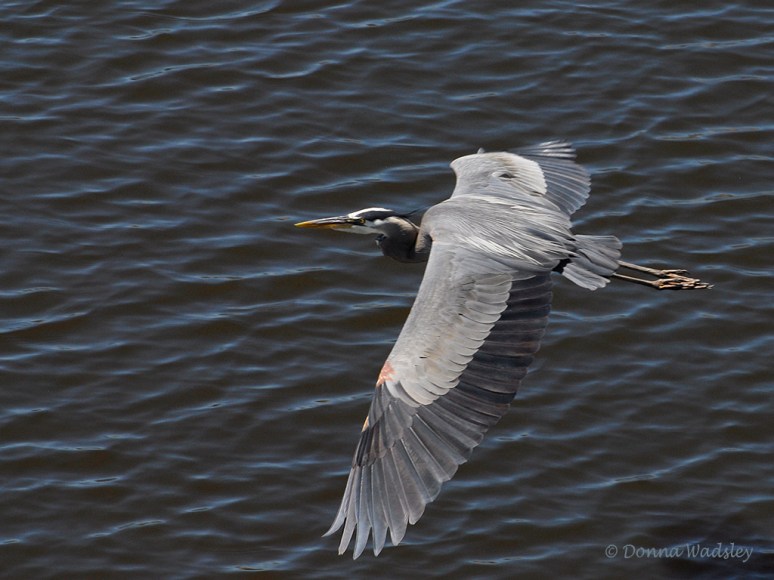
Great Blue Heron
When they fly this close, you can hear the ‘whoosh’ of their wings’ strong, graceful stride.
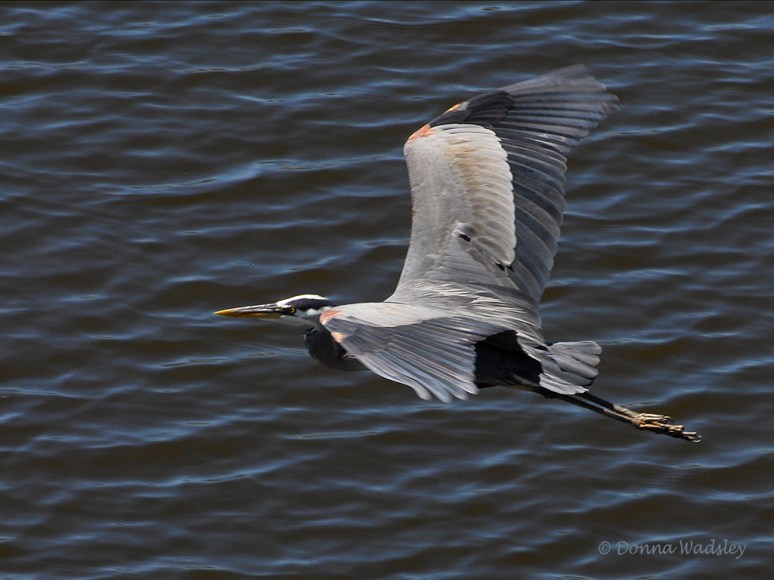
Great Blue Heron
Their wingspan can reach up to 6 1/2 feet wide.
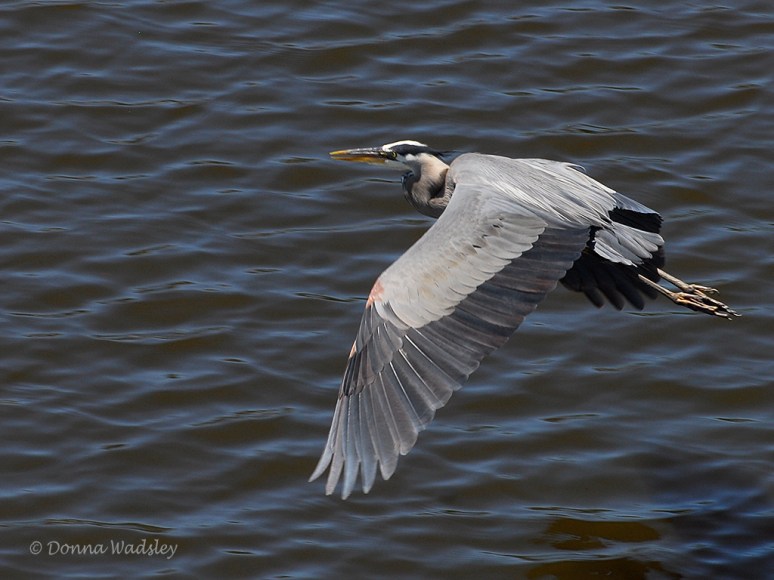
“Gorgeous Wings”
How nice to have a Great Blue Heron stop by the creek for a visit during these cold, January days!
The Great Blue Heron Stare
As the sun was setting, I spotted a Great Blue Heron hiding at Blackwater NWR.
He had already seen and locked eyes on me.

Great Blue Heron – “The Stare”
Those eyes! Sometimes their stare can be a bit intimidating…..
I can guarantee you he won the staring contest.
“Cassie” Canvasback’s Return
If you followed me last year, you may recall my posts (highlighted below) on a female Canvasback that I named “Cassie”. She had not migrated back to Canada last Spring, so I took a special interest in her and learned her left wing was damaged. Cassie wasn’t able to fly back home to breed.
She Is A Survivor (first post May 30, 2018)
Cassie hung around Cambridge Creek throughout the summer and was a delight and inspiration to me. I adored her, but as comes with getting attached, I worried about her survival too. Yet, she continued to prove she could take care of herself. Even if she could not fly, nor dive for food.
Cassie Canvasback – Remember Me? (second post August 2, 2018)
After the second post, I captured her a few more times. Here is one of the last photogenic shots of her back then hanging at our end of the creek.

“Cassie” Canvasback – August 10, 2018
I sighted her a few times after that, but it was at a distance down the creek. Those sightings became less and less. By the end of September, I didn’t see her any more. The wintering Canvasbacks weren’t due here until December. What had happened to her? I worried and continued to watch for her.
On the afternoon of December 21st, I stepped out on my balcony to check for wildlife on the creek. Lo and behold, there was a female Canvasback below me. Cassie was back and pretty as ever!

“Cassie” Canvasback – December 21, 2018
How did I know it was her? It’s as if she read my mind. Cassie flashed her wings for me shortly thereafter.

“Cassie” Canvasback (female)

Note damage to left wing
“Cassie” Canvasback See damage to her left wing in this photo?
I could tell many of her feathers had grown back on her left wing. How wonderful! Is she able to fly now? I don’t know that yet; I hope if she can, she will fly in or out of the creek one day to show me.
What about diving for food, can she do that now? She couldn’t before and had to forage piers, boats, and bulkheads for food.
Two days later, Cassie showed off her redeveloped diving skills. I was delighted for her!


Cassie showing me her diving skills
Did you miss that? Here, Cassie will do it again for you.


Cassie doing the dive
More from the past several weeks of beautiful “Cassie”.

“Reflecting Cassie”


Even ducks have itches!

“On the Move”

“Nap Time”

“Making Water Rings”
We iced over here at the top end of Cambridge Creek; and, of course, all the birds disappeared but the gulls. The ice has since melted, and I saw Cassie yesterday.
Even though hundreds of Canvasbacks are not too far from the creek’s entrance off the Choptank River, and maybe that is where Cassie has been “hiding”, how nice that she returned to Cambridge Creek that offered her a home to keep her healthy and safe as she healed through her wing injury the past year.
Welcome back, Cassie!