
Canada Geese Mating
Making a lot of splashing noise, I started watching and photographing a pair of Canada Geese.
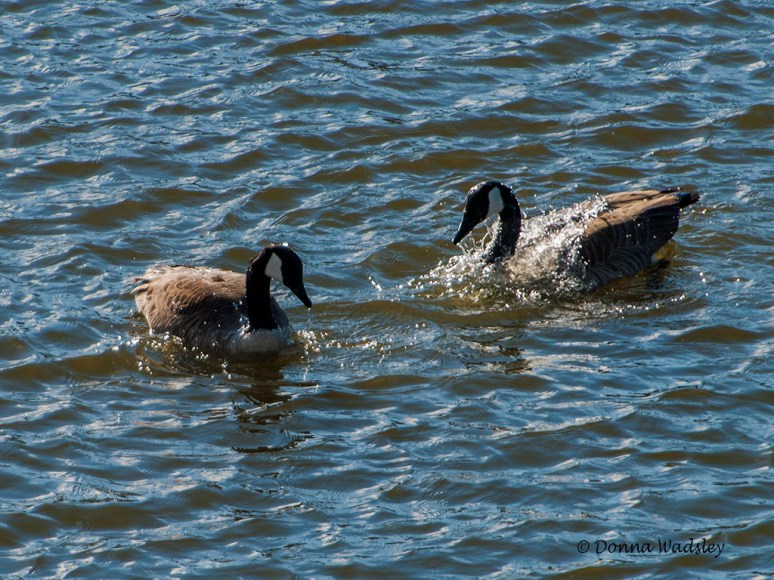
Canada Geese splashing
The splashing was a sign of mating.
And, sure enough, there was a heated moment.

Canada Geese mating
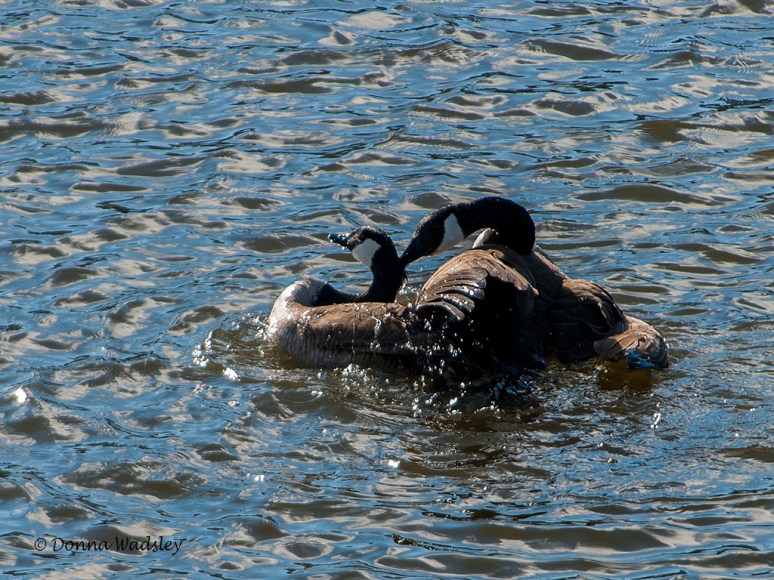
Canada Geese mating
And just as quick, it was over.

“Happy Ending”
Canada Geese mate for life and remain together year-round. What a beautiful commitment!
Blue Dasher & Muskrat Combo
While hanging around the boat docks with the Barn Swallows, I’ve also been trying my luck at the numerous dragonflies and damselflies that hunt the embankment.
Kudos to all you excellent insect photographers, these are not easy! Quite frankly, after a ton of takes over several days, I scored only two shots of the Blue Dasher dragonfly.

Blue Dasher “Smiling”

Blue Dasher
They were shot with a 70-200mm telephoto lens and 1.7 teleconverter combo from about 4-5 feet. I need to go back and work on these some more.
My “unusual combo” title also mentioned a Muskrat.
Yep, I had one come out from under the dock I was standing on while taking these dragonfly shots; it crossed the creek to swim alongside the bulkhead on the other side.
For over a month now, I’ve watched a muskrat going back and forth along the creek. I’ve finally gotten some great shots of him/her up close, with this one displaying a beautiful water-play of reflections.
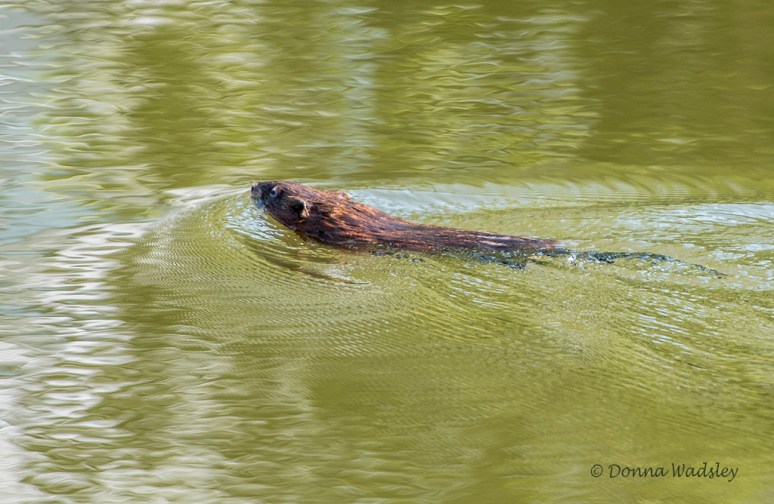
Muskrat
“Study nature, love nature, stay close to nature. It will never fail you.”
— Frank Lloyd Wright
Bella & Beau 2019: One, Two, Three – Cute As Can Be
Osprey nest location: Cambridge, Maryland, Chesapeake Bay Region, USA
June 9, 2019
A week has passed since the last update, and it’s exciting to report Chick #1 now has two siblings!

All three chicks lined up for a feeding
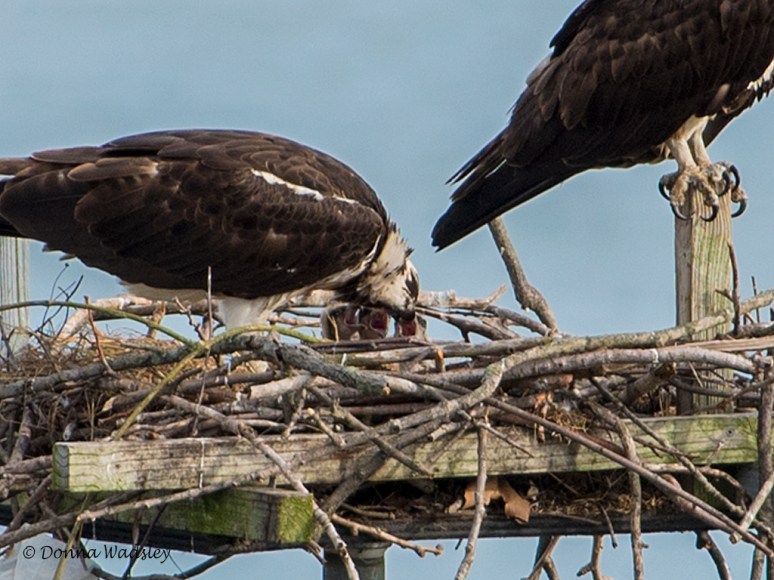
Three Hungry Chicks
Bella & Beau checking out their new chicks.

Beau (left) & Bella looking at their three chicks

Beau (left) & Bella looking at their three chicks

Beau (left) & Bella looking at their three chicks
Beau seems to give more looks of surprise, the looks are priceless.

Beau checking out the chicks.

The chicks amaze Beau.

“We had three???”
Since the hatchings, Bella has become the full-time incubator and chick feeder, only taking breaks to exercise or wash, before being back to the nest in a flash.
Beau always seems nervous and bewildered when she goes. He’ll glance at the chicks but keeps his eye on Bella the most. What is he supposed to do?

Beau keeping eye on Bella while he ‘babysits’.

“Come back, Bella!”
“Come back, Bella!”
I am most sure Beau would rather be fishing, right?! Of course, Beau now has to step up his game on quantity and size to feed Bella and three very hungry chicks.
Beau’s fish have indeed been been coming in bigger, and many with the head still attached. Beau will have to find his nourishment inbetween runs best he can.
This specific instance, Beau was enroute with a fish and had to chase an Osprey intruder away before delivering it to Bella. Talk about doing two things at once! Go, Beau!

Beau chasing an intruder with a fish in his talons.

Beau finally delivers the fish after successfully chasing the intruder away.
Another fish delivery….
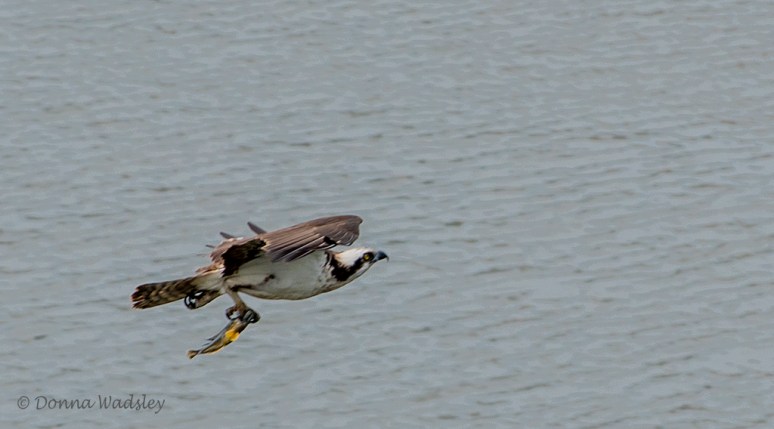

Beau landing with a fish and Bella taking it aggressively.

Beau landing with a fish and Bella taking it aggressively.

Beau landing with a fish and Bella taking it aggressively.

Beau landing with a fish and Bella taking it aggressively.

Beau landing with a fish and Bella taking it aggressively.

Beau landing with a fish and Bella taking it aggressively.

Beau landing with a fish and Bella taking it aggressively.

Beau landing with a fish and Bella taking it aggressively.

Poor Beau!
Beau delivering a fish and Bella aggressively taking it
Bella will feed herself first, hungrily devouring the head and gills. She then begins feeding the chicks the meatier portions in small bites.


Three mouths to feed


Feeding Time
Feedings easily last 20-30 minutes. Although Chick #1 is the biggest and most aggressive to grab the offered bites, Chick #2 is right in there alongside #1, getting his share. Chick #3 is hanging back, sometimes not even up and trying, letting the older ones get their fill first. But after a couple minutes, #3 tries to get in there for a bite. Bella is awesome, ensuring #3 is getting his share too! It can be very tough for the third chick to survive if food is scarce, even more so if any Osprey has four chicks.
After delivering, Beau gets out of the way, perching on the wood block until the feedings are done. His job is to keep his eye to the sky for any intruders, alarming when necessary.

Beau alarming a pair of Osprey intruders.

Beau got Bella’s attention to help watch the Osprey intruders.
Beau alarming an intruder
We still have numerous Osprey flying overhead often, agitating Bella and Beau to no end.

Osprey intruder harrassing Bella & Beau.

Osprey intruder harrassing Bella & Beau.

Osprey intruder harrassing Bella & Beau.

Osprey intruder harrassing Bella & Beau.

Bella & Beau watch the intruder move on.
Bella mantles over her chicks while she & Beau warn intruders
Beau would prefer to have a rest and scratch an itch, which always feels good.

Beau scratching an itch.

Beau scratching an itch.

“That feels better.”
Beau scratching an itch
While shooting the Barn Swallows around our marina, I can still see Bella & Beau’s nest, although it is at a distance farther than my balcony.
It was then an awesome photo-op moment occurred. From the marina docks, I watched Beau fly to the nest with a fish. Bella didn’t jump up like she always does, screaming and grabbing.
She just ignored him and stayed incubating.
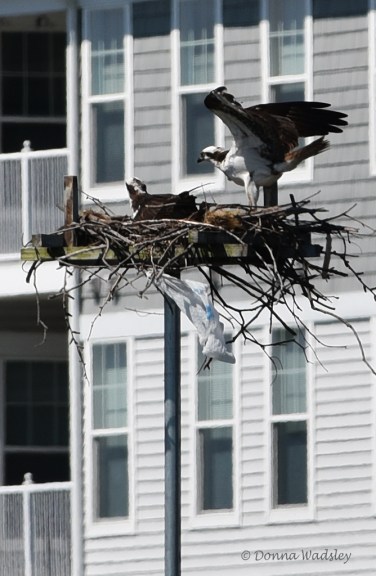
Bella ignoring Beau’s fish delivery
Bella must have told Beau to “Shhhhh…the babies are sleeping, go!”
I watched Beau take flight and fly directly towards and past me…..


Beau in flight with a fish
And then he landed atop a sailboat mast six boat slips from where I stood.

Beau preparing to land on a sailboat mast
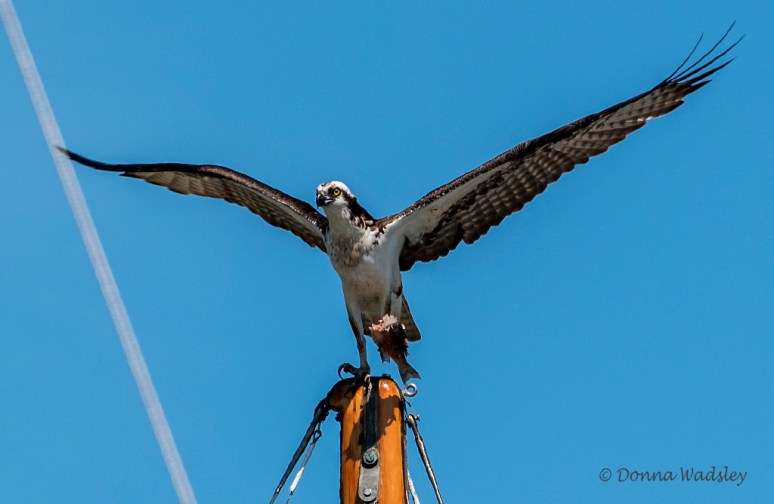
“Touchdown!”
He seemed to be worried with something or someone behind him that I couldn’t see.

And then just as quickly, Beau took flight again and flew off towards the water tower where I imagine he either ate the fish or waited with it for Bella to call when time.

Beau departing the sailboat mast
Talk about a right place, right time moment. It being Beau made it more special!
Starting today, we had and are due several days of rain showers. Wet Springs are detrimental to recently born Osprey. The female parent must try to keep them warm and dry best she can, and delay feedings if possible to not expose the fragile chicks to the extremes.
We’re sure Bella will do her absolute best during these rough times.
I’ll end with a comical series with Beau trying to help out with more nesting materials. Bella gave Beau some looks, she is known to prefer to arrange her nest herself.

Beau taking stick to nest.

Beau landing.

Beau arranging his stick.

Bella watching where Beau is putting it.

Bella’s thinking, no not there!

Bella ignores Beau, she’ll move it later. 🙂
And a shot of beautiful Mama Bella.
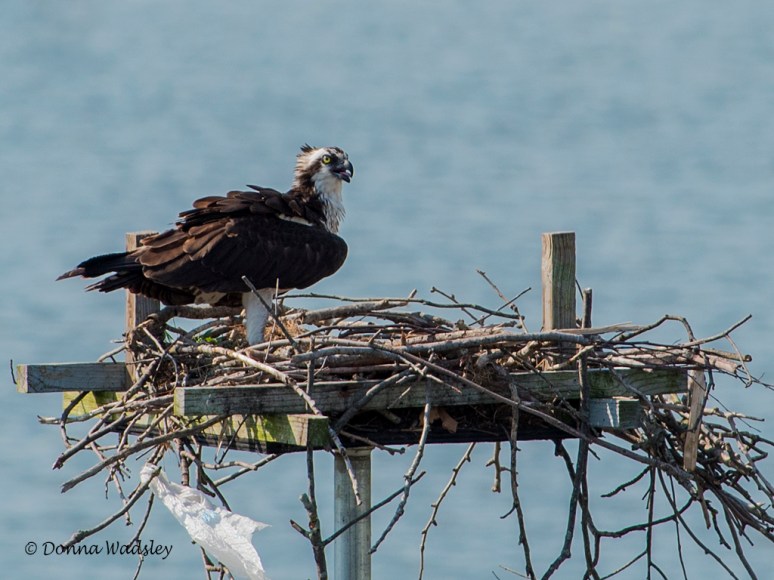
Bella taking a break on a warmer day, giving the chicks some fresh air.
Barn Swallows
With their aerial acrobatics, Barn Swallows are not easy to photograph, but I keep trying.
Fortunately, by our boat slip where they’re nesting underneath the docks, they will cooperate and pose nicely.
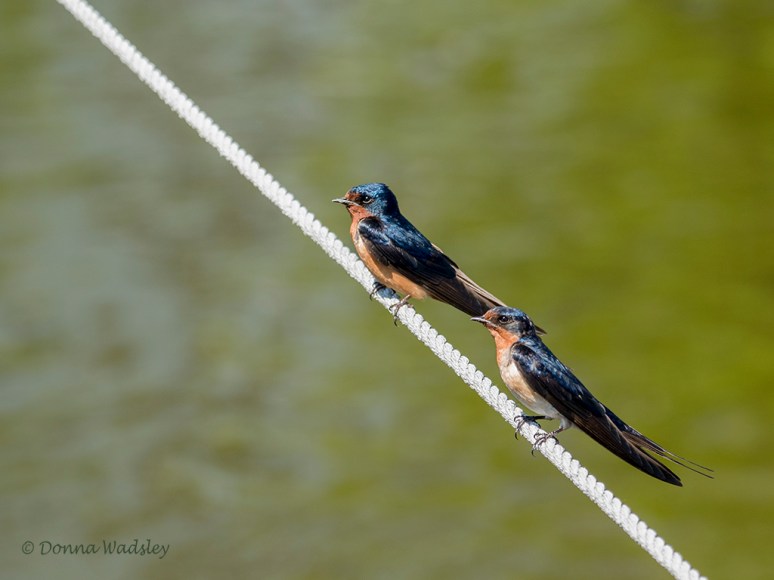
Barn Swallows
Sunny mornings and evenings, there are more photo ops than imaginable.
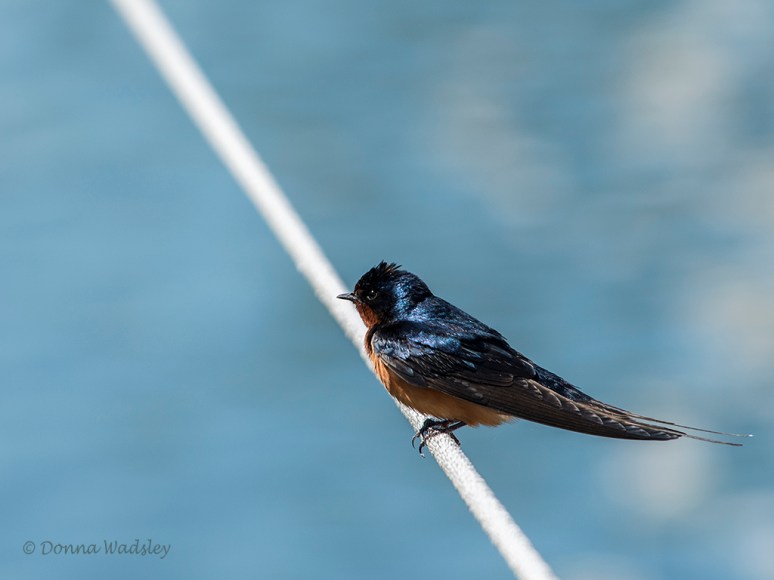
“Fluff-Up”
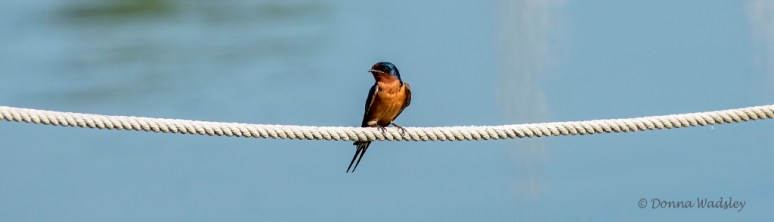
“Dock Line Swaying”
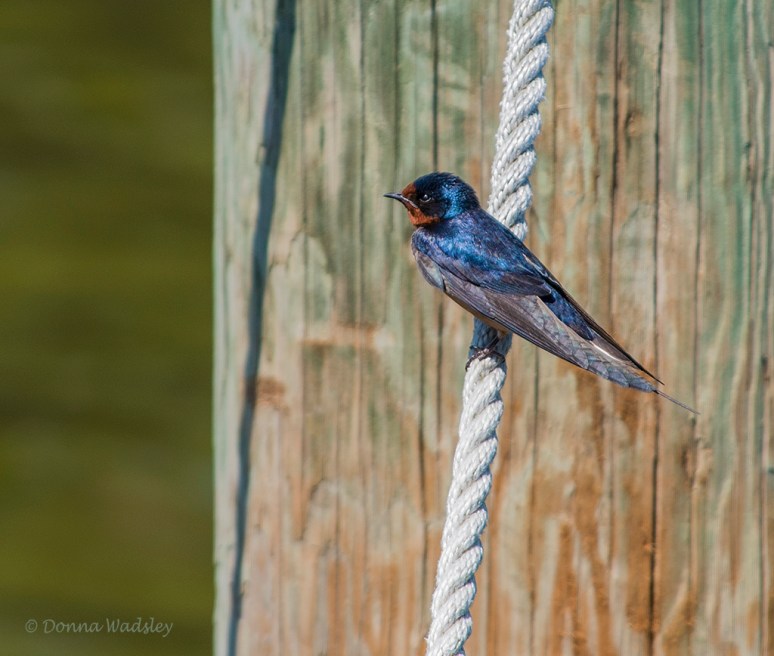
“Just Chillin’ in the Breeze”
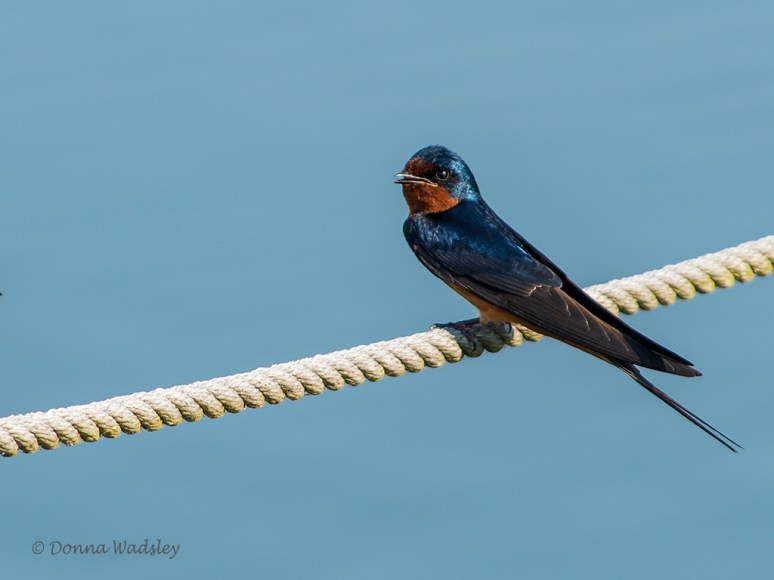
“Blue Beauty”
Cool Fact: Barn Swallows are the most widespread of all Swallow species — they’re found on every continent except Antarctica.
Sharps Island Lighthouse on the Chesapeake Bay
A switch up a bit from birds!
One of our recent boat outings was on a beautiful sky blue, fluffy cloud day. The winds were calm. That meant a great 20 mile boat-run out of the Choptank River to the Chesapeake Bay. Maybe we’d be lucky to see a huge ship passing by.
No huge ships sighted, but outside the Choptank River entrance sits Sharps Island Lighthouse.
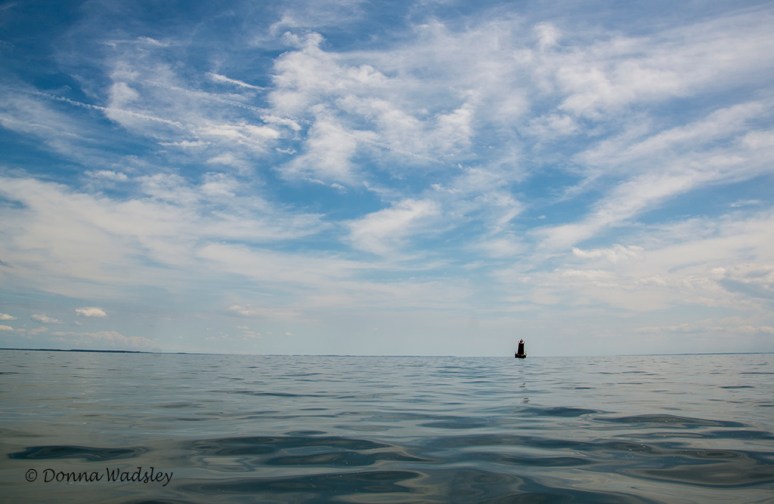
Sharps Island Lighthouse
Constructed in 1881, Sharps Island Lighthouse is a cast iron caisson structure filled with concrete, with a brick-lined cast iron tower built on top. It presently sits in ten feet of water.
This is the third lighthouse at this location. Sharps Island Lighthouse lost its last resident keepers in 1951, following automation of its light.
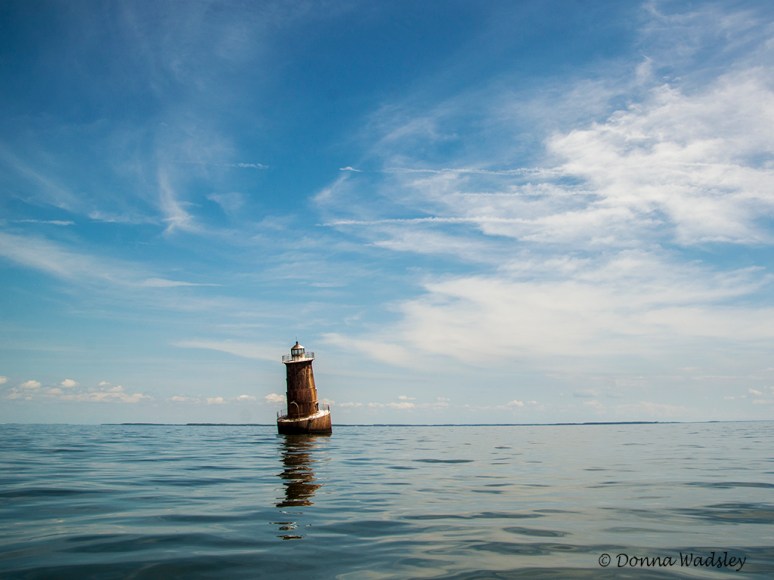
Sharps Island Lighthouse
Sharps Island Lighthouse got its characteristic tilt during the winter of 1976-7 when large ice flows, some piled as high as 40 feet, pushed against the tower and tipped it to the south at about a 15-20 degree angle.
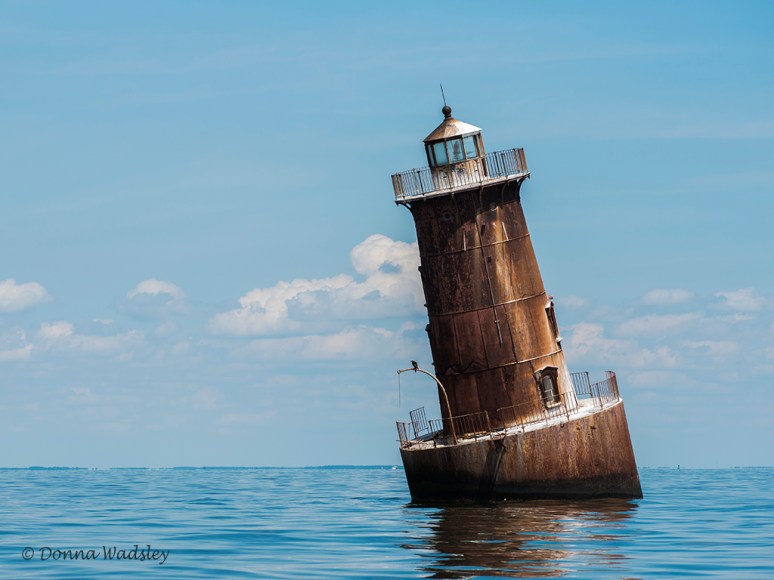
Sharps Island Lighthouse
Although fundamentally sound at the time, the Fresnel lens was still removed and replaced with a 250mm plastic beacon that flashed a white signal with a red sector.
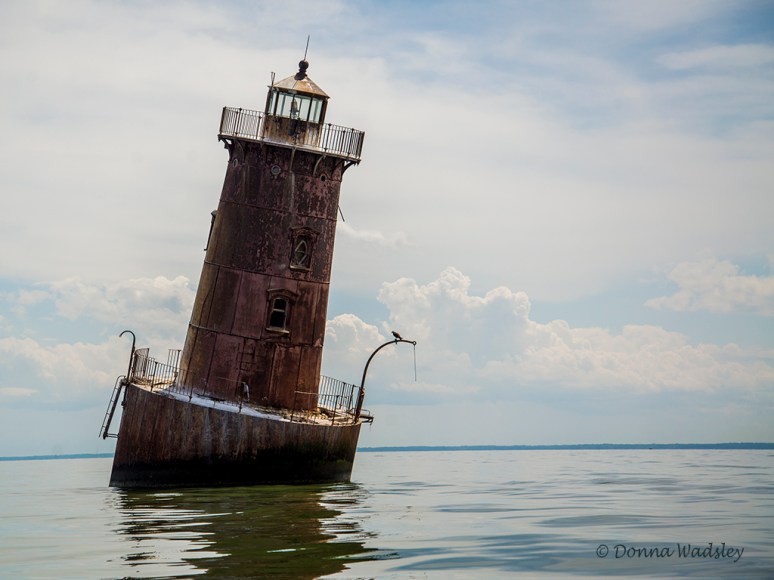
Sharps Island Lighthouse
Although still warning boaters & sailors of the dangerous shoals, Sharps Island Lighthouse began rapidly deteriorating with water damage and interior rot. It became more than what the Coast Guard and Maryland wanted to invest to renovate.
In 2006, Sharps Island Lighthouse was declared excess property and made available to federal & state agencies, non-profits, and historical preservation groups for free. However, no legitimate entity had an interest.
In 2008, Sharps Island Lighthouse was disposed through an online auction, noting that “the lighthouse was physically inaccessible, the iron plates in the caisson were cracked and corroding, and the wooden floor on the first level was unstable”. The terms of the sale gave the Coast Guard access to the structure, allowing them to continue maintaining it as an active aid to navigation.
The buyer from Delaware paid $80,000. Since their purchase, the buyer has done nothing to the lighthouse.
Declared in 2017 to now be too dangerous, the Coast Guard stopped maintaining the lighthouse and its light went out. Any efforts now to save it will cost the private owner an enormous amount of money. Today, Sharp’s Island Lighthouse remains on the Lighthouse Digest Doomsday List of Endangered Lighthouses. 😦
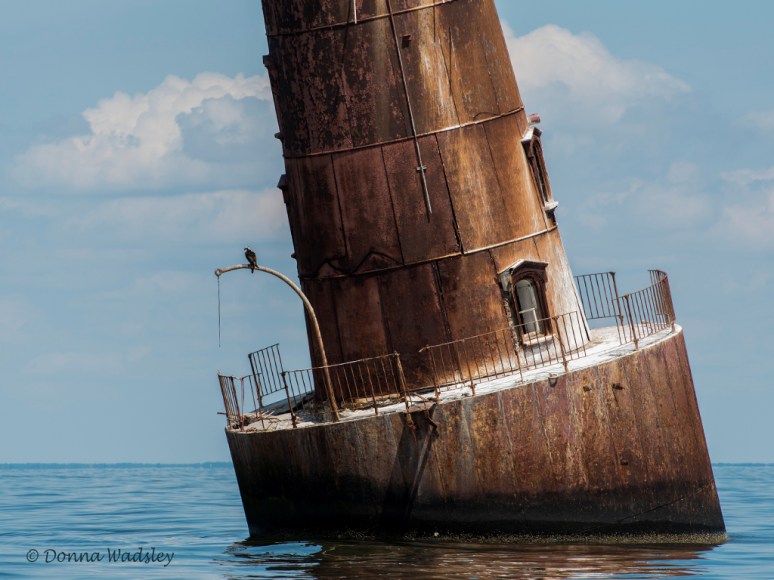
Sharps Island Lighthouse with a male Osprey on watch
Oh, did I say a post with no birds?? My bad!! 😉

Female Osprey on the other side of the lighthouse, incubating on their nest
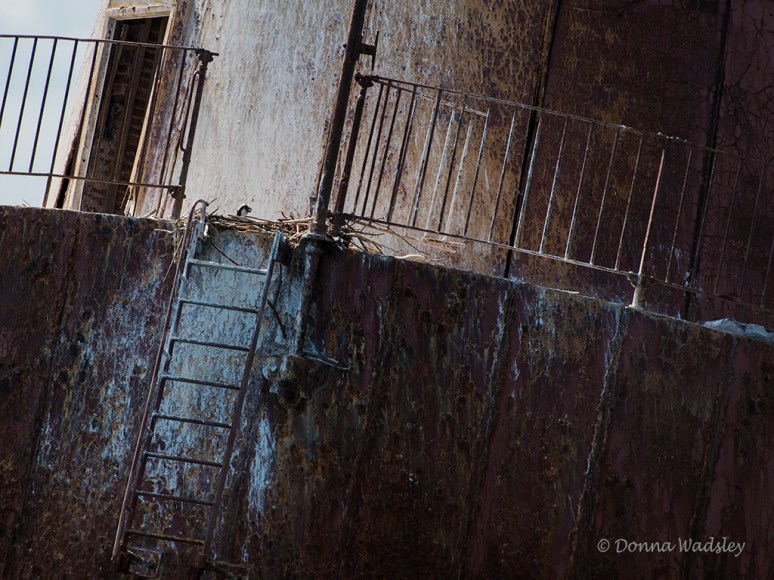
There’s the Mrs!
It is so nice of the private owner to provide this nice waterfront property for the Osprey this season!
Bella & Beau 2019: Welcome Little One
Osprey nest location: Cambridge, Maryland, Chesapeake Bay Region, USA
June 3, 2019
The past 1½ weeks seemed to have crawled along, waiting and watching for any signs of a hatchling. The storms in the U.S. mid-West kept rolling through our region with heavy rains, winds, and high temperatures exceeding normal.

Bella Incubating Her Egg(s)
Each passing day was a repeat of the previous day’s routine. Bella incubating for long stretches, then going flights to exercise or go perch to dine on a fish delivered by Beau, then maybe a bath or make a quick run to bring back more nesting material.

Bella in flight

Bella in flight

Bella in flight

Bella in flight

Bella in flight
Bella in flight

Bella taking a fish from Beau

Bella enroute to a perch to eat

This fish is NOT for you!

Bella taking flight with a fish delivery from Beau

Bella bringing in the big sticks

Bella with nesting materials

Bella delivering while Beau watches

Bella bringing softer materials for the nesting cup

Bella bringing softer materials for the nesting cup

Bella heading to the nest
Bella bringing nesting materials

“Bella, I’m trying to nap!”

Bella building ‘fences’ around the nest

Bella moving nesting cup materials
Bella working on the nest while Beau incubates and rests

Bella telling Beau his time is up

Bella landing while Beau naps

Beau smiles, “There’s my pretty Bella!”
Bella returning from a break
Beau has kept his duties up with fish deliveries for Bella, maintaining watch over her and the nest from either the platform or a near-by perch, as well as relieving Bella to incubate the eggs (and possibly get a little nap) while she’s on break.

Beau in flight

Beau in flight

Beau in flight

Beau in flight

Beau in flight

Beau in flight

Beau in flight

Beau in flight
Beau in flight

Bella & Beau watching an overhead intruder

Beau warning an intruder

Beau warning an intruder

Beau giving a defense stance at an intruder
Beau protecting Bella and their nest

Beau perched atop the sailboat on watch

Beau on watch, getting ready to be tapped by a bird not liking Beau’s presence

Beau on Cambridge water tower. Looks like a great shot for a commercial!
When not on the nest, Beau is nearby on watch over Bella and the nest
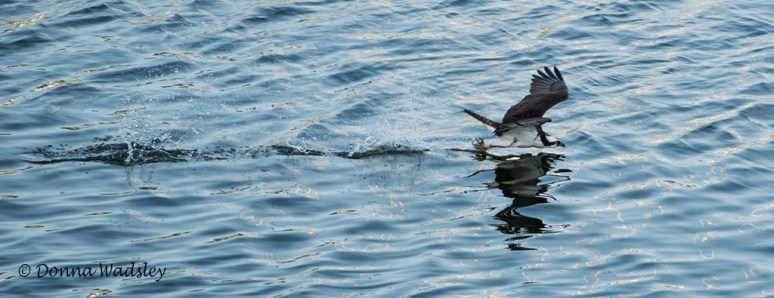


Beau skimming the water, cleaning his talons
Before I continue, I must share a photo of Bella & Beau that was to be in my last post but got misfiled. I kept looking for it because, not only was it an endearing shot, it was also the first time I photographed this behavior. Bella was incubating when Beau arrived to the nest. Beau climbed down next to Bella and cozied up along side her, and they incubated and rested together. I loved it!

Bella and Beau’s cozy, bonding moment
The day finally arrived. Early morning June 1st, I checked on the nest and saw Bella incubating, then up, then down. Two hours later, I spotted an eggshell off to the side of the nest cup.

Broken shell in front of Bella
Now things were different. Bella was moving a lot, up and down, peering into the nesting cup. Time to get busy.

Bella attending deep into the nest

“Beau! I need a fish”

Beau delivering fish

Beau incoming!
Beau delivering fish in just minutes
Bella ate a few good chunks of the fish and then moved with it more into the cup and began to feed. Beau is quite curious.

Beau checks out the hatchling

Beau can’t take his eyes off of the hatchling
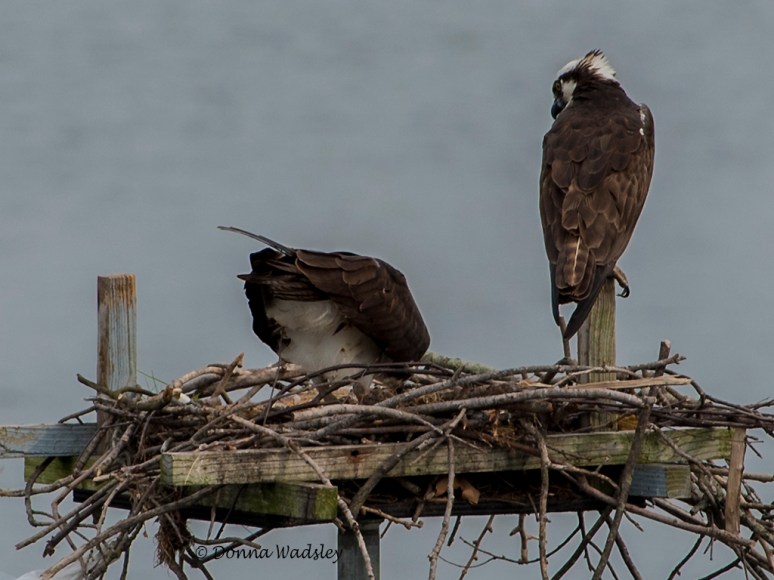
Curious Beau gets out of the way and watches the feeding
I started watching the nest with binoculars while Bella fed, trying to catch movement between the nest branches, and saw a passing head-bob. Later, I set up my camera and waited for the next feeding.
The little one appeared.

Bella and the new little one waiting as Beau lands with a meal

Little one waiting next to Mama for a feeding
I tried another photo session late today when I got a chance, got a couple more photos.

Baby Osprey looking up at Bella, waiting for another fish morsel

Same photo, showing chick in circle
Beau continues to be amazed

Hello World!
Bella & Beau have a hatchling. Will there be more?
While watching and photographing the feeding late today, I got this next best shot of a series, showing Bella giving attention to another ‘spot’ in the nesting cup, alongside Chick #1.

Bella attending to possibly Chick #2
After a very quick feeding, Bella settled back on the chick(s) and any remaining eggs.
Osprey usually lay 2-4 eggs; Bella herself produced at least 3 eggs last year. Hatching now of any remaining eggs will occur 1-3 days apart from the previous hatched one.
Once the hatching is complete, the growth of the chick(s) will be amazingly fast. So don’t be surprised with the chick photos in a couple weeks along with an official head count!
Double-crested Cormorants
Although Osprey pair, Bella & Beau, have a dislike for them fishing near their nest platform, the prehistoric-looking Double-crested Cormorants are very shy, calm water birds, and are no threat at all.
I’ve been very fortunate to have the opportunity to capture Double-crested Cormorants while they fish daily in our creek. Here are some of my favorites I’ve shot recently….
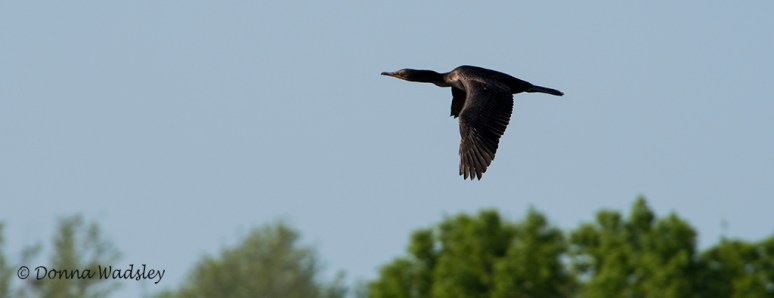
“Flying High”

“Sliding in on a Landing”

“Touch Down”

“Mirrored Waters”
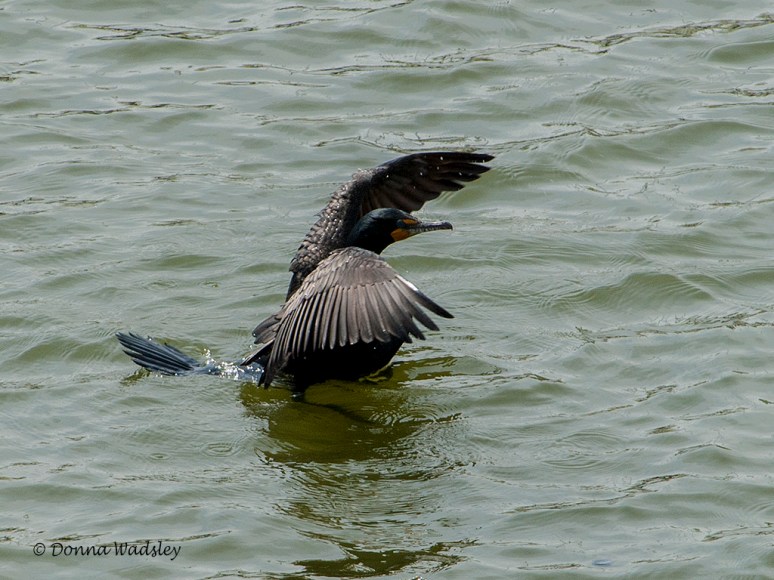
“Balancing Act”

“Fresh Meal”

“Gulp”

Gulp – Take 2″
“Dinner Time”

“Hopping Lift-Off”

“Almost Air Born”
One of the Cormorants that visits our creek often is banded on each leg, one with a silver band, the other with a yellow. The silver band is probably a federal band designating either the United States or Canada. The yellow band would be from a private group of banders.
Unfortunately, I cannot read either of the bands in any of my photos, but here’s a couple to show this Cormorant’s ‘ankle bracelets’. Hopefully, it’s a gal, right? 😉
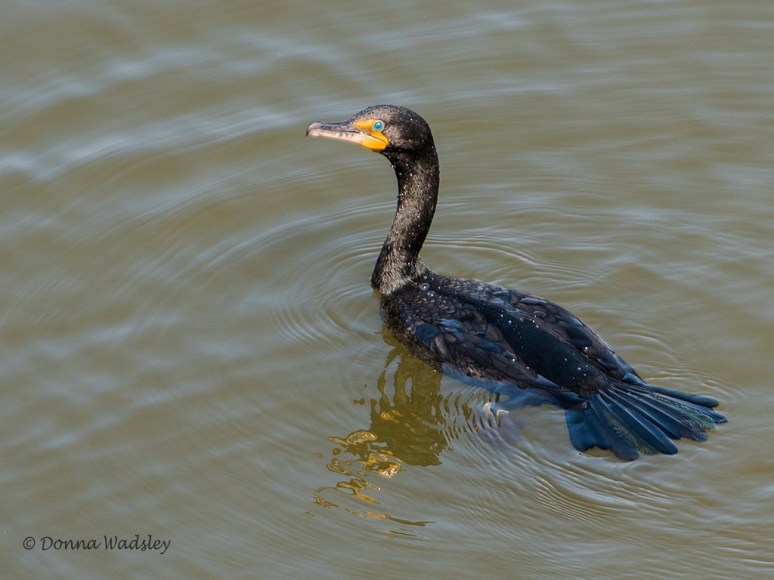
Double-crested Cormorant with a silver band on it’s left leg

Double-crested Cormorant with a silver band on it’s left leg
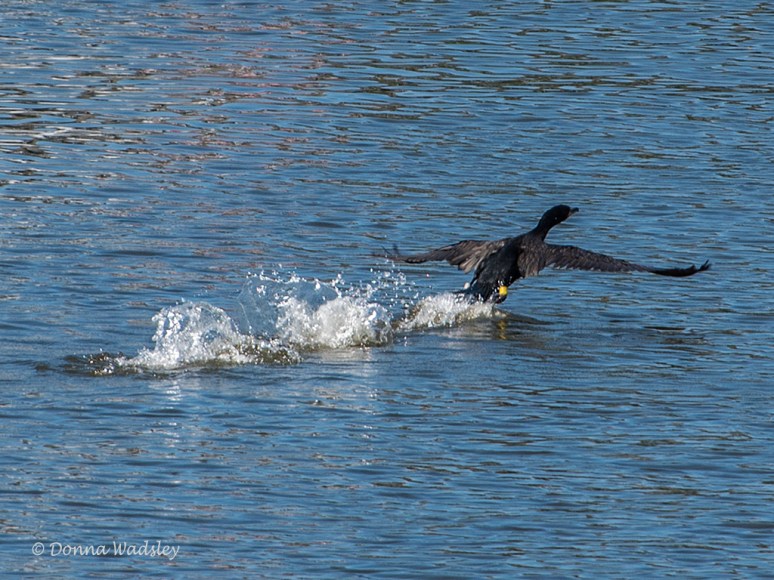
Banded – silver on left leg, yellow on right leg
It’s been pretty cool to see him/her return often. I wish I could read the bands to know where it’s from!
I’ve tried numerous times to capture the small double crest of stringy black feathers that appear on each side of the Double-crested Cormorant’s head during breeding season, the reason for this bird’s name. Here’s an attempt to show you.

“Double Crest Feathers”
Finally, here’s an up-close-and-personal instance just a few days ago with an immature who popped up fishing alongside us while we sat quietly on our boat in our marina. It was a moment of surprise for each of us for sure.
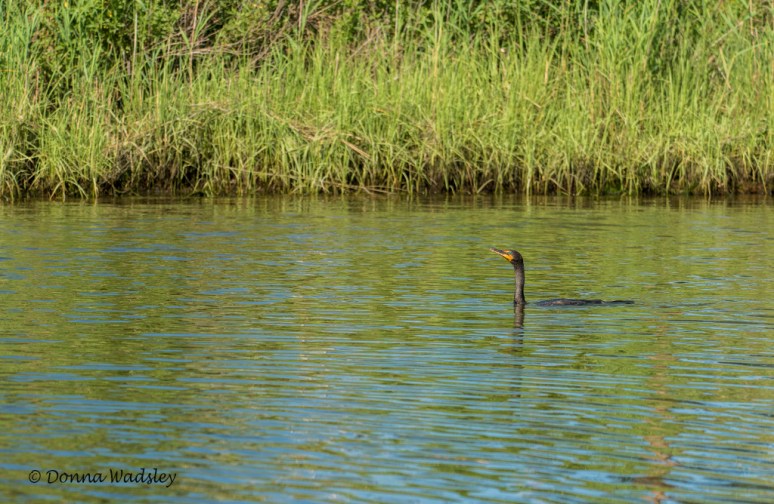
Immature Double-crested Cormorant

Immature Double-crested Cormorant

Immature Double-crested Cormorant

Immature Double-crested Cormorant
I was rewarded well and very thankful with that two-minute photo-op moment. 🙂
An American Robin Family
In a previous post back in March, I shared the return of our American Robins, who had a song to sing in the tree outside our bedroom window any time from 3:00 a.m. until after sunrise.
At that time, I had also noticed in another tree directly below my balcony a nest from last year’s season.

Nest from last year (taken 3/30/19)
It was a few weeks later, I thought about that nest again and looked down to find it was undergoing a tidy renovation.
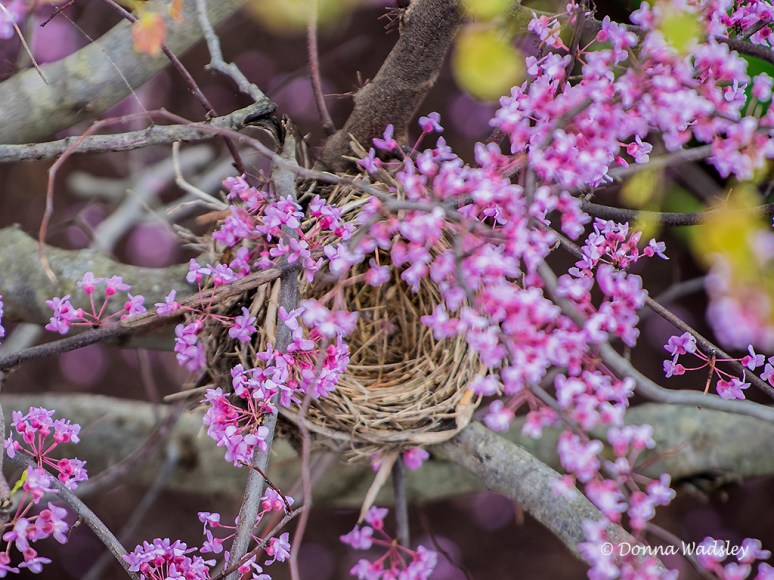
Nest Under Renovation – 4/19/19
So that’s what those Robins were doing.
Their short-story in photos.
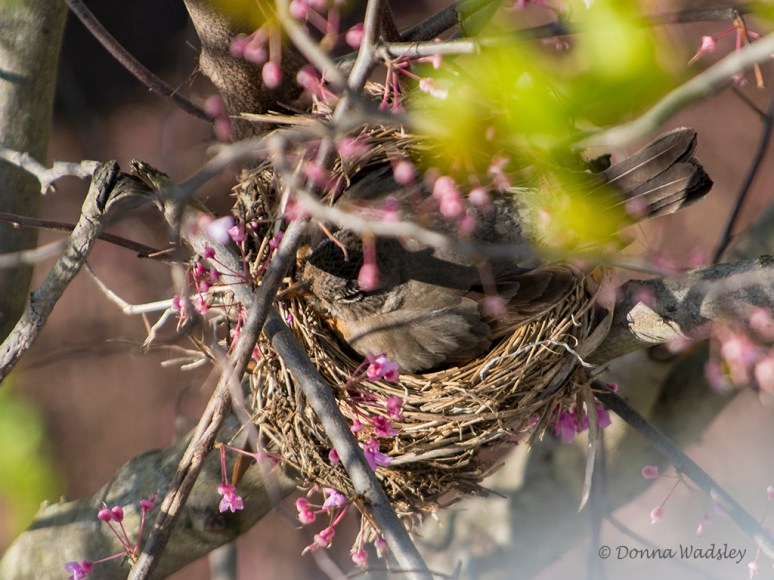
Incubation Time – 4/27/19

Beautiful Eggs – 4/30/19
As the tree leaves began to fill out, I could no longer see the nest. It took breezy conditions to blow the leaves/branches out of the way enough for me to get the rest of these nest shots.
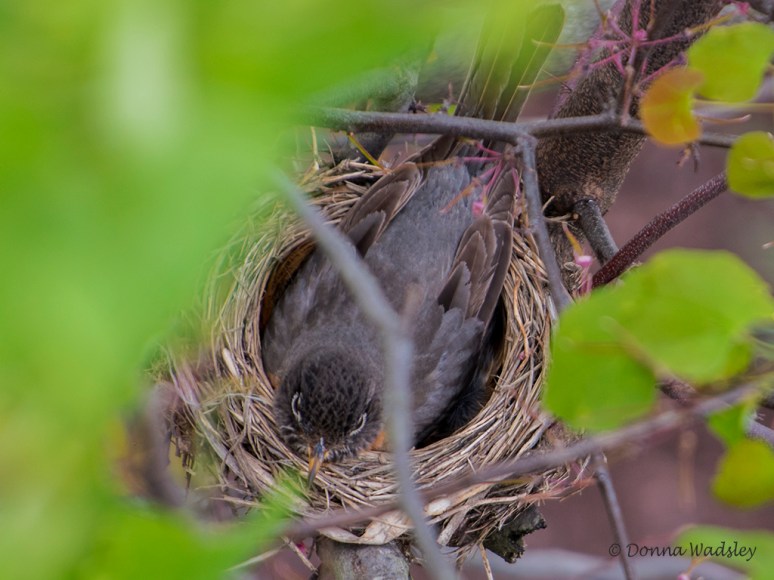
Keeping Those Eggs Warm – 5/4/19

Parent On Watch – 5/6/19
And then I saw a clue…..
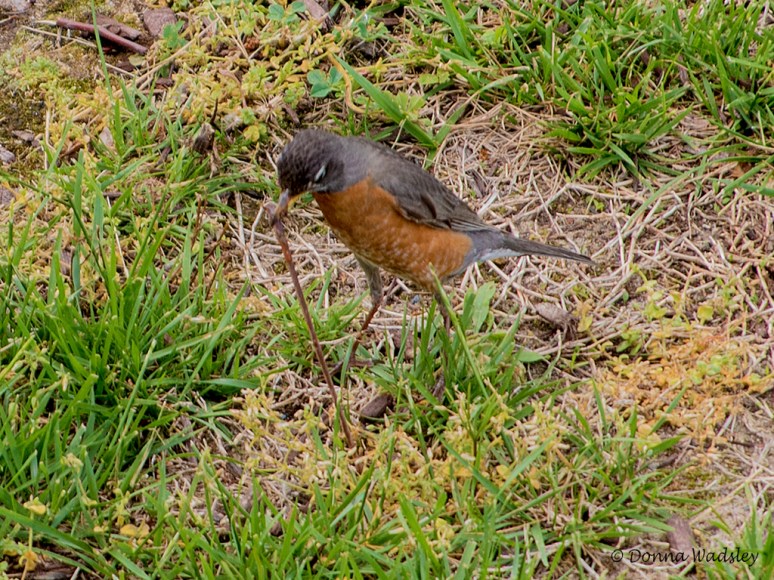
Worm Tug of War – 5/9/19

Hanging Onto The Wiggle – 5/9/19

“This is not enough, is it?” – 5/9/19
I was elated with the day’s breezy conditions to try and actually capture these next shots.

Four Newborns – 5/9/19

Hungry – 5/9/19
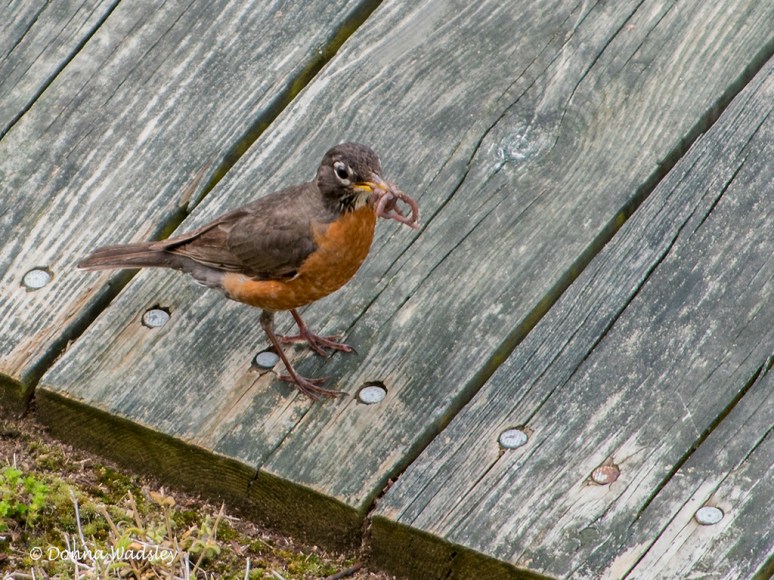
Continuous Gathering of Worms – 5/10/19
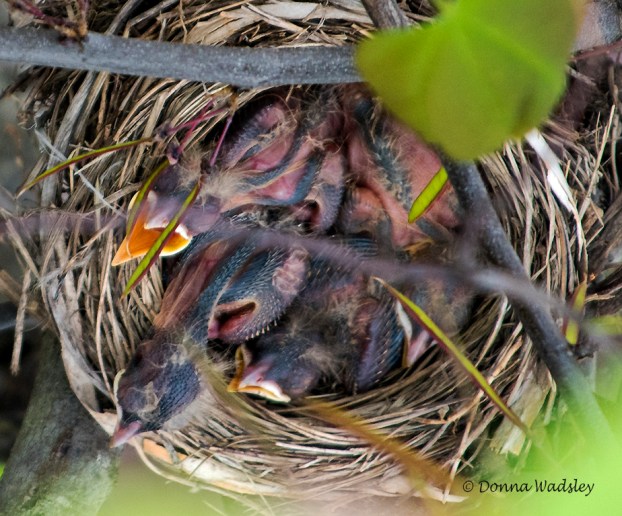
Pile ‘0 Robins – 5/10/19

Hungry Mouths – 5/10/19
After those last two days, the winds died down and I was never able to see down in the nest again.
But I could hear them. And I watched the parents stay busy.

On Watch – 5/17/19

Lots of Mouths to Feed – 5/18/19

Here’s the nest about six feet high off ground level – 5/20/19

Nest – 5/20/19
I eventually knew the Robins had fledged but could never spot them hiding in the flowerbed.
A few evenings ago, an hour before sunset, I heard a little one begging quite loudly, so I looked for him.
There he was….

Alone – 5/24/19
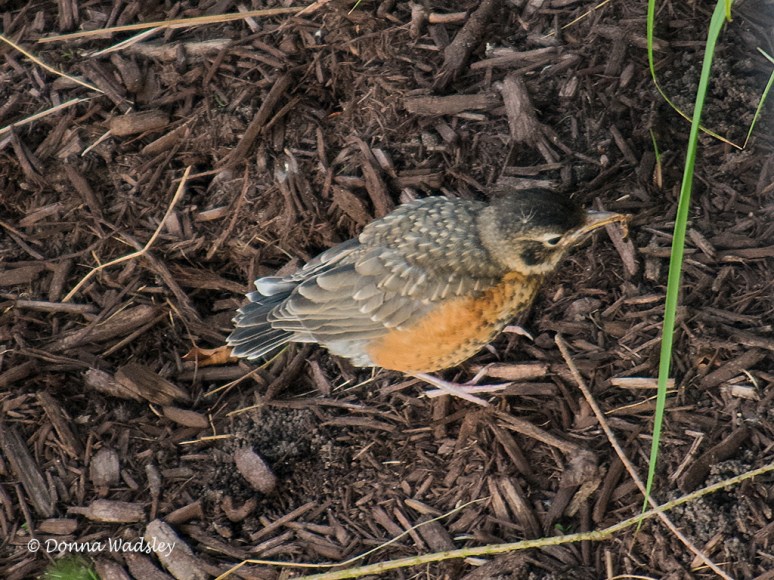
Between 2-3 weeks old – 5/24/19

“Doesn’t Anyone Hear Me???” – 5/24/19

“Cutie Pie” – 5/24/19
He suddenly hopped quickly out of sight to an incoming parent. Food!
I can still hear a chirp-chirp on occasion but haven’t seen the babies since, most likely they are learning to fly short spurts and increasing that skill each day now.
The parents are still around, keeping a watchful eye.

Parent On Guard – 5/26/19
American Robins can successful lay 1-4 broods a year.
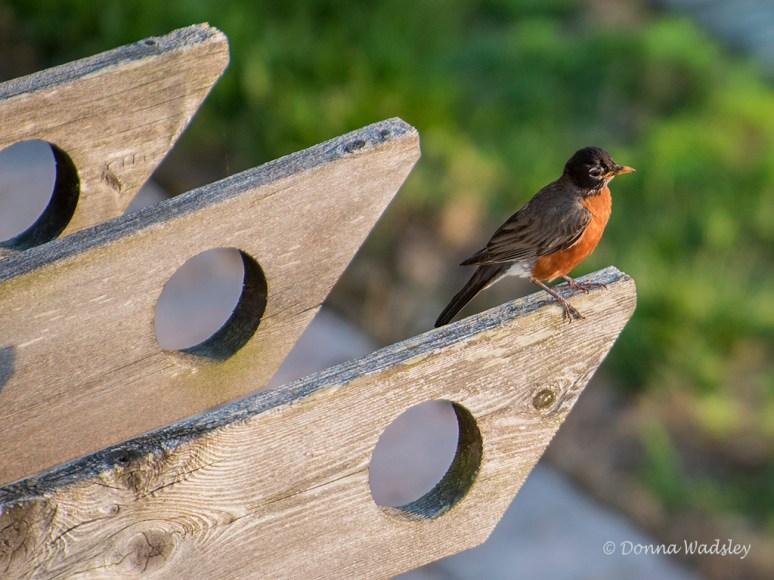
Parent at Sunset – 5/27/19
“Get ready for Round 2….”

“What???” – 5/27/19
Flight Delights
Hanging out on my balcony watching Osprey pair, Bella & Beau, is never boring. There is always something to practice shooting.
Many of you know, I love the challenge of flight. Guarantee, if it’s flying by, I’m going to try and capture it.
Hang on, we’re going flying!

Mallard

Great Blue Heron

Double-crested Cormorant

Barn Swallow

Canada Goose

Great Blue Heron
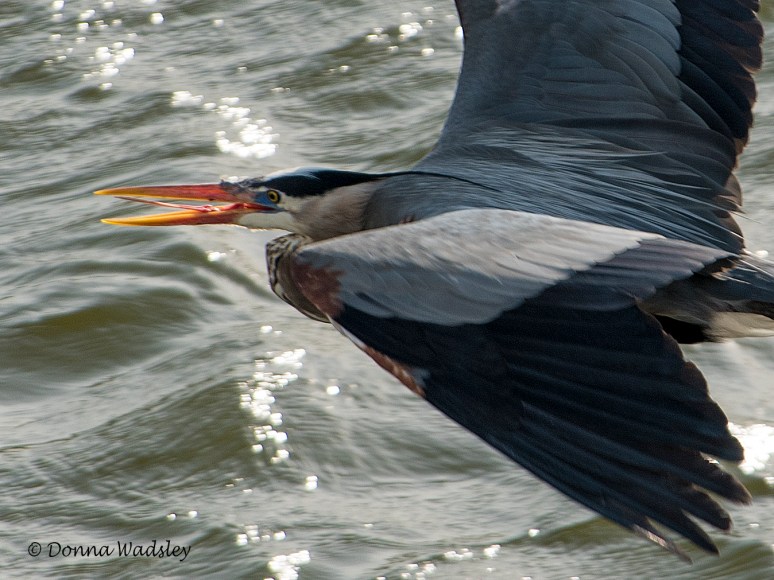
Great Blue Heron Close-up
(check out his tongue!)

Laughing Gull

Barn Swallow

Barn Swallow
Barn Swallow swooping down to snatch something from the water
Yes, I’ll practice on anything in flight….

F-16 Fighting Falcon screaming pass (oops, not a bird!)

Canada Geese
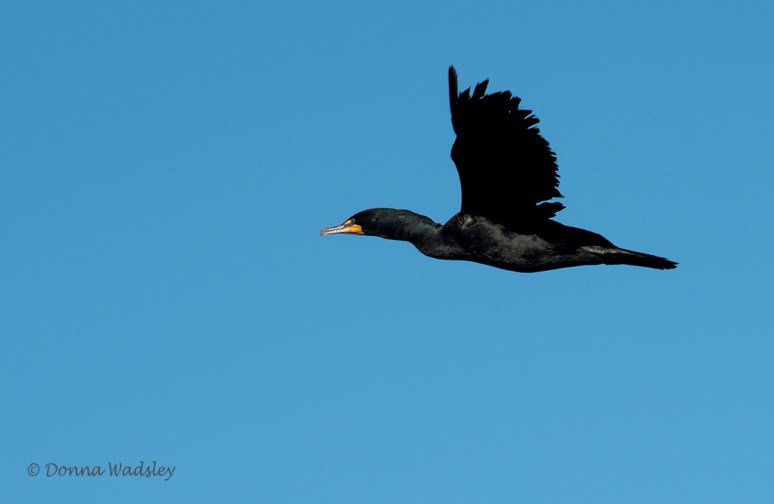
Double-crested Cormorant

Barn Swallow

Barn Swallow
Barn Swallows

Great Blue Heron
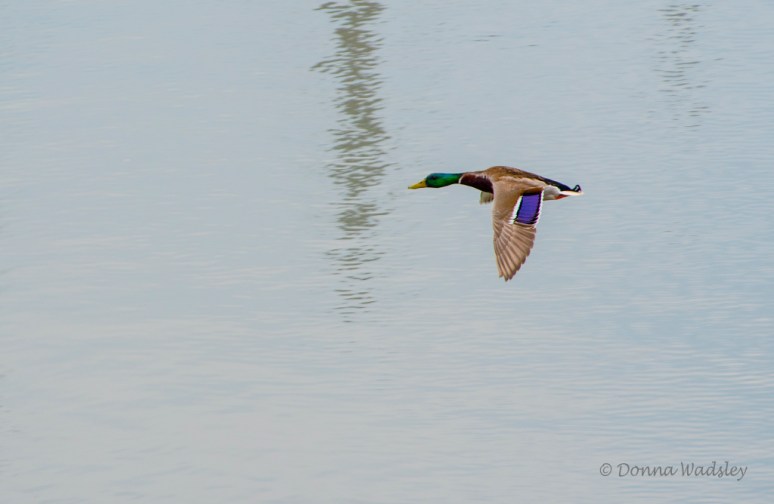
Mallard

Wasp (to be silly)

Green Heron

Double-crested Cormorant

Great Blue Heron

Our home is reflecting.

Our home is reflecting.

Three boats in the marina in front of our home.
Bubbles
(click to enlarge for reflections)

Great Blue Heron

Great Blue Heron
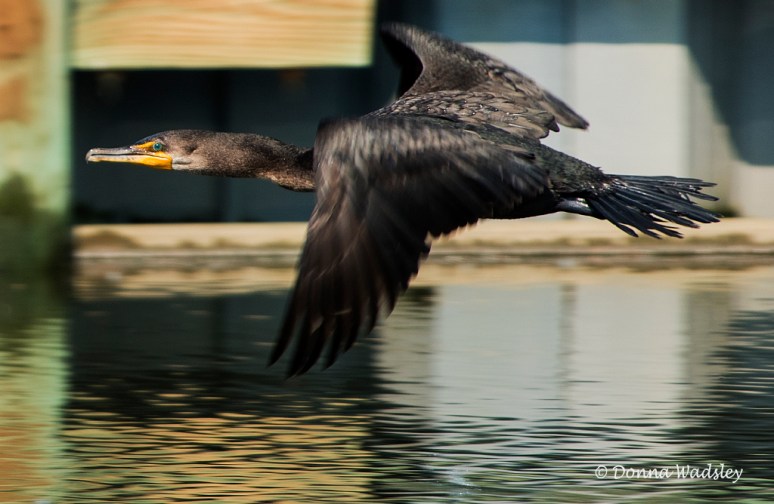
Double-crested Cormorant
“Such a delight to the day to enjoy birds on the way.”
~ author unknown
Bella & Beau 2019: The Wait Is Almost Over
Osprey nest location: Cambridge, Maryland, Chesapeake Bay Region, USA
May 23, 2019
It’s been a quiet past couple weeks for the most part for Bella and Beau. Incubating and protecting their precious egg(s) is top priority 24/7.

Expecting Parents Bella & Beau
The long wait is exhausting. Naps continue to be taken when possible.

Catching a nap

Nap Time
Beau still needs to be urged at times by Bella to give up his incubating/nap time. When he won’t get up, Bella gets louder and louder until he does.

Bella telling Beau his nap time is up.
In this instance, it took Bella 12 minutes of hollering to get Beau up.
So off Beau will go, to do what Bella asked, either go fishing or gather more nesting materials or even just off to perch on a nearby sailboat to watch over Bella and their nest.
I think we all know by now Bella rules the roost.


Beau in flight, on missions for Bella

Sunset Dinner for Bella

Beau arriving with a fish for Bella

Bella is quick to ‘grab & go’

In mid-flight, Bella maneuvers the fish from her beak to her talons for a secure hold.
(Look at those sharp talons!)
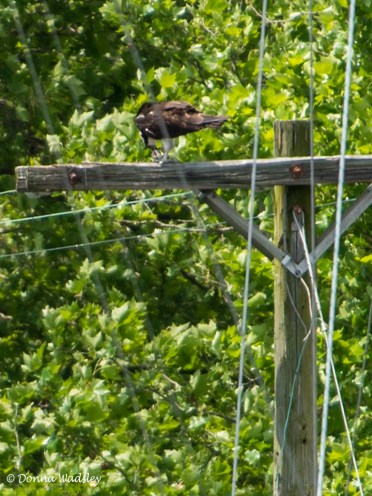
Bella’s favorite place to dine across the creek
Most times, the male Osprey will eat the head of a caught fish before delivering it to the female, a refueling snack for him while he does his chores.
I imagine Bella wasn’t too pleased with the size of her meal Beau delivered in the next photos. Beau must have been so hungry, he forgot to stop at the head, delivering just the end of the fish’s tail to Bella.

Bella with a fish-tail meal

Bella passing by with her fish-tail meal

Bella perching to eat her fish
Bella enroute to her perch with her fish-tail meal where she devoured it in just a few bites
With Bella doing most of the incubating, the rainy days can make a mess of her and the nest. Hygiene is important, so baths are necessary. After eating and a flight, sometimes Bella will take a splish-splash creek bath! (click on the first image to go through the series)


Bella taking a bath


Bella’s splish-splash creek bath
Doesn’t it look like she’s enjoying it? Here she goes again, this time a quick one.


Bella taking a bath
Bella’s baths sure look refreshing!

Bella in flight
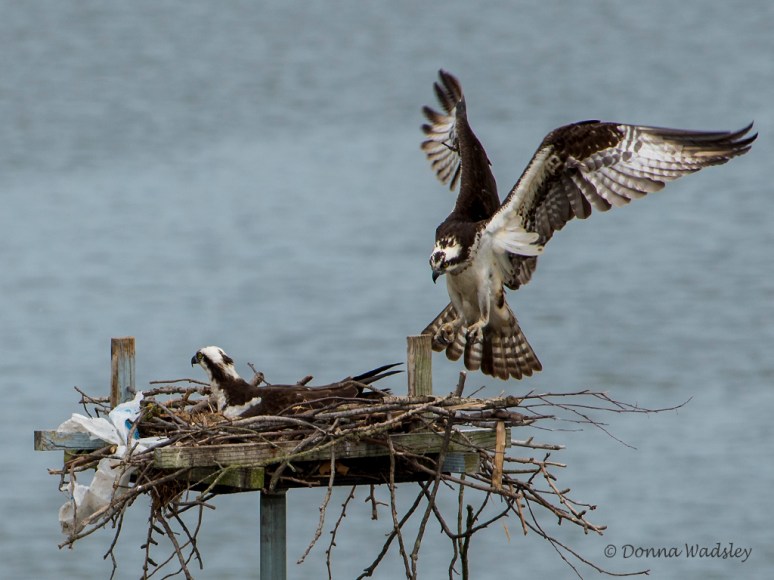
Bella returning to the nest

Bella’s beautiful wingspan
The Double-breasted Cormorants continue to visit daily to fish on Cambridge Creek. Bella & Beau’s scare attacks do not deter the Cormorants from returning. It’s almost like a game of ‘cat and mouse’.

Double-breasted Cormorant keeping an eye on Bella & Beau

The Cormorant dives as Beau closes in on an attack
Double-breasted Cormorant and Beau playing ‘cat & mouse’
It is easy to tell when there’s an intruder passing over in the sky. Bella & Beau’s alarms are distinct and loud, giving out the threat that says you’re not welcomed here.
(Osprey audio courtesy of Audubon.org)
Yesterday, Bella was alone on the nest and got incredibly loud, so I went out to investigate.
Sure enough an Osprey intruder was circling overhead. And Beau wasn’t anywhere to be seen. Bella was on her own.
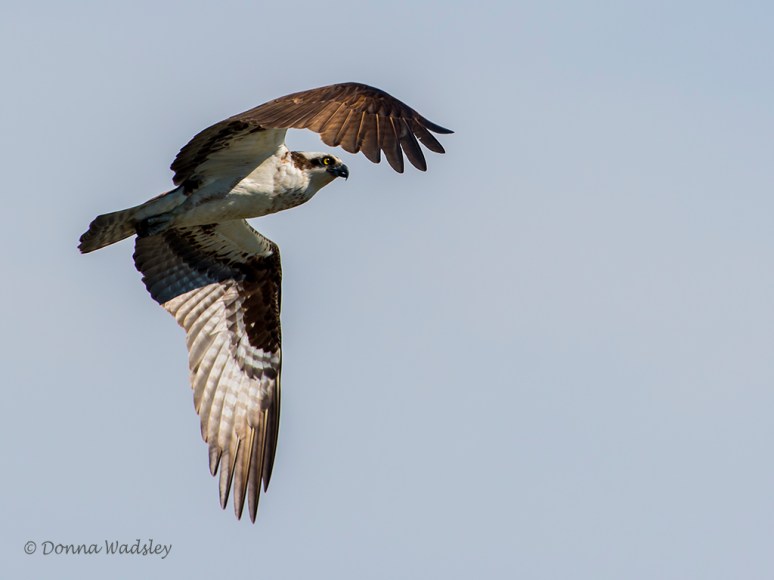
Osprey Intruder
After another circling, the Osprey intruder started dropping down towards Bella. Bella screams hysterically.
(Osprey audio courtesy of Audubon.org)
The Osprey intruder did not appear to be attacking in as much as just wanting to land on the nest. Bella was not having it.
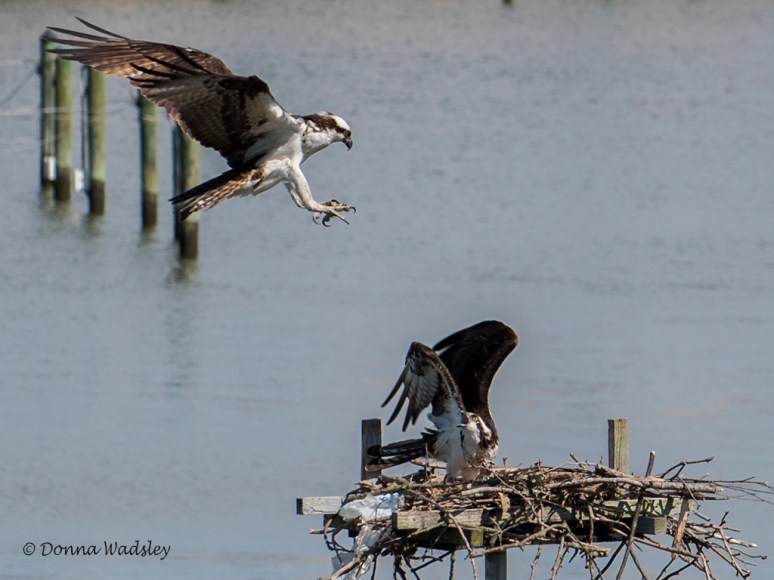
Bella in full-alarm mode as the Osprey intruder prepares to land
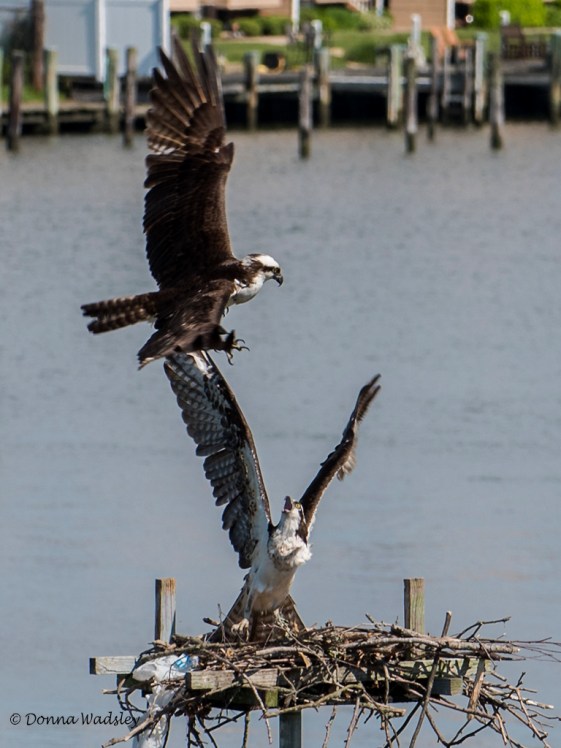
Bella prevents the landing.

Osprey intruder aborts and keeps going.

Bella keeps her stance as the Osprey intruder flies off. Out of nowhere, Beau swooped in, with a fish in his talons, and chased the intruder off for good.
Except for those few exceptions, Bella and Beau seem to be very tolerant of all else, including humans and the daily boats that pass by, even those big ones. Bella & Beau always have front row seats to the entertainment.

Maryland DNR’s “John C. Widener” stationed in Annapolis

Maryland DNR’s “Big Lou” stationed on Cambridge Creek

Local Watermen

Sailboat hailing from Australia

“Dorothy Megan” Paddle Boat Tour
Just a sampling of the big boats that passed by Bella & Beau this past two weeks
I find it amusing that the people on the ‘touring’ boats who are pointing at and taking photos of Bella & Beau have no idea of Bella & Beau’s ‘fame’ on the internet. 😊
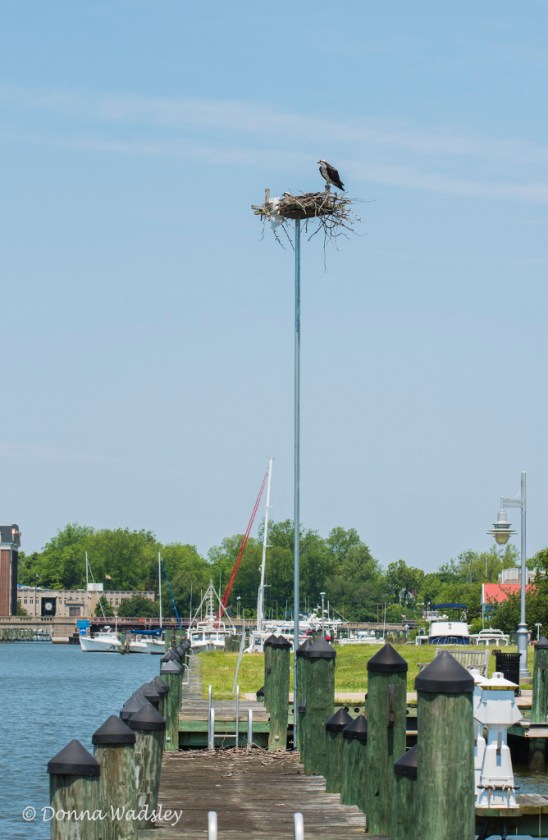
Bella & Beau’s Happy Home
Bella & Beau are now in the final stretch of their wait. Their precious egg(s) are due to hatch around May 25th to June 1st.

Bella taking a break on a recent very warm Spring day (we passed her by on our boat)

Beautiful Momma Bella
Fingers crossed with high hopes for successful hatchlings, Bella & Beau!

Bella settled in for the evening

 Bay Photos by Donna