
Burrowing Owl ‘Love’
Last week I attempted another drive-by on some of the Burrowing Owl locations on Marco Island in hopes of seeing one again, maybe catch a glimpse of a chick. One chick has already been seen by another!
At one location, a lone male owl was sitting at a burrow entrance. Well outside their respected area, I was putting the sun behind me to take a shot, when the female emerged from a separate burrow in their compound.
As soon as she popped out, the male flew over and landed alongside her. You can see the sand still kicked up in the first photo of him landing on the left.
With a quick “Hey Sweetheart” look, the male attempted to mate with her. She certainly didn’t look too pleased, did she?
(click on the first photo to run through the full series)

Burrowing Owl “Love”

Burrowing Owl “Love”

Burrowing Owl “Love”

Burrowing Owl “Love”

Burrowing Owl “Love”

Burrowing Owl “Love”

Burrowing Owl “Love”

Burrowing Owl “Love”

Burrowing Owl “Love”
Burrowing Owl “Love”
Maybe it wasn’t so successful this try, but didn’t he give her a little head nuzzling during? It looked like it to me! Awwww…….
While the male stood guard, the female immediately went to kicking sand out of their burrow.
Series: Take A Moment and Enjoy A Sunset
The beauty of a sunset is a promise of a new tomorrow.
Let us hope and pray as each of our days progress, our tomorrows get better and brighter.
For sure, one day they will.

Sunset over Barron River, Everglades City
“When your world moves too fast and you lose yourself in the chaos, introduce yourself to each color of the sunset.” – Christy Ann Martine
Please take time to venture outside with your loved one(s) during your evenings and catch one of your sunsets. You will be happy you did, I promise!
Roseate Spoonbills in Flight
My last post shared Roseate Spoonbills foraging in the 10,000 Islands NWR. After working the shallow water area from one end to the other, those Rosies took flight.
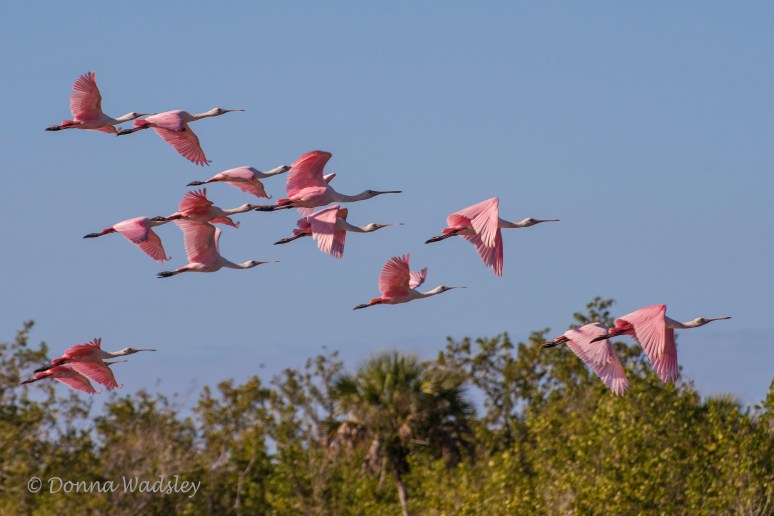
Roseate Spoonbills in flight

Roseate Spoonbills in flight
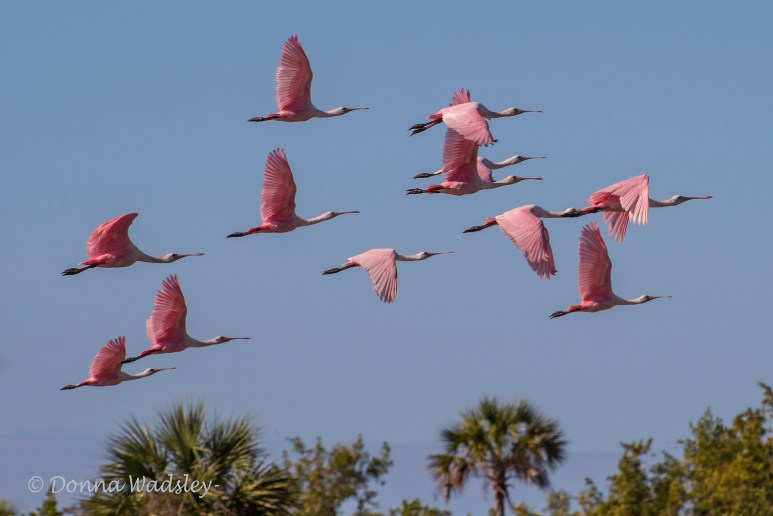
Roseate Spoonbills in flight
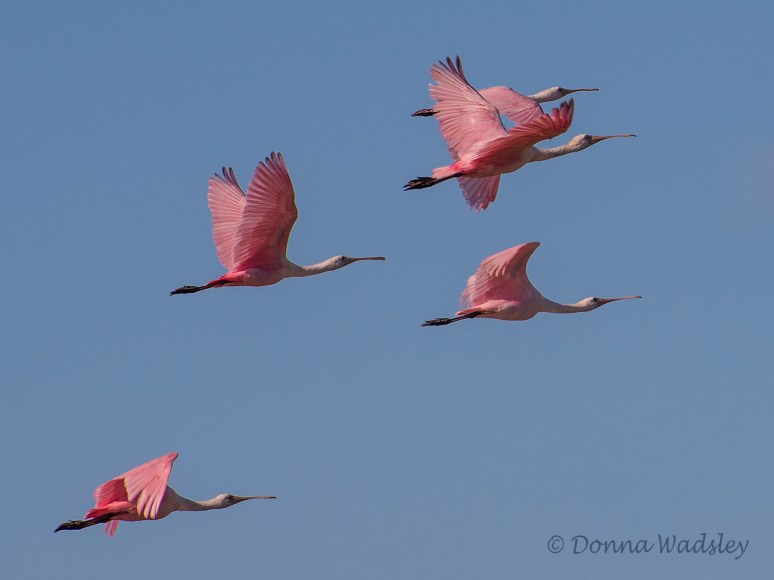
Roseate Spoonbills in flight
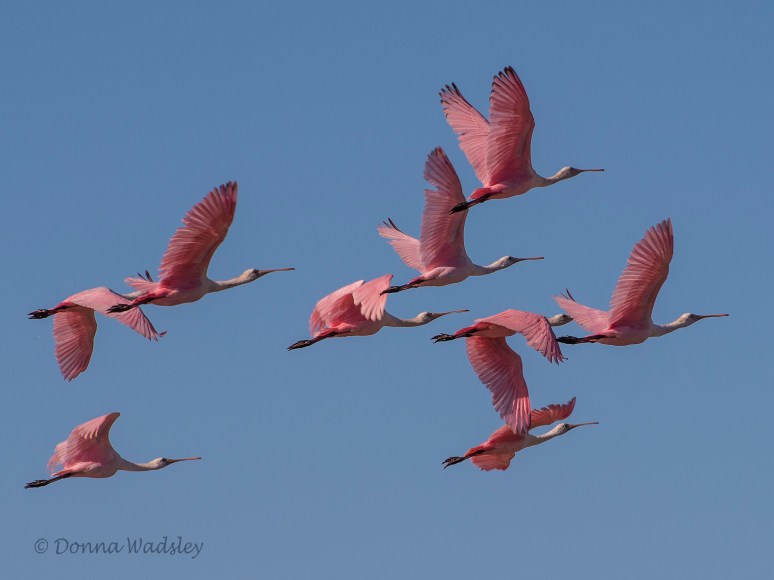
Roseate Spoonbills in flight
What a sight to behold! One I’ll long remember…..
Roseate Spoonbills Foraging
Thank you, Patty, for seeing them and telling Carol; and thank you, Carol, who then told me about the Roseate Spoonbills who were about 20 minutes away. I was out the door and in my car in 10 minutes!
There’s just something about Roseate Spoonbills that we all go ‘gaga’ over.

“You mean us?”
So let’s go gaga over these pink-a-licious beauties!

Bowl of Roseate Spoonbills foraging
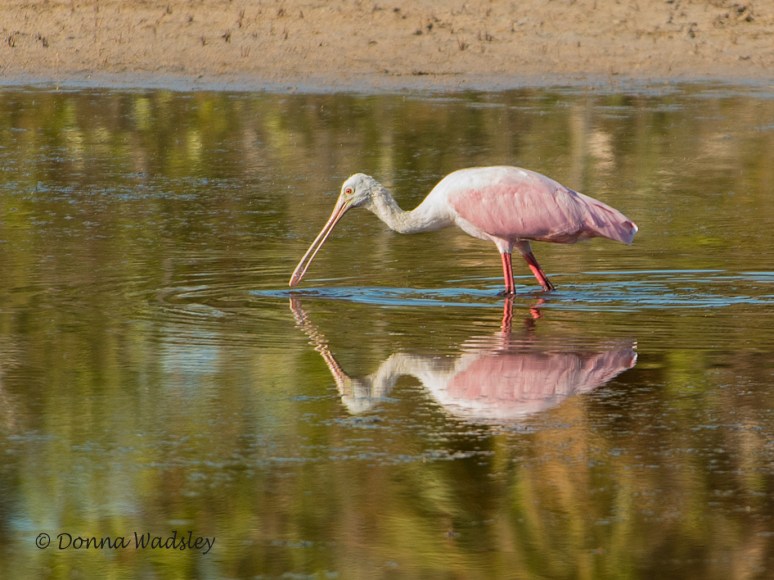
Roseate Spoonbill

Roseate Spoonbills

Roseate Spoonbills

Roseate Spoonbills
I hope these brightened your day! 😊
Red-shouldered Hawk
This Red-shouldered Hawk displayed nicely alongside Lower Wagonwheel Road, a dirt road I was following in Big Cypress National Preserve.

Red-shouldered Hawk

Red-shouldered Hawk
With no one else around and the looks I was getting, it was apparent I had interrupted his/her hunt. The hawk took flight to the next tree, putting a little more distance between us. Social distancing!
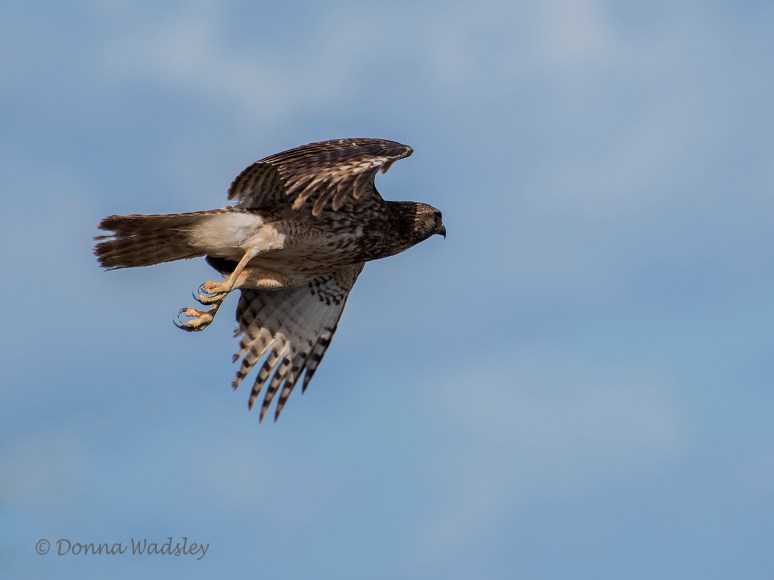
Red-shouldered Hawk
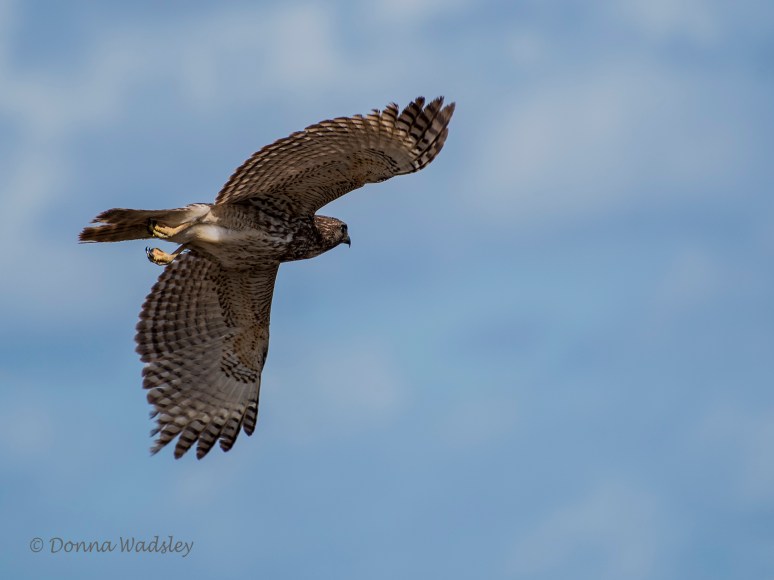
Red-shouldered Hawk

Red-shouldered Hawk
S/he went on with their hunt as did I for another bird! 🙂
Blue-headed Vireo
Luckily around me, there are so many remote areas and pull-offs in Everglades NP, 10,000 Islands NWR, and Big Cypress Preserve, that it is still easy to venture out and be the only person or one of a handful of others, so social distancing is not a problem.
I headed to 10,000 Islands NWR yesterday morning for some one-on-one with nature. As soon as I crossed the ‘bridge’ to the walking path, movement occurred in the tree before me.
Into the tree’s shadows, I spotted this bird sporting bold white “spectacles”!
Welcome #204 to my bird lifer list, the Blue-headed Vireo!
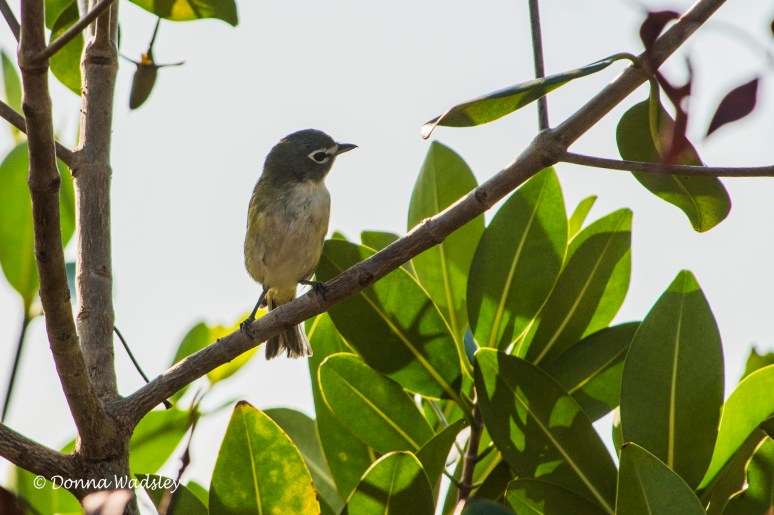
Blue-headed Vireo with his wings tucked tight!
I was so thankful he turned around before taking off!
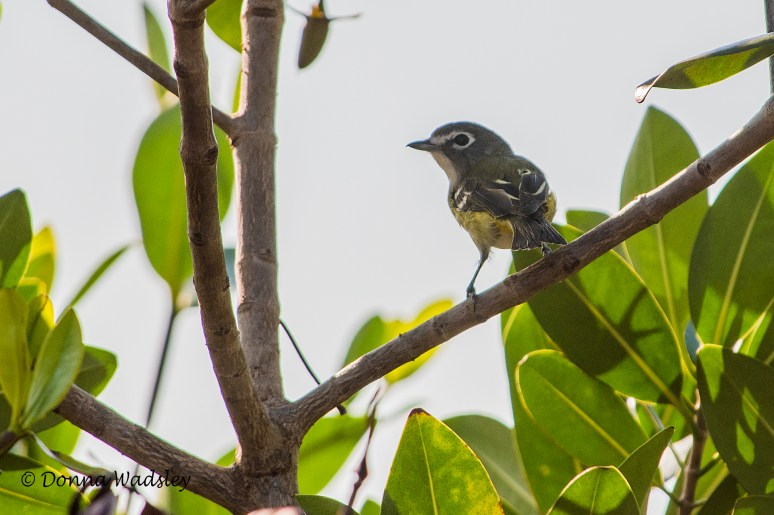
Blue-headed Vireo
I really did not do this bird’s beautiful coloring justice with its blueish-gray head, mossy green back, and greenish-yellow to white underparts.
Seeing this bird immediately put a ‘happy dance’ in my step as I ventured on to the path to see what else I could find! 😊
Ruby-throated Hummingbirds
My last post featured a Gray Catbird flanked with pink orchids, and I mentioned another tiny bird I was watching in that same tree for this next post.
Had I known, I’d have visited much sooner this Hong Kong orchid tree in Everglades City that I found to be a magnet for Ruby-throated Hummingbirds. I saw six at one time drinking the nectar from the orchids several days ago.
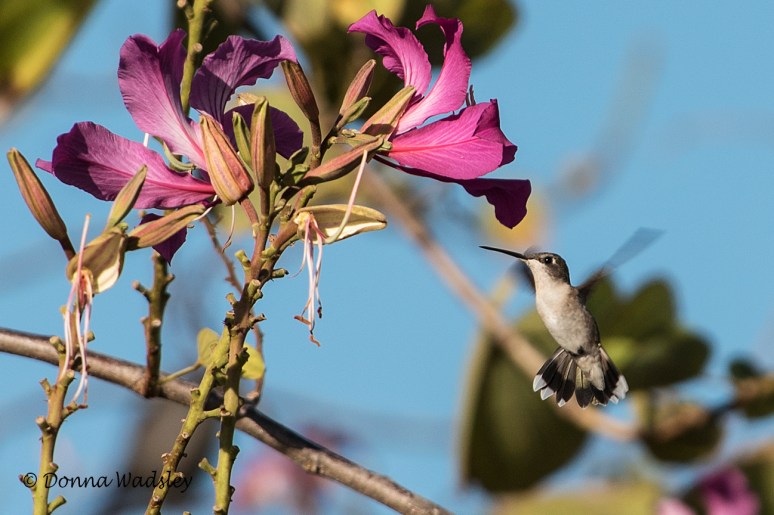
Ruby-throated Hummingbird (female)
Photographing them high up in a tree with their quick movements wasn’t so easy. With no luck prior, I spent extra time the last two evenings to take on the challenge of getting at least a couple nice photos before the orchids and they disappeared. All while sitting on my birding mobile! 😉
Bingo!


Ruby-throated Hummingbird (females)

Ruby-throated Hummingbird (female)
I hope these brightened your day as they did mine!
Gray Catbird
There is an abundance of Gray Catbirds in the Everglades and Big Cypress area of Florida.

Gray Catbird collecting berries
Have you heard one to understand why they’re named a catbird? Take a listen…..
Gray Catbird ‘meowing’ call
(courtesy of Audubon.org)
The first time I heard one years ago, I honestly thought a kitten was hiding in the bushes. I searched and searched for that poor kitty that needed help. Suddenly a gray bird shot out of the bushes and was gone. So was the meowing!
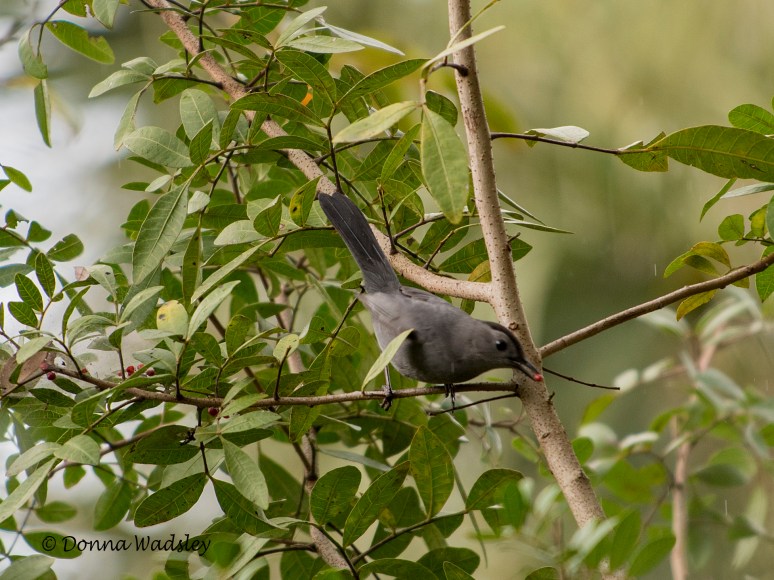
Gray Catbird collecting berries
This is a very secretive bird, always trying to hide from you in the thick of the leaves and branches.
Because I had been sitting still (in my bird mobile) for a while, watching and photographing this and several other bird species, a Gray Catbird brazenly landed in front of me on a fence. 😲

Curious Gray Catbird
When I see the Gray Catbird, I always think their ‘black cap’ looks like they have on a toupee. 😉
The Gray Catbird isn’t just black and gray. If you’re lucky, you’ll get a glimpse of its rusty-color feathers under its tail.
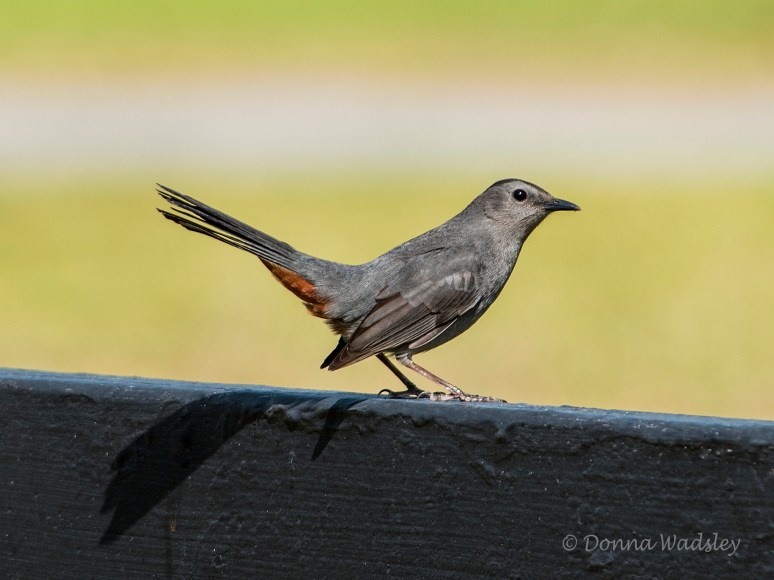
Gray Catbird displaying its rusty brown rump
I watched and photographed all the birds in that one sitting for almost an hour, hoping I’d capture this bird with some of the pink flowers of a Hong Kong orchid tree s/he was flying in and out.
Finally, a moment of its rest gave me the opportunity.
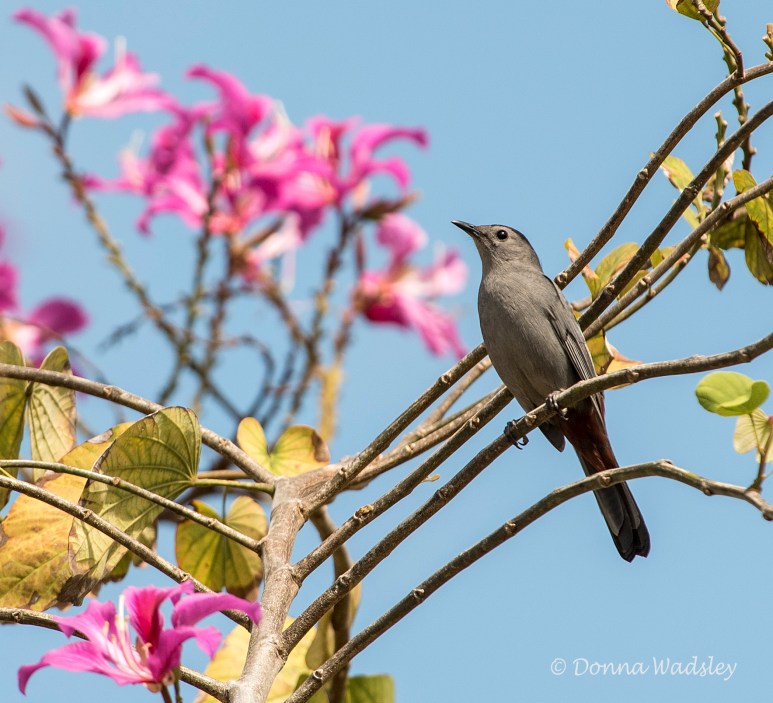
Gray Catbird in a Hong Kong Orchid Tree
There was another, much smaller bird I was trying to capture in this same tree. Next post!
American White Pelican Pair
I mentioned in my last post about a boat tour we took at low tide and being delighted with dolphins.
My primary reason for the boat ride was to hopefully see a large number of American White Pelicans known to use Indian Key as a resting place at low tide.
As we circled the island, we found just two. Along with a Double-crested Cormorant keeping them company.

American White Pelicans and Double-crested Cormorant
You can see a ‘horn’ beginning to protrude from the top of these pelicans’ beaks. When the horn is fully grown, it’s a sign to each other they are ready to breed.

American White Pelicans and Double-crested Cormorant
American White Pelicans and Double-crested Cormorants are an interesting mix often found together. And here I found proof! Cormorants even nest individually or in groups within pelican colonies.
No doubt, they must feel safe with these enormous white birds.
And although there were only two pelicans, I was happy with seeing them. It was later, inland, that I would see many more to my delight and of which I’ve already shared with you!
Bottlenose Dolphins Having Fun
A month ago we took the first morning boat tour out of Everglades National Park.
We were told we had a good chance on seeing Bottlenose dolphins feeding in a specific area, and sure enough the dolphins were there. Seeing them breach the water so close to the boat got very exciting.
The boat captain told us to hold on, we were going to see if the dolphins wanted to play.
Come along on a boat ride and watch Bottlenose dolphins having a blast jumping through our boat’s wake!
(click on the first photo and you can enlarge to run through the gallery sequence)


Bottlenose Dolphins having fun!
Dolphins are such a delight! I hope they made you feel good and smile….

Be smart, be safe, be well, my friends!

 Bay Photos by Donna